Blog / Article
Kyle Whittingham Is Right About College Football’s NIL Problem, but a Salary Cap Comes With a Price
Kyle Whittingham Is Right About College Football’s NIL Problem, but a Salary Cap Comes With a Price
C
CFB Team
July 30, 2026
Sponsored by


Kyle Whittingham did not arrive at his first Big Ten Media Days appearance as Michigan’s head coach looking to preserve college football’s increasingly fictional sense of normalcy.
He went straight to the part everyone inside the sport understands but rarely says plainly: the money is moving faster than the rules, the enforcement and, in some cases, the athletic departments expected to provide it.
Whittingham argued Thursday that college football needs a salary cap and should begin moving toward something resembling an NFL minor league. Not an exact copy, he clarified, but a professional structure with actual financial boundaries rather than a collection of suggested limits, creative accounting methods and booster-funded workarounds.
“I believe we have to have a salary cap,” Whittingham said.
That is the headline. It is also only half the conversation.
Whittingham is probably right that the current model cannot continue indefinitely. He is also describing a future that would require college football to surrender the last meaningful pieces of its amateur identity. A real cap would likely require real contracts, organized player representation, collectively negotiated rules and acknowledgment that major college football players are not merely students who happen to receive unusually lucrative marketing opportunities.
They are the workforce powering a multibillion-dollar entertainment product.
College football keeps trying to become the NFL without adopting the labor structure that makes the NFL function. Whittingham’s proposal correctly identifies that contradiction. The question is whether the sport’s decision-makers actually want the solution, or simply want players to cost less.
Whittingham Said the Quiet Part Out Loud
Whittingham’s comments came during his first Big Ten Media Days appearance after taking over at Michigan, following more than two decades at Utah. Asked about LSU coach Lane Kiffin’s suggestion that incoming freshmen should face a form of compensation limit, Whittingham called the concept reasonable before expanding the discussion beyond first-year players.
He said NIL spending is rising by 20, 30 or even 40 percent and argued that the current trajectory is financially unsustainable. He described a system without sufficient parameters and predicted a “seismic change” within the next two to four years.
That does not sound like a coach complaining because another program signed a five-star offensive tackle.
It sounds like someone who has watched recruiting evolve into year-round roster procurement and understands where the numbers are headed.
The House settlement created a system in which participating schools can directly share revenue with athletes. The estimated institutional cap for the 2026-27 academic year is approximately $21.3 million per school, an increase from the initial $20.5 million figure. But third-party NIL agreements exist outside that direct revenue-sharing limit, provided they meet reporting and fair-market requirements.
That distinction matters.
College football technically has a cap on money distributed directly by schools. It does not have a clean, comprehensive cap on the total amount of compensation that can be assembled around a roster.
That is why the current setup can feel like driving on a highway where the speed limit is posted but every serious contender knows about a private lane with no radar.
Programs with the wealthiest donors, most ambitious collectives, strongest corporate networks and highest institutional tolerance for financial aggression can keep pushing. Everyone else is forced to match that pace, find a competitive alternative or slowly accept a lower ceiling.
Whittingham joked that the sky may be the limit for some programs, but not for everybody. That is the entire competitive-balance problem in one sentence.
He Is Right About the Diagnosis
The popular response to any coach criticizing NIL is to point toward coaching salaries, facility spending or conference television revenue.
That response is not wrong.
College football spent decades creating an arms race while insisting the players were amateurs. Coaches received guaranteed contracts. Conferences chased television markets. Athletic departments built locker rooms that looked like luxury resorts designed by someone who had just discovered LED lighting. Every adult surrounding the product was permitted to maximize their value.
Then players entered the marketplace, and suddenly everyone became deeply concerned about sustainability.
That history makes skepticism toward salary-cap proposals healthy. A spending restriction cannot exist merely to protect athletic department margins or rescue coaches from uncomfortable recruiting conversations.
But hypocrisy does not automatically make Whittingham’s economic point incorrect.
The current system asks programs to operate under a revenue-sharing ceiling while competing in a broader NIL marketplace that remains difficult to standardize. The House settlement allows direct payments and provides a review system for qualifying third-party deals, but it does not magically eliminate the incentives that produce booster-driven roster spending.
The amount necessary to land one recruiting class can influence the price of the next. Returning starters can renegotiate based on portal interest. A breakout season can create an immediate retention battle. Quarterbacks, offensive tackles, edge rushers and defensive backs are not being evaluated only as athletes. They are assets in a market where replacement costs can change before the next depth-chart meeting.
That is not inherently bad. Players should be allowed to benefit from the value they create.
The instability comes from attempting to run that market without universally accepted contracts, transparent compensation figures, consistent enforcement or a labor agreement connecting the rules to the people being governed.
College football has professional money, professional pressure and professional personnel decisions. Its rulebook is still trying to wear a fake mustache and get into the amateurism bar.
A Real Salary Cap Would Require More Than a Number
The phrase “salary cap” sounds simple because NFL fans understand it.
Every team receives a spending limit. Contracts count against it. There are penalties for violations. Players and teams negotiate within a defined structure. Competitive balance is never perfect, but every organization is at least playing the same financial game.
College football is not organized that way.
There are more than 100 Football Bowl Subdivision programs with dramatically different revenue levels, state laws, institutional missions and donor ecosystems. The sport does not have a single ownership group or one centralized league office with NFL-level authority. Conferences compete against each other financially and politically. Schools may agree on a rule Monday and challenge its legality by Friday.
A college football cap would therefore need answers to questions far more complicated than choosing a dollar amount.
Would the cap apply only to school revenue sharing, or also to legitimate third-party endorsements? Would a national company be prevented from paying a star quarterback because his school had already reached its roster limit? Would every sport share one athletic-department cap? Would football operate separately? How would Title IX obligations interact with the structure? What happens when a player outperforms his agreement? Can he renegotiate? Can he be released? Can he transfer without restriction?
Most importantly, who represents the players when those rules are written?
Professional salary caps do not exist in isolation. They are tied to collective bargaining, player unions, negotiated benefits and enforceable contracts. A legal expert interviewed by the Associated Press about college sports’ financial structure noted that collective bargaining would provide a route toward establishing a uniform compensation ceiling. Meanwhile, Stanford players recently formed a campus chapter of the College Football Players Association as an early step toward eventual collective bargaining.
That is the part administrators and coaches cannot skip.
A salary cap imposed on players without giving them a formal role in negotiating it would look less like competitive reform and more like coordinated wage suppression.
Whittingham’s NFL comparison is persuasive precisely because the NFL model includes power on both sides. Owners receive cost certainty. Players receive negotiated revenue shares, benefits, minimum salaries, grievance procedures and representation.
College football cannot order only the parts of the professional model that appear on the athletic department’s preferred menu.
The Freshman Cap Sounds Logical Until the Freshman Is a Star
Kiffin’s proposal to restrict what incoming freshmen can receive has an obvious football comparison: the NFL rookie wage scale.
The reasoning is understandable. Coaches are watching high school prospects command enormous packages before playing a college snap. A freshman limit could reduce bidding wars, prevent desperate programs from wildly inflating the market and shift more compensation toward proven college players.
Whittingham called it a good concept, and from a roster-management perspective, it probably is.
But incoming college players are not NFL draft picks.
NFL rookies enter through a collectively bargained draft system. Their negotiating leverage is restricted, but their contracts, minimum compensation and rights exist within a structure agreed upon by the league and the players’ union.
A college freshman may currently choose among competing schools. Restricting his compensation would reduce one of the few sources of leverage available to him before he commits.
That does not mean a rookie-style model is impossible. It means the model would need to provide something in return.
Perhaps players would receive multiyear guaranteed agreements, defined educational protections, medical coverage beyond their playing careers, performance incentives, transfer provisions and a percentage of revenue. Perhaps the initial compensation scale would rise based on experience or production.
But simply telling the nation’s best high school quarterback that coaches, athletic directors and television executives may operate in an open marketplace while his earning potential is capped would be a difficult sell.
Especially when that quarterback may become the face of a program before finishing his first semester.
Congress Is Not Arriving With an Easy Fix
Whittingham’s comments unfolded as the Protect College Sports Act dominated conversations around Big Ten Media Days.
The proposed federal legislation is intended to create national standards covering athlete compensation, transfers, eligibility, enforcement and other issues that currently vary across states or exist under an uncertain collection of NCAA and conference policies. The bill advanced through the Senate Commerce Committee in June by a 19-9 vote.
Negotiations continued this week as lawmakers sought support from the Big Ten and SEC. Revised concepts included a substantial retention pool that could sit on top of the existing $21.3 million revenue-sharing cap, potentially allowing schools to spend tens of millions more to retain athletes. The proposal also raised questions about antitrust protection, state-law preemption, women’s sports funding and the relationship between new legislation and the House settlement.
The Senate adjourned Thursday without Majority Leader John Thune filing for cloture, making a vote the following week increasingly unlikely. There was technically still time for the legislation to move, but its immediate path had narrowed significantly.
Whittingham acknowledged that he did not know the bill’s specific details. His broader concern was whether federal legislation would create lasting stability or merely another temporary patch.
That skepticism is fair.
College football has spent years installing temporary patches. The transfer portal received windows. NIL received disclosure rules. Revenue sharing received a cap. Third-party agreements received a clearinghouse. Every reform addresses part of the marketplace while leaving another part available for innovation, litigation or circumvention.
The sport does not lack individual rules.
It lacks agreement on what it wants to be.
Whittingham’s Future Is Already Arriving
Whittingham predicted college football will experience a seismic transformation within two, three or four years.
That may be the safest prediction made at any media-days podium this summer.
Players are receiving direct revenue from schools. Third-party NIL agreements remain part of roster construction. Congress is debating national legislation. Conferences are exploring expanded financial authority. Stanford players are organizing. Coaches are publicly discussing salary caps, rookie scales and professional models.
The transformation is not waiting in the distance. It is already inside the building, eating catered lunch and asking where to submit its direct deposit information.
Whittingham’s argument should not be dismissed as another wealthy coach becoming uncomfortable when players receive money. His central point is stronger than that. College football has built a compensation market without completing the infrastructure necessary to govern it.
He is right that the system needs guardrails.
He is right that unchecked annual growth will widen the gap between programs.
He is right that a more professional structure is coming.
But the salary cap cannot be the beginning and end of reform. A fair professional model would also give players contracts, representation, negotiated rights and a meaningful share of the decision-making process.
That is the trade college football must eventually make.
The sport can continue pretending NIL is a strange side business attached to amateur competition, or it can acknowledge that roster compensation is now a fundamental operating expense. It can keep asking Congress and the courts to preserve a version of college athletics that no longer exists, or it can build a modern system around the reality everyone can already see.
Kyle Whittingham did not merely call for a salary cap Thursday.
Whether he intended to or not, Michigan’s new coach made the case for college football to finally admit what it has become.
Kyle Whittingham did not arrive at his first Big Ten Media Days appearance as Michigan’s head coach looking to preserve college football’s increasingly fictional sense of normalcy.
He went straight to the part everyone inside the sport understands but rarely says plainly: the money is moving faster than the rules, the enforcement and, in some cases, the athletic departments expected to provide it.
Whittingham argued Thursday that college football needs a salary cap and should begin moving toward something resembling an NFL minor league. Not an exact copy, he clarified, but a professional structure with actual financial boundaries rather than a collection of suggested limits, creative accounting methods and booster-funded workarounds.
“I believe we have to have a salary cap,” Whittingham said.
That is the headline. It is also only half the conversation.
Whittingham is probably right that the current model cannot continue indefinitely. He is also describing a future that would require college football to surrender the last meaningful pieces of its amateur identity. A real cap would likely require real contracts, organized player representation, collectively negotiated rules and acknowledgment that major college football players are not merely students who happen to receive unusually lucrative marketing opportunities.
They are the workforce powering a multibillion-dollar entertainment product.
College football keeps trying to become the NFL without adopting the labor structure that makes the NFL function. Whittingham’s proposal correctly identifies that contradiction. The question is whether the sport’s decision-makers actually want the solution, or simply want players to cost less.
Whittingham Said the Quiet Part Out Loud
Whittingham’s comments came during his first Big Ten Media Days appearance after taking over at Michigan, following more than two decades at Utah. Asked about LSU coach Lane Kiffin’s suggestion that incoming freshmen should face a form of compensation limit, Whittingham called the concept reasonable before expanding the discussion beyond first-year players.
He said NIL spending is rising by 20, 30 or even 40 percent and argued that the current trajectory is financially unsustainable. He described a system without sufficient parameters and predicted a “seismic change” within the next two to four years.
That does not sound like a coach complaining because another program signed a five-star offensive tackle.
It sounds like someone who has watched recruiting evolve into year-round roster procurement and understands where the numbers are headed.
The House settlement created a system in which participating schools can directly share revenue with athletes. The estimated institutional cap for the 2026-27 academic year is approximately $21.3 million per school, an increase from the initial $20.5 million figure. But third-party NIL agreements exist outside that direct revenue-sharing limit, provided they meet reporting and fair-market requirements.
That distinction matters.
College football technically has a cap on money distributed directly by schools. It does not have a clean, comprehensive cap on the total amount of compensation that can be assembled around a roster.
That is why the current setup can feel like driving on a highway where the speed limit is posted but every serious contender knows about a private lane with no radar.
Programs with the wealthiest donors, most ambitious collectives, strongest corporate networks and highest institutional tolerance for financial aggression can keep pushing. Everyone else is forced to match that pace, find a competitive alternative or slowly accept a lower ceiling.
Whittingham joked that the sky may be the limit for some programs, but not for everybody. That is the entire competitive-balance problem in one sentence.
He Is Right About the Diagnosis
The popular response to any coach criticizing NIL is to point toward coaching salaries, facility spending or conference television revenue.
That response is not wrong.
College football spent decades creating an arms race while insisting the players were amateurs. Coaches received guaranteed contracts. Conferences chased television markets. Athletic departments built locker rooms that looked like luxury resorts designed by someone who had just discovered LED lighting. Every adult surrounding the product was permitted to maximize their value.
Then players entered the marketplace, and suddenly everyone became deeply concerned about sustainability.
That history makes skepticism toward salary-cap proposals healthy. A spending restriction cannot exist merely to protect athletic department margins or rescue coaches from uncomfortable recruiting conversations.
But hypocrisy does not automatically make Whittingham’s economic point incorrect.
The current system asks programs to operate under a revenue-sharing ceiling while competing in a broader NIL marketplace that remains difficult to standardize. The House settlement allows direct payments and provides a review system for qualifying third-party deals, but it does not magically eliminate the incentives that produce booster-driven roster spending.
The amount necessary to land one recruiting class can influence the price of the next. Returning starters can renegotiate based on portal interest. A breakout season can create an immediate retention battle. Quarterbacks, offensive tackles, edge rushers and defensive backs are not being evaluated only as athletes. They are assets in a market where replacement costs can change before the next depth-chart meeting.
That is not inherently bad. Players should be allowed to benefit from the value they create.
The instability comes from attempting to run that market without universally accepted contracts, transparent compensation figures, consistent enforcement or a labor agreement connecting the rules to the people being governed.
College football has professional money, professional pressure and professional personnel decisions. Its rulebook is still trying to wear a fake mustache and get into the amateurism bar.
A Real Salary Cap Would Require More Than a Number
The phrase “salary cap” sounds simple because NFL fans understand it.
Every team receives a spending limit. Contracts count against it. There are penalties for violations. Players and teams negotiate within a defined structure. Competitive balance is never perfect, but every organization is at least playing the same financial game.
College football is not organized that way.
There are more than 100 Football Bowl Subdivision programs with dramatically different revenue levels, state laws, institutional missions and donor ecosystems. The sport does not have a single ownership group or one centralized league office with NFL-level authority. Conferences compete against each other financially and politically. Schools may agree on a rule Monday and challenge its legality by Friday.
A college football cap would therefore need answers to questions far more complicated than choosing a dollar amount.
Would the cap apply only to school revenue sharing, or also to legitimate third-party endorsements? Would a national company be prevented from paying a star quarterback because his school had already reached its roster limit? Would every sport share one athletic-department cap? Would football operate separately? How would Title IX obligations interact with the structure? What happens when a player outperforms his agreement? Can he renegotiate? Can he be released? Can he transfer without restriction?
Most importantly, who represents the players when those rules are written?
Professional salary caps do not exist in isolation. They are tied to collective bargaining, player unions, negotiated benefits and enforceable contracts. A legal expert interviewed by the Associated Press about college sports’ financial structure noted that collective bargaining would provide a route toward establishing a uniform compensation ceiling. Meanwhile, Stanford players recently formed a campus chapter of the College Football Players Association as an early step toward eventual collective bargaining.
That is the part administrators and coaches cannot skip.
A salary cap imposed on players without giving them a formal role in negotiating it would look less like competitive reform and more like coordinated wage suppression.
Whittingham’s NFL comparison is persuasive precisely because the NFL model includes power on both sides. Owners receive cost certainty. Players receive negotiated revenue shares, benefits, minimum salaries, grievance procedures and representation.
College football cannot order only the parts of the professional model that appear on the athletic department’s preferred menu.
The Freshman Cap Sounds Logical Until the Freshman Is a Star
Kiffin’s proposal to restrict what incoming freshmen can receive has an obvious football comparison: the NFL rookie wage scale.
The reasoning is understandable. Coaches are watching high school prospects command enormous packages before playing a college snap. A freshman limit could reduce bidding wars, prevent desperate programs from wildly inflating the market and shift more compensation toward proven college players.
Whittingham called it a good concept, and from a roster-management perspective, it probably is.
But incoming college players are not NFL draft picks.
NFL rookies enter through a collectively bargained draft system. Their negotiating leverage is restricted, but their contracts, minimum compensation and rights exist within a structure agreed upon by the league and the players’ union.
A college freshman may currently choose among competing schools. Restricting his compensation would reduce one of the few sources of leverage available to him before he commits.
That does not mean a rookie-style model is impossible. It means the model would need to provide something in return.
Perhaps players would receive multiyear guaranteed agreements, defined educational protections, medical coverage beyond their playing careers, performance incentives, transfer provisions and a percentage of revenue. Perhaps the initial compensation scale would rise based on experience or production.
But simply telling the nation’s best high school quarterback that coaches, athletic directors and television executives may operate in an open marketplace while his earning potential is capped would be a difficult sell.
Especially when that quarterback may become the face of a program before finishing his first semester.
Congress Is Not Arriving With an Easy Fix
Whittingham’s comments unfolded as the Protect College Sports Act dominated conversations around Big Ten Media Days.
The proposed federal legislation is intended to create national standards covering athlete compensation, transfers, eligibility, enforcement and other issues that currently vary across states or exist under an uncertain collection of NCAA and conference policies. The bill advanced through the Senate Commerce Committee in June by a 19-9 vote.
Negotiations continued this week as lawmakers sought support from the Big Ten and SEC. Revised concepts included a substantial retention pool that could sit on top of the existing $21.3 million revenue-sharing cap, potentially allowing schools to spend tens of millions more to retain athletes. The proposal also raised questions about antitrust protection, state-law preemption, women’s sports funding and the relationship between new legislation and the House settlement.
The Senate adjourned Thursday without Majority Leader John Thune filing for cloture, making a vote the following week increasingly unlikely. There was technically still time for the legislation to move, but its immediate path had narrowed significantly.
Whittingham acknowledged that he did not know the bill’s specific details. His broader concern was whether federal legislation would create lasting stability or merely another temporary patch.
That skepticism is fair.
College football has spent years installing temporary patches. The transfer portal received windows. NIL received disclosure rules. Revenue sharing received a cap. Third-party agreements received a clearinghouse. Every reform addresses part of the marketplace while leaving another part available for innovation, litigation or circumvention.
The sport does not lack individual rules.
It lacks agreement on what it wants to be.
Whittingham’s Future Is Already Arriving
Whittingham predicted college football will experience a seismic transformation within two, three or four years.
That may be the safest prediction made at any media-days podium this summer.
Players are receiving direct revenue from schools. Third-party NIL agreements remain part of roster construction. Congress is debating national legislation. Conferences are exploring expanded financial authority. Stanford players are organizing. Coaches are publicly discussing salary caps, rookie scales and professional models.
The transformation is not waiting in the distance. It is already inside the building, eating catered lunch and asking where to submit its direct deposit information.
Whittingham’s argument should not be dismissed as another wealthy coach becoming uncomfortable when players receive money. His central point is stronger than that. College football has built a compensation market without completing the infrastructure necessary to govern it.
He is right that the system needs guardrails.
He is right that unchecked annual growth will widen the gap between programs.
He is right that a more professional structure is coming.
But the salary cap cannot be the beginning and end of reform. A fair professional model would also give players contracts, representation, negotiated rights and a meaningful share of the decision-making process.
That is the trade college football must eventually make.
The sport can continue pretending NIL is a strange side business attached to amateur competition, or it can acknowledge that roster compensation is now a fundamental operating expense. It can keep asking Congress and the courts to preserve a version of college athletics that no longer exists, or it can build a modern system around the reality everyone can already see.
Kyle Whittingham did not merely call for a salary cap Thursday.
Whether he intended to or not, Michigan’s new coach made the case for college football to finally admit what it has become.
Share this story
C
CFB Team
CFB Team
The most trusted college football team.
The most trusted college football team.
More College Football Stories
More College Football Stories

CFB
September 23, 2026
Judge Frees Indiana's Stephen Daley and Kellan Wyatt, Cole Hutson Wins Again: College Football's Eligibility War Moves to County Courthouses
Judge Frees Indiana's Stephen Daley and Kellan Wyatt, Cole Hutson Wins Again: College Football's Eligibility War Moves to County Courthouses

CFB
September 21, 2026
Dave Doeren Owns NC State's Intentional Safety Disaster as the 1,046-1 Fumble at Vanderbilt Refuses to Fade
Dave Doeren Owns NC State's Intentional Safety Disaster as the 1,046-1 Fumble at Vanderbilt Refuses to Fade
CFB
September 19, 2026
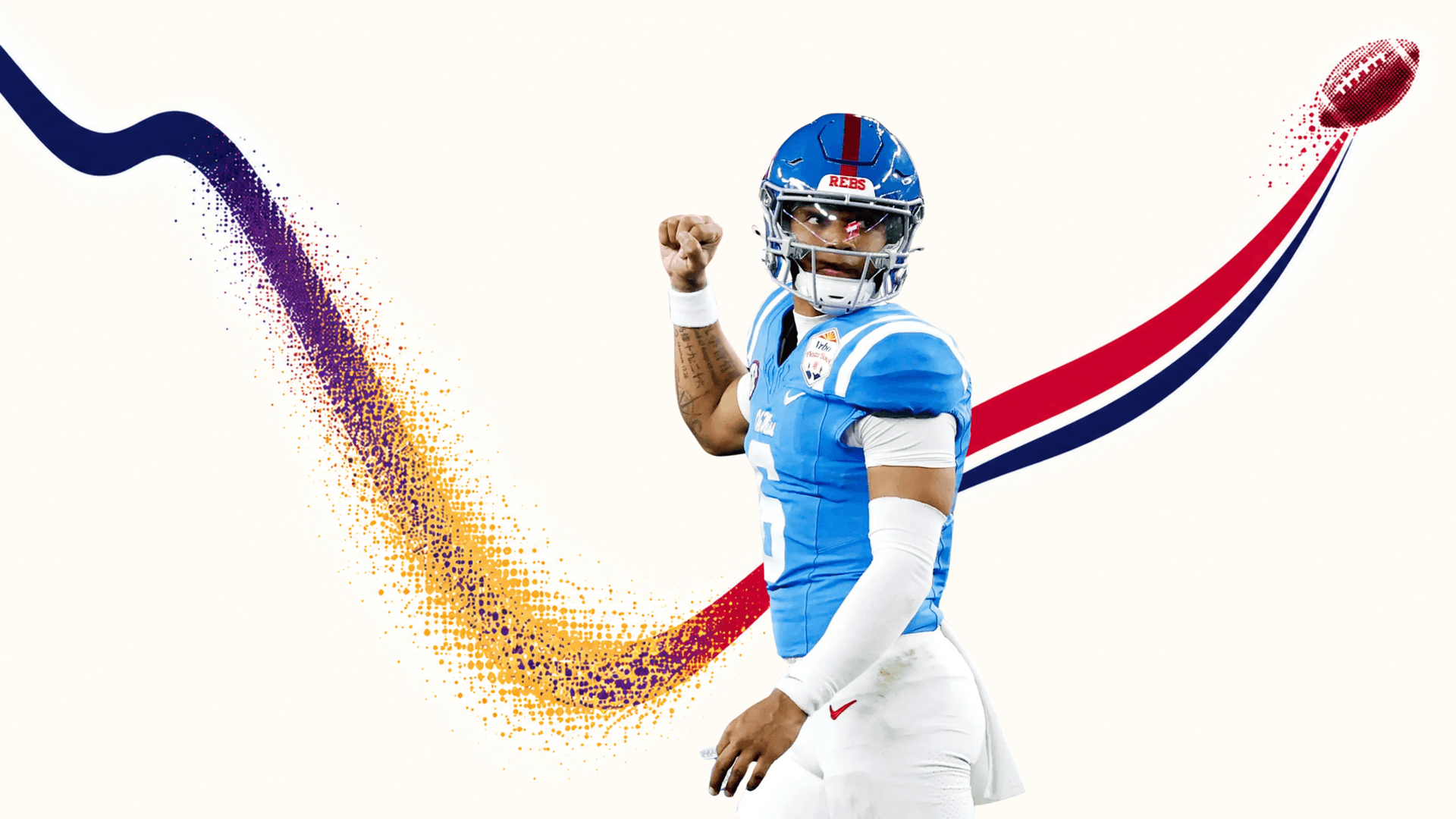
Trinidad Chambliss Spoils Lane Kiffin's Homecoming as No. 8 Ole Miss Holds Off No. 7 LSU 32-24
Trinidad Chambliss Spoils Lane Kiffin's Homecoming as No. 8 Ole Miss Holds Off No. 7 LSU 32-24
Keep Reading
Never Miss The Next Alert
Real-time college football news, NIL moves, and recruiting intel — delivered the moment it breaks.
Keep Reading
Never Miss The Next Alert
Real-time college football news, NIL moves, and recruiting intel — delivered the moment it breaks.
Coast To Coast
Trusted By Programs Across The Country


Coast To Coast
Trusted By Programs Across The Country

