
Picture the scene in Guadalajara. A 40-year-old goalkeeper, still sweating from 90 minutes of throwing his body in front of one of the best teams on the planet, gets handed a phone. On the screen is a number. He gasps. He laughs. He says it’s crazy — twice. The number is his Instagram follower count, and in the time it took to play one soccer game, it had gone supernova.
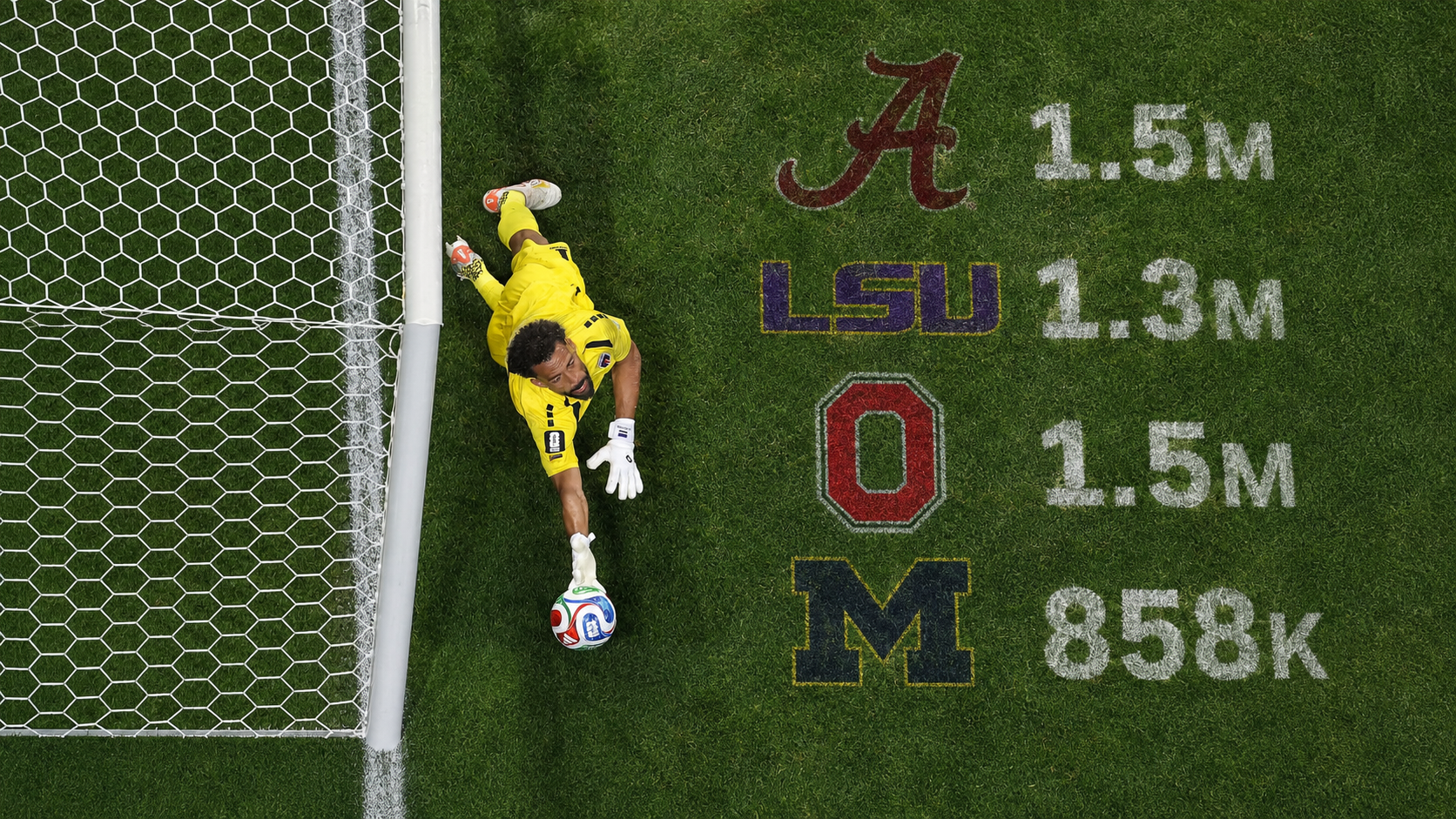
That keeper is Josimar Dias, known to roughly half a million Cape Verdeans and now to the entire internet as Vozinha — “little granny” in Portuguese, a childhood nickname that has been stitched onto the back of his shirt ever since. On the morning of June 15, 2026, he had about 50,000 followers, the kind of number a decent high school running back pulls in a good recruiting cycle. By the next morning he was sitting at roughly 10.5 million — more than Victor Wembanyama, more than Patrick Mahomes, and, as the CFB Alerts comparison series lays out slide by slide, more than the entire blue-blood tier of college football combined.
Let that marinate. A second-division Portuguese-league goalkeeper from a volcanic archipelago off West Africa now commands a bigger digital audience than the most valuable brands in the sport we cover. This is the attention economy doing donuts in the parking lot, and it is one of the most college-football-relevant soccer stories you’ll read all year.
How a 0-0 draw broke the internet
Start with the game, because none of this happens without it. Cape Verde, ranked 67th in the world and making its first-ever World Cup appearance, walked into Atlanta’s Mercedes-Benz Stadium — rebranded “Atlanta Stadium” for the tournament — as a 12-to-1 underdog against Spain, the reigning European champions and one of the favorites to lift the trophy. The setup screamed blowout. A day earlier, Germany had put seven past Curacao. Everyone expected Spain to do the same.
Instead, Cape Verde dug a trench and dared Spain to dig them out. The Spanish had the ball 74% of the time, fired 27 shots, and piled up an expected-goals total north of 2.2. They completed 734 passes to Cape Verde’s 205. By every analytics model ever built, they should have won comfortably. And they scored exactly zero goals, because expected goals don’t go on the scoreboard — saves do.
Vozinha made seven of them, stopping every single shot Spain put on target. He tipped a header over the bar, smothered Ferran Torres from point-blank range, clawed an Aymeric Laporte effort around the post, and slammed the door on Mikel Merino and Marc Cucurella late. Defender Pico Lopes threw in a goal-line block for the ages, and Cape Verde nearly stole the whole thing when Diney Borges’ header forced a save at the other end. Final whistle: 0-0. For a debutant nation of fewer than 500,000 people, a draw with Spain isn’t a tie. It’s a parade.
The man of the match who became a meme machine
The performance alone would’ve made Vozinha a cult hero. The records made him a headline. At 40 years and 12 days, he became the oldest player ever to feature in a nation’s World Cup debut and the oldest goalkeeper to keep a clean sheet on his own World Cup debut. The only 40-plus keeper to make more saves in a World Cup match since 1966 is Pat Jennings, who did it on his 41st birthday in 1986. That’s the company we’re talking about.
Then there’s the backstory that turns a highlight reel into a movement. Vozinha didn’t turn pro until he was 25. He bounced through nine clubs. He told reporters he cried after the match thinking about the grandparents who raised him — the same grandparents who gave him his nickname — and about his mother, who couldn’t get a visa in time to watch her son play on the biggest stage of his life. If a screenwriter pitched this, you’d call it too on-the-nose.
The viral engine: a streamer, not an algorithm
Here’s the part that should make every college program’s social media director sit up straight. The follower explosion wasn’t organic in the traditional sense. It was manufactured, in real time, by a creator. CazeTV, the Brazilian streaming operation fronted by Casimiro Miguel — the only outlet in Brazil with rights to all 104 World Cup matches — pointed its enormous audience directly at Vozinha mid-broadcast. The pitch, paraphrased: forget asking you to subscribe today; go follow this man, he’s the one stopping Spain. From about 50,000, he crossed a million almost immediately, then just kept climbing through the day.
It wasn’t even the first time this World Cup. A month earlier, an Argentine influencer named El Scarso anointed New Zealand’s Tim Payne the “least known” player in the tournament and pushed him from 4,700 followers to nearly six million. FIFA, for its part, leaned all the way into the creator era, cutting record digital deals and partnering with TikTok and YouTube to put live match moments in front of younger eyeballs. The lesson is blunt: in 2026, a single creator with the right audience can mint a global brand faster than a marketing department can schedule a meeting.
Slide by slide: Vozinha vs. college football’s royalty
This is where the CFB Alerts carousel earns its keep, because the comparisons aren’t close — they’re comedic. The cover frames the premise: World Cup star goalkeeper Vozinha’s Instagram following, measured against the official accounts of college football’s heaviest hitters. Then it goes to war.
Alabama (1.5M): The most decorated program of the modern era, the brand that printed national titles and first-round picks, sits at 1.5 million. Vozinha has seven times that. The Crimson Tide machine, out-followed by a guy whose club plays in Portugal’s second division.
Ohio State (1.5M): The reigning-standard Buckeyes, fresh off their championship pedigree and one of the most rabid fan bases in America, also land at 1.5 million. Same gap. Columbus runs one of the slickest content operations in the sport and still gets lapped by a keeper who’d never trended before Monday.
LSU (1.3M): Death Valley, Saturday night in Baton Rouge, the whole mystique — 1.3 million. Vozinha cleared LSU’s entire following before most of America had finished its lunch break on Monday.
Georgia (1.2M): Back-to-back-era Dawgs, an SEC powerhouse with a national footprint, check in at 1.2 million. The defending blueprint for roster-building in college football, dwarfed nearly nine-to-one.
Texas (1.2M): Everything’s bigger in Texas except, apparently, this. The Longhorns’ brand power and SEC arrival still nets 1.2 million — a rounding error against 10.5.
Michigan (858K): A recent national champion and the winningest program in the history of the sport sits under a million at 858,000. Vozinha has more than twelve Michigans.
Clemson (783K): The ACC’s flagship and a fixture of the playoff era brings up the rear at 783,000. Vozinha out-followed Clemson roughly thirteen times over — in a day.
Add those seven blue-bloods up — Alabama, Ohio State, LSU, Georgia, Texas, Michigan, Clemson — and you land around 8.3 million. Vozinha, by himself, sits north of 10.5 million. One goalkeeper, one game, and he’s got more reach than the seven biggest brands in our sport stacked on top of each other.
What it actually means for college football
It’s easy to file this under “funny soccer story” and move on. Don’t. This is a flashing neon sign about how value gets created in the NIL and revenue-sharing era. College football has spent two years obsessing over brand value, follower counts, and the marketability of its stars — the entire NIL marketplace runs on the assumption that audience equals dollars. Vozinha just demonstrated that an audience of that size can be built in 24 hours by a performance and a push, not by a decade of program-building.
The catch, of course, is durability. Program accounts grow slowly because they grow permanently; Alabama’s 1.5 million aren’t going anywhere. A viral spike can deflate just as fast as it inflated — ask any number of one-week internet darlings. The real question for athletic departments and collectives watching this: is a follower earned in a frenzy worth the same as one earned over years of Saturdays? The honest answer is no — but the gap between those two kinds of followers is exactly the inefficiency that smart creators, players, and brands are learning to exploit.
The closing take
Vozinha isn’t a threat to college football. He’s a mirror. He showed, in the space of one scoreless afternoon in Atlanta, that attention is the most volatile currency in sports — and that the gatekeepers of reach aren’t TV networks or storied programs anymore, they’re creators and the moments they choose to amplify. A 40-year-old keeper named after his grandmother out-followed the entire aristocracy of the sport we cover, and he did it before his jersey was even dry.
The blue-bloods will be just fine. But if you run a brand in this space — a program, a collective, a player, a media company — the takeaway is the same one Casimiro handed his audience mid-broadcast: the followers are out there, waiting to be pointed somewhere. Vozinha just proved how fast they move when someone finally points.

Trusted By Programs Across The Country