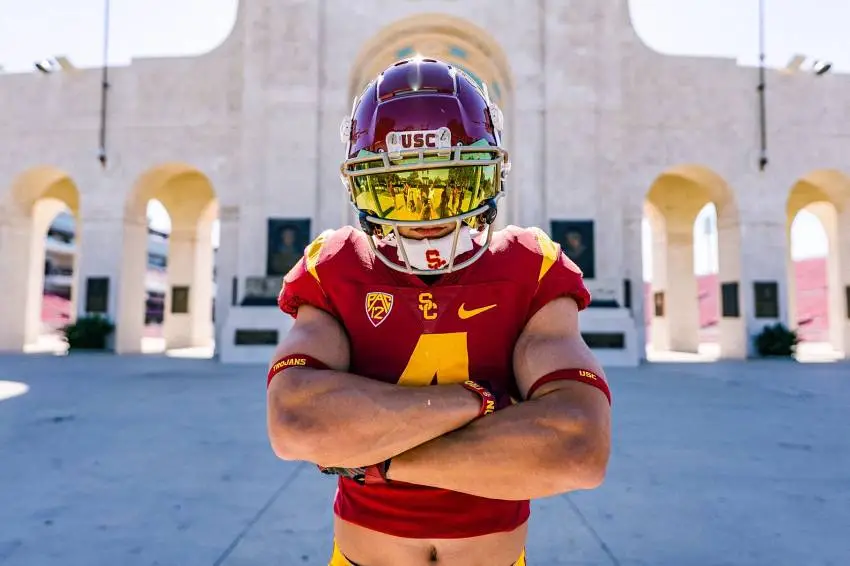
They Said USC Was Broken. Lincoln Riley Just Proved Everyone Wrong.
There is a specific kind of satisfaction in watching a narrative collapse in real time. For the better part of three years, the story on USC football was one of unfulfilled potential — a program with the talent and the name but not the results, a head coach with undeniable offensive genius but a team that couldn't stay healthy or consistent long enough to make a serious run. The hot takes were plentiful. The patience was running thin in Los Angeles.
Then the 2026 recruiting rankings dropped, and Lincoln Riley's program didn't just land a top class — they landed the top class in the entire country. The first non-SEC program to do so since 2008. The Trojans are officially back in the conversation, and this time they've got the receipts to prove it.
The Class That Changed the Conversation
USC's 2026 haul is not a collection of hopeful four-stars padded to look elite. This is a genuinely loaded group, headlined by Keenyi Pepe — the number five overall prospect in the country and the consensus top offensive tackle in the class. At 6'7" and 320 pounds with footwork that belongs on a prospect two years ahead of his development curve, Pepe is the kind of generational offensive lineman that programs build their entire front around. He prepped at IMG Academy, which has essentially become a finishing school for players who are already elite, and he came out of it looking even better than he arrived.
Alongside Pepe, USC loaded up on skill positions and defensive talent with a class that features more than 20 four and five-star prospects. Riley also flipped a wide receiver commit from Ohio State — landing Dixon-Wyatt on signing day in a move that sent a message about USC's pull on the national stage — and added quarterback Jonas Williams as the program's signal-caller of the future. The depth of the class is what separates it. This isn't a top-heavy roster addition that thins out quickly. The talent runs through the entire board.
Why This Matters Beyond the Rankings
Recruiting rankings are a means, not an end. The point is what the talent eventually becomes on the field, and USC's class needs to be evaluated through that lens. But rankings matter for a very specific reason: they reflect how elite prospects and their families view a program's trajectory. When the top players in the country choose to play for you over Alabama, Georgia, Ohio State, and Oregon, that is a vote of confidence in the program's direction that carries real weight.
The last time a non-SEC school finished with the top class was 2008. That's nearly two decades of SEC dominance in the recruiting ecosystem — a period that tracked almost exactly with the SEC's run of national championships and NFL Draft dominance. For USC to break that streak is not just a statistical anomaly. It's a structural shift that reflects the changing college football landscape: the Big Ten's expanded footprint, the NIL resources available in Los Angeles, and the genuine belief among elite recruits that the conference can compete with the best programs in the sport.
The Big Ten Context
USC joined the Big Ten ahead of the 2024 season and has been in the process of proving that the move was about more than just revenue sharing. The conference is the most physically demanding in college football right now — a relentless schedule of road environments that tests roster depth in ways the old Pac-12 simply did not. Lincoln Riley knows that winning the Big Ten requires a different kind of program than what he inherited, and this recruiting class is the clearest evidence yet that he's building toward that standard.
Keenyi Pepe and the offensive linemen in this class are specifically designed for that environment. Big Ten football is won and lost in the trenches — everyone from Ryan Day to Bret Bielema will tell you that — and USC addressing the offensive line with the top prospect in the country at the position is not an accident. It's a philosophy statement.
What Riley Has Built in Los Angeles
Lincoln Riley arrived at USC with one undeniable asset: he could recruit the best quarterbacks in the country. Caleb Williams was the proof of concept. The offensive genius label and the NFL pipeline credibility gave Riley a pitch that very few coaches in the sport could match at the position.
But this class shows a maturation of the recruiting operation beyond that quarterback-first identity. USC is now pulling elite linemen, elite defensive backs, and elite skill players in a way that signals a fully operational program rather than a one-position pipeline. The NIL infrastructure in LA — one of the most lucrative media markets in the country — is clearly working. The facilities are world-class. The brand name still carries cultural weight that no Big Ten program can fully replicate.
The combination is formidable, and the 2026 class is the loudest evidence yet that Riley has figured out how to weaponize all of it simultaneously.
The Bottom Line
USC finishing with the number one recruiting class in America is not a fluke. It's the result of a program that has been quietly building the infrastructure, the NIL resources, and the coaching credibility to compete with the sport's elite — and then doing exactly that on the biggest stage. The Trojans aren't knocking on the door anymore. They just walked through it.
College football's power structure has been SEC-centric for so long that it's easy to forget what a resurgent USC looks like. This recruiting class is the reminder. Los Angeles is open for business, Lincoln Riley is running the operation, and the rest of the sport should be paying very close attention.

Trusted By Programs Across The Country