The QB1 Take That Lit the Match
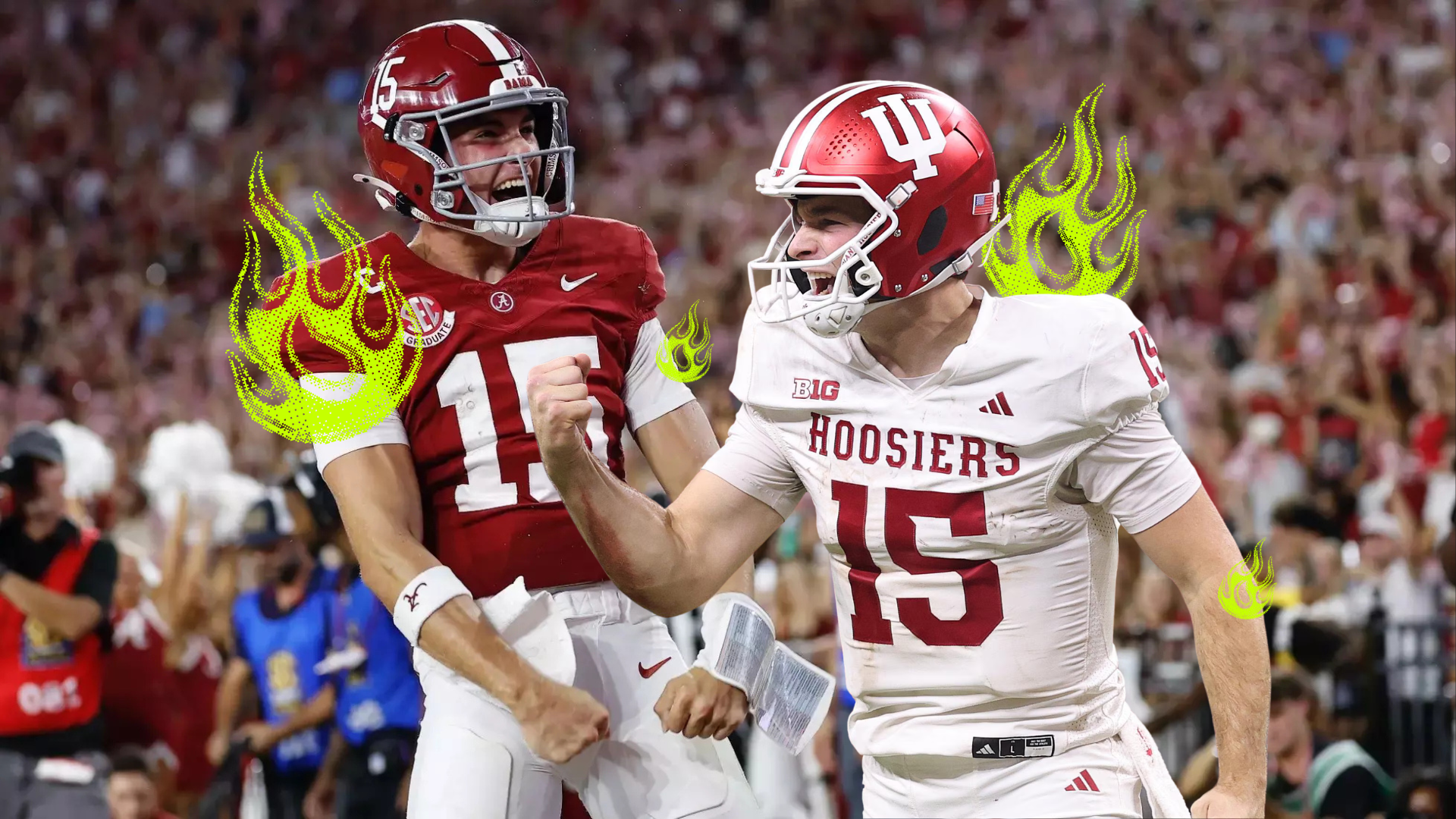
Draft season doesn’t really start until someone says something loud enough to make the entire football internet tilt its head. Enter Dan Orlovsky, who stepped onto Get Up and casually tossed a grenade into the 2026 NFL Draft discourse: Alabama’s Ty Simpson is QB1 — not Indiana’s Fernando Mendoza, the Heisman Trophy winner and presumed No. 1 overall pick.
Not QB2. Not “sleeper.” Not “rising.” QB1.
And just like that, what felt like a settled debate turned into a full-blown quarterback controversy.
Because while Mendoza has been cruising as the golden child of this class — big numbers, big moments, and a Heisman to flex — Orlovsky is betting on something a little less flashy and a lot more translatable: poise, processing, and pro-style execution.
Two Stars, Two Styles, One Debate
Let’s not pretend this is a lopsided conversation. On paper, Fernando Mendoza looks like the kind of prospect front offices dream about.
3,535 passing yards.
41 touchdowns.
6 interceptions.
72% completion percentage.
Those are video game numbers. That’s the kind of stat line that gets you invited to New York, gets your highlights looped on every pregame show, and gets you penciled in as the future of a franchise like the Raiders.
Mendoza didn’t just produce — he exploded. Indiana’s offense ran through him, often leaning into quick reads, RPO-heavy concepts, and vertical shots that let him showcase his accuracy and decision-making. When things were clean, Mendoza looked unstoppable. When things broke down, he could take off and create.
But here’s where Orlovsky’s argument gets interesting.
Because Ty Simpson’s numbers don’t scream louder — they whisper something different.
3,567 passing yards.
28 touchdowns.
5 interceptions.
64.5% completion percentage.
Less efficient. Fewer touchdowns. Not as sexy.
But context matters. And according to Orlovsky, Simpson wasn’t just playing quarterback — he was carrying Alabama’s offense on his back in a way Mendoza simply wasn’t asked to.
The “Moments of Panic” Argument
If there’s one phrase that defines this entire debate, it’s this: moments of panic.
Orlovsky zeroed in on it, and honestly, it’s the kind of detail that separates casual draft talk from real evaluation.
Because in the NFL, nothing is clean. Pockets collapse. Reads disappear. Windows close in half a second. And what a quarterback does in those chaotic moments often defines their ceiling.
According to Orlovsky, Simpson thrives there.
Where Mendoza occasionally defaults to instinct — dropping his eyes and taking off — Simpson keeps his composure. He stays in structure. He delivers throws that actually exist on Sundays.
We’re talking 15- to 25-yard in-breaking routes. Deep corners. Layered throws over linebackers and under safeties. The kind of stuff that doesn’t always go viral on Saturdays but pays rent in the NFL.
It’s not that Mendoza can’t do those things. It’s that Simpson does them more consistently — and under more pressure.
And in a league where “consistent under pressure” is basically quarterback gold, that matters.
Game Control vs. Game Breaking
Here’s the simplest way to frame it:
Mendoza is a game-breaker.
Simpson is a game-controller.
Mendoza can flip a game on its head in two drives. He’s explosive, aggressive, and thrives in rhythm. When he’s hot, defenses look helpless. His deep ball is legit, and his ability to operate quick-game concepts makes him incredibly efficient.
But Simpson? He’s the guy who makes sure things don’t spiral in the first place.
Orlovsky made it clear: when it came to “taking over games,” Simpson did it more often — and more completely. Not just with big plays, but with sustained control. Drives that didn’t stall. Decisions that didn’t backfire. Situational awareness that kept Alabama ahead of the chains.
It’s the difference between lighting a match and controlling the fire.
Downfield Throws and NFL Translation
One area where the two quarterbacks meet in the middle is the deep ball.
Orlovsky sees them as relatively even when it comes to vertical shots — posts, go routes, and those classic “air it out” moments that make highlight reels pop. Mendoza, in particular, has made a living off go routes, showcasing both touch and confidence.
But the separation shows up in the middle of the field.
Simpson’s comfort attacking intermediate zones — those 15–25 yard windows that define NFL offenses — is what gives him the edge in Orlovsky’s eyes. Those throws require timing, anticipation, and trust in your reads. You’re not just reacting — you’re dictating.
And right now, Simpson looks more like a quarterback who’s already thinking in NFL terms.
The Stat Sheet vs. The Tape
This is where draft debates always get messy.
Because if you’re building your argument off stats, Mendoza is your guy. Higher completion percentage. More touchdowns. More efficiency. A Heisman Trophy to cap it all off.
But if you’re building it off tape — especially through an NFL lens — Simpson starts to creep into that QB1 conversation.
And that’s exactly what Orlovsky is doing.
He’s not saying Mendoza is bad. Far from it. He’s saying that when you strip away system advantages, when you isolate decision-making under pressure, and when you project forward to Sundays, Simpson might be the safer — and possibly better — bet.
What This Means for the Draft
Right now, Mendoza is still widely expected to go No. 1 overall. The Raiders, or whoever ends up holding that pick, aren’t going to ignore a Heisman-winning quarterback who just lit up college football.
But takes like Orlovsky’s don’t just disappear. They linger. They spread. They get picked up in draft rooms, whispered in meetings, debated in film sessions.
And suddenly, Simpson isn’t just a “late first-round possibility.” He’s a legitimate challenger.
Maybe not for the top spot — at least not yet — but for the narrative.
Because all it takes is one team falling in love with the idea that Simpson’s game translates cleaner, faster, and more reliably to the NFL.
And if that happens? Draft night could get weird in a hurry.
Final Take: Ceiling vs. Control
This isn’t a debate that’s getting settled in March. It’s not even one that’ll be settled on draft night.
Because this is a classic football argument:
Do you bet on the guy who dominated college football and looks like a star?
Or the guy who might already be built for Sundays?
Mendoza feels like the headline.
Simpson feels like the fine print that ends up mattering more.
And if Orlovsky’s right, we might look back at this moment the same way we look at every “wait, he wasn’t QB1?” debate in NFL history.
Because sometimes, the best quarterback in the class isn’t the one holding the trophy.
It’s the one who never panics when everything around him starts to burn.

Trusted By Programs Across The Country