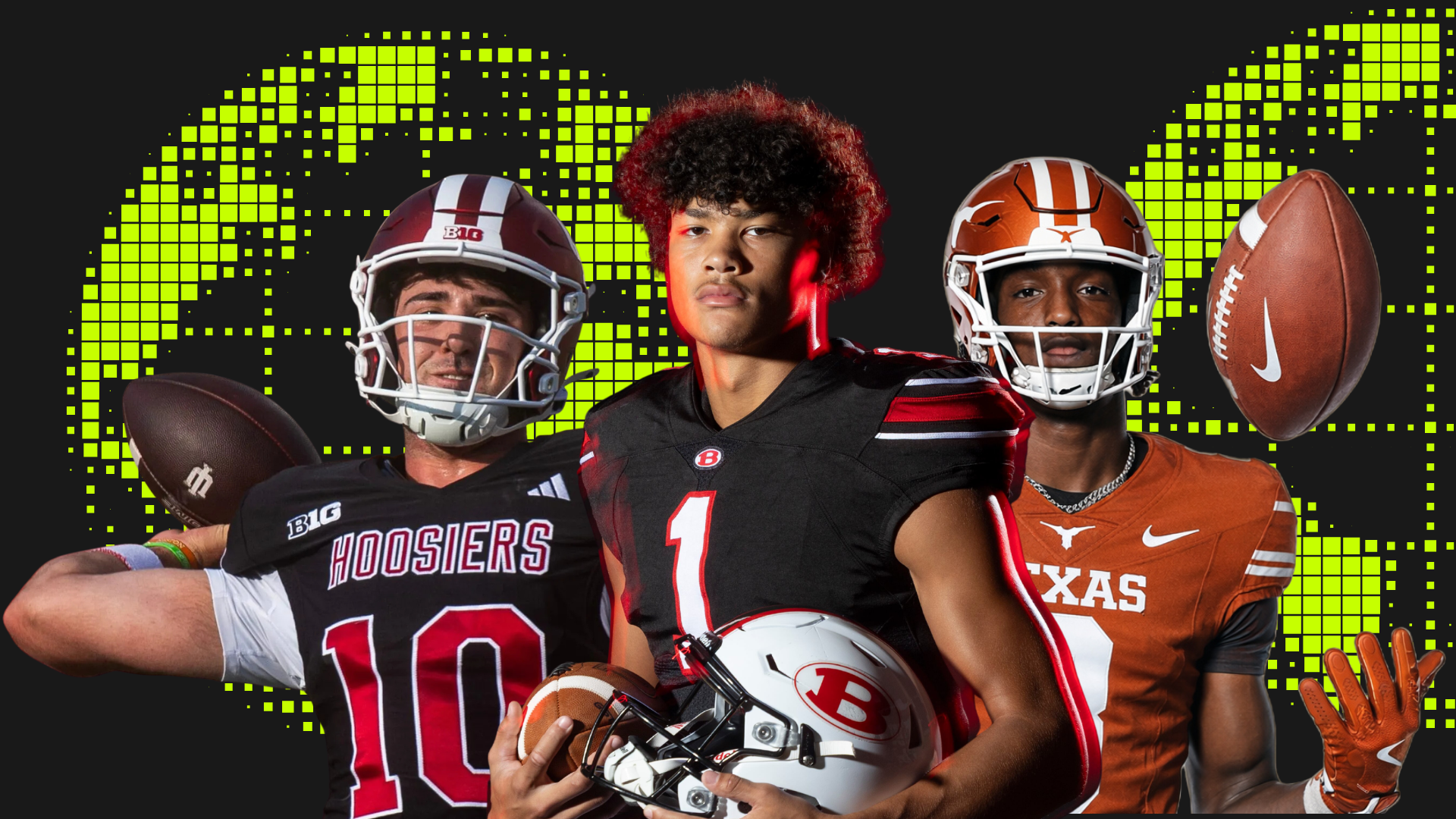
The portal didn't open this winter so much as it detonated. Over 4,000 players hit the market after the regular season, blue bloods got gutted, collectives emptied their war chests, and by the time the dust settled in mid-January, half the sport had a new ZIP code. What follows isn't a list of guys who switched jerseys. It's a snapshot of where the leverage moved, position by position, and the single most important newcomer at each one heading into 2026.
Some of these names are recruiting-class jewels stepping onto campus for the first time. Most are portal veterans chasing a ring, a paycheck, or both. All of them tell you something about who's actually built to win.
Quarterback: Josh Hoover, Indiana (formerly TCU)
Curt Cignetti has turned Bloomington into a quarterback laundromat. Kurtis Rourke ran the table to the Playoff in 2024. Fernando Mendoza won the Heisman and bolted for a top-five draft slot. Next man up: Josh Hoover, who walks in as the most accomplished passer in college football by raw production.
Hoover already owns more career passing yards than any returning quarterback in the country, and it isn't close. He threw for 3,472 yards and a career-high 29 touchdowns last fall on a TCU team that had lost its top three receivers to the NFL. The year before, he set the Horned Frogs' single-season record with 3,949 yards. The arm has always been there. Now it gets paired with Cignetti's operation, the same machine that has manufactured a quarterback whisperer reputation in record time. There's a poetic wrinkle, too: Hoover was committed to Indiana out of high school in 2021 before flipping to Fort Worth. Five years later, the kid finally shows up. Sometimes the recruiting board really is a flat circle.
Running back: Raleek Brown, Texas (formerly Arizona State)
Texas torched its own backfield to the studs this offseason. Quintrevion Wisner, CJ Baxter, and Jerrick Gibson all left, which meant Steve Sarkisian needed a feature back yesterday. Enter Raleek Brown, a 5-foot-9 ball of kinetic energy who finally got a full season of touches and turned it into 1,141 rushing yards, a 6.1 per-carry average, and First-Team All-Big 12 honors.
Brown is the rare back who can win on the perimeter as a receiver, having added 34 catches for 239 yards and two scores, which is exactly the Swiss-army profile Sarkisian likes to deploy. He dropped 255 yards on Colorado in a single game last year, the third-highest single-game total in Arizona State history. Brown turned down the NFL to come do this, betting on Austin's stage and a fatter NIL bag. With five-star freshman Derrek Cooper also arriving, Texas went from barren to loaded in a matter of weeks.
Wide receiver: Cam Coleman, Texas (formerly Auburn)
This is the headliner. The 6-foot-3, 201-pound former five-star was the consensus No. 1 wideout in the portal and, by most boards, the most coveted offensive weapon available anywhere. After two seasons surviving Auburn's quarterback carousel, where he still piled up 1,306 yards and 13 touchdowns, Coleman cashed in his eligibility to play for a real contender.
Pair him with Arch Manning and returning standout Ryan Wingo, and Sarkisian suddenly has the vertical attack that the 2025 Longhorns sorely lacked. The comp floating around recruiting circles is Will Howard-to-Jeremiah Smith at Ohio State in 2024, the kind of quarterback-receiver fit that flips a season. Coleman's ceiling in this offense is a 1,000-yard, double-digit-touchdown year and a first-round draft slot. The production is sitting there waiting. The only question is whether he grabs it.
Tight end: Kaiden Prothro, Georgia
The lone true freshman to crack this list, and for good reason. Prothro is a 6-foot-6 matchup nightmare, a top-30 overall prospect and five-star who picked Kirby Smart over Texas and Florida. Georgia already runs one of the deepest tight end factories in the sport, and now they've added a kid built like a power forward who can flex out and bully defensive backs.
Smart's staff has even floated using him at receiver. Whatever the alignment, the message is the same: the Bulldogs aren't slowing down at a position they already dominate. Prothro is the future, and in Athens the future tends to arrive early.
Offensive tackle: Jordan Seaton, LSU (formerly Colorado)
If you want to understand the 2026 portal, just look at what Lane Kiffin did in Baton Rouge. The self-anointed Portal King left Ole Miss, took the LSU job, and immediately assembled the No. 1 transfer class in the country, including three players ranked No. 1 at their position. Seaton is the cornerstone.
LSU's offensive line was a liability in a 7-6 collapse, and eight linemen hit the portal afterward. Kiffin's answer was to beat out Oregon, Miami, and Mississippi State for the best tackle available, a future pro who reshapes the entire front. You don't build a Playoff push without somebody to keep the quarterback upright. The Tigers just signed the best somebody on the market.
Edge: Princewill Umanmielen, LSU (formerly Ole Miss)
Loyalty in the Kiffin era apparently includes the moving van. Umanmielen followed his coach from Oxford to Baton Rouge, becoming the fourth Rebel to make the jump. The No. 1 edge in the portal is worth every penny of the reported $500,000 buyout LSU paid to spring him, plus the seven-figure deal that followed.
The production backs it up: a team-high nine sacks and 13 tackles for loss at Ole Miss last season, plus an interception for good measure. On a defense Kiffin is rebuilding from scratch, Umanmielen is the load-bearing wall. He also happens to embody the new SEC reality, where coaches and their best players migrate together and rivalries get personal in a hurry.
Defensive tackle: Mateen Ibirogba, Texas Tech
Texas Tech has quietly become a portal heavyweight, bankrolled by oil money and the Matador Club collective, and Ibirogba is part of the Red Raiders' interior overhaul. A well-traveled big man with stops at Georgetown and Wake Forest, he lands in Lubbock to anchor a defensive front that's trying to turn cash into contention. In a league where the trenches decide everything, Texas Tech is paying up front, literally.
Linebacker: Rasheem Biles, Texas (formerly Pittsburgh)
Texas didn't just rebuild the offense. Sarkisian raided the portal for an All-ACC-caliber linebacker out of Pitt to stabilize the second level. Biles joins Coleman and Brown as part of a haul designed to keep the Longhorns' national-title window propped wide open while Manning runs it back. When a program adds elite talent at every level in the same cycle, that's not a rebuild. That's a statement.
Cornerback: Smith Snowden, Michigan (formerly Utah)
Coaching changes drag players in their wake, and when Kyle Whittingham resurfaced at Michigan, his best defensive back came with him. Snowden is a 5-foot-10 nickel with track speed, having run a 10.74 in the 100 meters, and three years of starting reps. He earned Second-Team All-Big 12 honors in 2025 with 37 tackles, nine pass breakups, and two interceptions, and he's a true Swiss-army defender who even moonlighted on offense.
For a young Michigan secondary that got gutted by departures, Snowden is plug-and-play insurance with playoff experience baked in. The family ties run deep in football, and his fit in Jay Hill's matchup-zone scheme is cleaner than the man-heavy system he left. Smart move all around.
Safety: Koi Perich, Oregon (formerly Minnesota)
This one stung an entire state. Perich was Minnesota's homegrown hero, a freshman All-American with five interceptions as a true freshman and a do-everything weapon who played safety, returned kicks, and even caught passes. Then he left for Oregon, and the Barstool Gophers crowd did not take it well.
The reasoning was simple and ruthless: Perich wanted a national contender, and the Gophers haven't sniffed the Playoff. Oregon, flush with Phil Knight's money and back-to-back Playoff appearances, offered exactly that. The Ducks lose Dillon Thieneman to the draft and replace him with arguably the most versatile safety in the portal. Six career interceptions, one returned for a touchdown, and the kind of ball skills that make a defensive coordinator sleep easy. Welcome to modern college football, where hometown stories have an expiration date.
What it all means
Add it up and a pattern snaps into focus. Texas reloaded across all three levels around Arch Manning, treating the portal like a free-agency shopping spree. LSU bet the house on Kiffin's reputation and bought three position-best transfers in a single cycle. Oregon, Michigan, and Indiana plugged their exact holes with proven vets. Meanwhile the schools that developed these players, Auburn, Minnesota, Colorado, Utah, TCU, watched their best work walk out the door.
That's the deal now. The portal isn't a side door anymore. It's the front entrance, and the programs with the deepest pockets and the sharpest pitches are the ones answering it. Recruiting rankings still matter, but roster construction in 2026 looks a lot more like an NBA front office working the trade deadline than anything your dad would recognize as college football.
The talent on this list will decide January. The dollars that moved it already reshaped the sport. Buckle up, because the team that wins it all this year probably just met half its starters in a Zoom call last winter.

Trusted By Programs Across The Country