
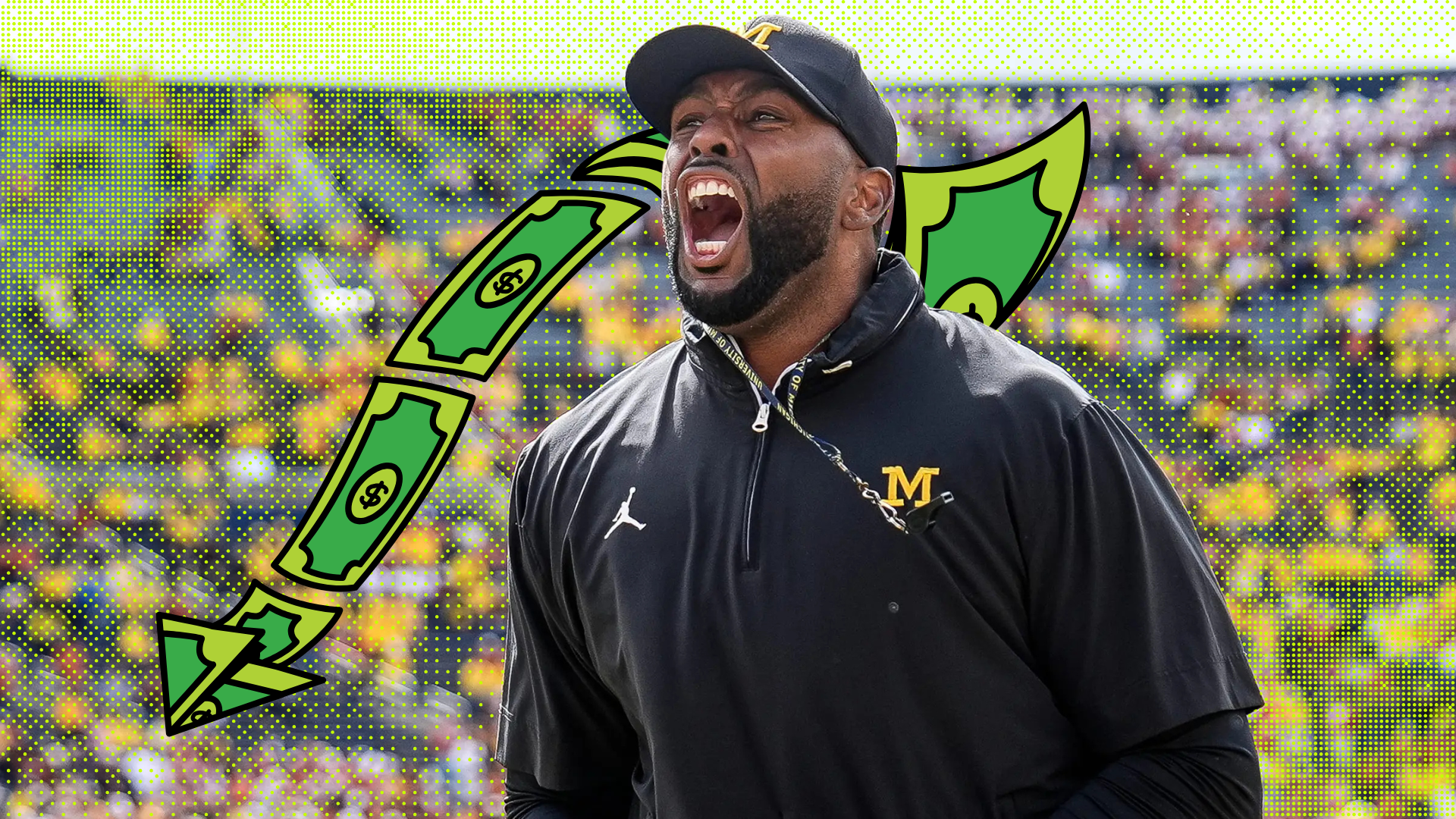
There is a specific kind of financial tragedy that only exists in college football. It's not losing a game. It's not blowing a recruiting class. It's signing a contract worth more money than most humans will see across ten lifetimes — then torching it so completely that the school finds a clause, calls a lawyer, and watches you walk out the door with significantly less than you came in with. Call it a bag fumble. And nobody in the history of the sport has fumbled the bag quite like this group.
Across seven coaches, the total contractual carnage clears $200 million. Some of it was paid out as settlements. Some of it disappeared entirely through for-cause terminations. All of it was preventable. This is the definitive ranking of college football's most spectacular self-destructions — measured not just in dollars, but in the sheer audacity of how each man found a way to lose.
The Mount Rushmore of Moral Turpitude
Mel Tucker — Michigan State | $86.7 Million
No one else is close. Mel Tucker didn't just fumble the bag — he punted it off the roof of Spartan Stadium in a hurricane.
In November 2021, Michigan State handed Tucker a 10-year, $95 million fully guaranteed contract — the third-largest deal ever given to a college football coach at a public university. He had just gone 11-2, won Big Ten Coach of the Year, and beaten Michigan for the first time in years. The Spartans were petrified of losing him to LSU, so they paid him like a generational cornerstone. Tucker became the highest-paid Black head coach in college football history and the highest-paid coach in the Big Ten. The deal reset the market across the entire sport.
Then, less than two years later, it was all gone.
Michigan State fired Tucker for cause in September 2023 following a Title IX investigation into allegations made by Brenda Tracy — a nationally recognized sexual assault prevention advocate who had been hired, specifically, to speak to Tucker's football team about sexual violence. The school determined his conduct constituted moral turpitude and triggered the early termination clause in his contract, eliminating the roughly $80 million remaining on the deal. Tucker denied the allegations, refused to attend the independent hearing, and later filed a civil rights and breach-of-contract lawsuit against the university — arguing the firing was racially motivated and that Michigan State manipulated its own process to avoid writing a nine-figure check.
The case is still working its way through federal court. Tucker has pointed to how Michigan State stood by white coaches whose programs faced far more systemic allegations. The counter-argument from the school is that the evidence was clear. What is not disputed is the math: the man was holding a $95 million fully guaranteed contract and is now a plaintiff in a lawsuit trying to prove it was real. That's a level of financial volatility that would make a crypto bro wince.
The Tucker situation also changed how the entire industry thinks about guaranteed money. His deal, which looked like a milestone for Black coaches in football, became an inflection point for contract language, termination clauses, and the uncomfortable reality that "guaranteed" in college sports often comes with an asterisk the size of a football field.
Art Briles — Baylor | $33.0 Million
If Tucker represents the modern era of bag fumbling, Art Briles wrote the original blueprint.
Briles spent eight seasons at Baylor, transforming a program that had been a perpetual Big 12 afterthought into a legitimate national contender. He compiled a 65-37 record, won two Big 12 championships, and had the Bears ranked in the top ten for the first time in program history. By every on-field metric, he was delivering. Off it, he was presiding over one of the most catastrophic institutional failures in the history of college athletics.
A 2016 investigation by law firm Pepper Hamilton found that Baylor had systematically mishandled sexual assault allegations against football players for years — allegations involving, by some counts, 31 players and over 50 acts of assault. The NCAA later concluded that Briles had failed to report potential criminal conduct by his own players when it came to his attention. The panel characterized his attitude toward those allegations as deeply troubling. Baylor fired him for cause in May 2016 with roughly $39 million left on his contract. After Briles threatened wrongful termination litigation, the school settled — paying him $15.1 million to go away. The total contractual loss, factoring in what he forfeited, lands around $33 million.
Briles spent years insisting he didn't know the extent of what was happening. He returned to coaching at the high school level, had a four-day stint at Grambling State that lasted about as long as a hot take, and was most recently hired at Eastern New Mexico — a Division II program — nearly a decade after Waco. The fall from Big 12 powerhouse builder to Division II is its own kind of accounting.
Bobby Petrino — Arkansas | $25.9 Million
Bobby Petrino is unique on this list because he is the only man who fumbled the bag, somehow got a new bag, fumbled that one too, and then kept getting offered bags anyway. He is the cockroach of college football coaching scandals — unkillable, resilient, and somehow always eating.
The Arkansas chapter was the big one. Petrino was in the middle of building something genuinely special in Fayetteville — the Razorbacks were a legitimate SEC contender with a coach who could light up a scoreboard. Then came the motorcycle. In April 2012, Petrino crashed his motorcycle and, in trying to manage the fallout, revealed that the passenger on the bike was a 25-year-old woman he had hired for an athletic department position — a woman he was having an extramarital affair with, and whose hiring he had failed to disclose to the university. Arkansas fired him. The remaining value on his contract came to approximately $25.9 million.
Petrino was back at Western Kentucky within eight months after going on ESPN and delivering an apology so polished it practically had its own highlights package. He eventually made his way back to Arkansas as an assistant in 2024, then served as interim head coach. He is currently the offensive coordinator at North Carolina. This man treats career rehabilitation the way most people treat a Netflix subscription — it just keeps renewing.
The Mid-Tier Meltdowns
Steve Sarkisian — USC | $17.6 Million
Steve Sarkisian's story is complicated by the fact that the core of his issue was addiction — a genuine disease — rather than the misconduct that defines most entries on this list. But the dollar figure is real, and the circumstances under which USC let him go in 2015 were damaging enough to land him here.
After being hired away from Washington in 2014, Sarkisian showed up to a USC booster function visibly impaired and made a series of erratic public appearances that the program eventually could not manage. The school fired him midseason, citing his behavior, with approximately $17.6 million remaining on his deal. Sarkisian sued USC for wrongful termination, claiming the university failed to provide the support it had promised around his alcohol dependency. They settled. Sarkisian eventually rebuilt his career through an offensive coordinator run at Alabama under Nick Saban — arguably the best possible rehab environment in football — and became head coach at Texas in 2021, where he subsequently won a Big 12 championship. His arc is genuinely one of the more redemptive in the sport. That doesn't make the bag fumble any less real.
Hugh Freeze — Ole Miss | $16.4 Million
Hugh Freeze built his entire personal brand around being the Christian coach — the man of faith, the recruiter of character, the guy who talked about God in press conferences with the same conviction most coaches reserve for third-down conversion rates. Then a USA TODAY investigation in 2017 revealed that calls had been made from his university-issued phone to a number connected to an escort service. Ole Miss, after reviewing a "concerning" pattern in his phone records, accepted his resignation. The contractual fallout was approximately $16.4 million.
The genuinely remarkable thing about Freeze's story isn't the scandal — it's what came after. He was coaching Liberty University within two years, leaning fully into the evangelical Christian identity at a school that specifically markets itself on those values. He eventually landed the Auburn head coaching job in 2023. The man lost $16 million and a high-profile SEC job, then landed another high-profile SEC job. College football's capacity for selective amnesia is truly a wonder of the modern world.
Jeremy Pruitt — Tennessee | $15.4 Million
Jeremy Pruitt's exit from Tennessee in 2021 had a different flavor from the others on this list — less personal scandal, more institutional failure. Pruitt was fired for cause following an internal investigation into recruiting violations, with the school alleging that Pruitt and members of his staff had been involved in impermissible payments to prospects and their families. The NCAA investigation that followed painted a picture of a program where cash, gift cards, and other benefits had allegedly been exchanged in recruiting as a matter of course.
Tennessee fired him for cause, attempting to void the roughly $15.4 million remaining on his deal. Pruitt disputed the characterization. What followed was predictably messy — legal back-and-forth, a program left in disarray, and a school that had already been suffering through one of the more turbulent decades in program history adding another ugly chapter. Tennessee eventually settled. Pruitt has not returned to a head coaching position. The Vols, meanwhile, have since turned things around under Josh Heupel — proof that sometimes the bag fumble is just one bad hire in a longer story.
Sherrone Moore — Michigan | $14.4 Million
Sherrone Moore's story is the freshest entry on this list, and arguably the most jaw-dropping in terms of context. Moore was not some outside hire brought in with a checkered history. He was Jim Harbaugh's handpicked lieutenant, the man who held the program together during Harbaugh's suspension, and he was elevated to head coach when Harbaugh bolted for the Los Angeles Chargers. He was also, notably, the first Black head coach in Michigan football history — a program with over 140 years of football. The weight of that milestone was real.
Michigan fired Moore in December 2025 after discovering credible evidence of an inappropriate relationship with a staffer. What followed was worse: Moore was subsequently charged with felony home invasion and stalking, with prosecutors alleging he had confronted the woman at her home after she disclosed the relationship to the university. He was arraigned in court on multiple charges including the felony count. The $14.4 million remaining on his deal was suddenly the least of his problems.
The Moore situation reignited a broader conversation that Tucker's firing had already sparked — one about whether Black coaches face a fundamentally different standard when it comes to second chances. Commentators pointed out that Petrino, Freeze, Sarkisian, and others had all found their way back to prominent positions. The data on Black coaches getting equivalent grace is, to put it generously, thin.
What It All Means
Zoom out from the individual disasters and a pattern emerges that says something uncomfortable about the economics of college football. Schools have spent two decades handing out contracts that were structurally designed to signal permanence — ten-year deals, full guarantees, life insurance for coaches whose track records often didn't warrant that level of commitment. Tucker's deal at Michigan State literally reset the market for everyone. The arms race to retain coaches created contractual obligations that schools now spend enormous legal energy trying to escape whenever things go sideways.
The irony is that the coaches themselves often don't understand what they're signing away when they take these deals. The buyout clause cuts both ways. The moral turpitude language that schools use to fire coaches for cause is the same fine print that looked like boilerplate when the contract was signed in front of a room full of boosters and flash photography.
More than $200 million in contractual value, gone. Some of it paid out in settlements, some of it litigated away, some of it vanished entirely through for-cause terminations. All of it the result of men who had everything — the money, the platform, the staff, the institution behind them — and found a way to give it back.
The bag was guaranteed. The decisions were not.

Trusted By Programs Across The Country