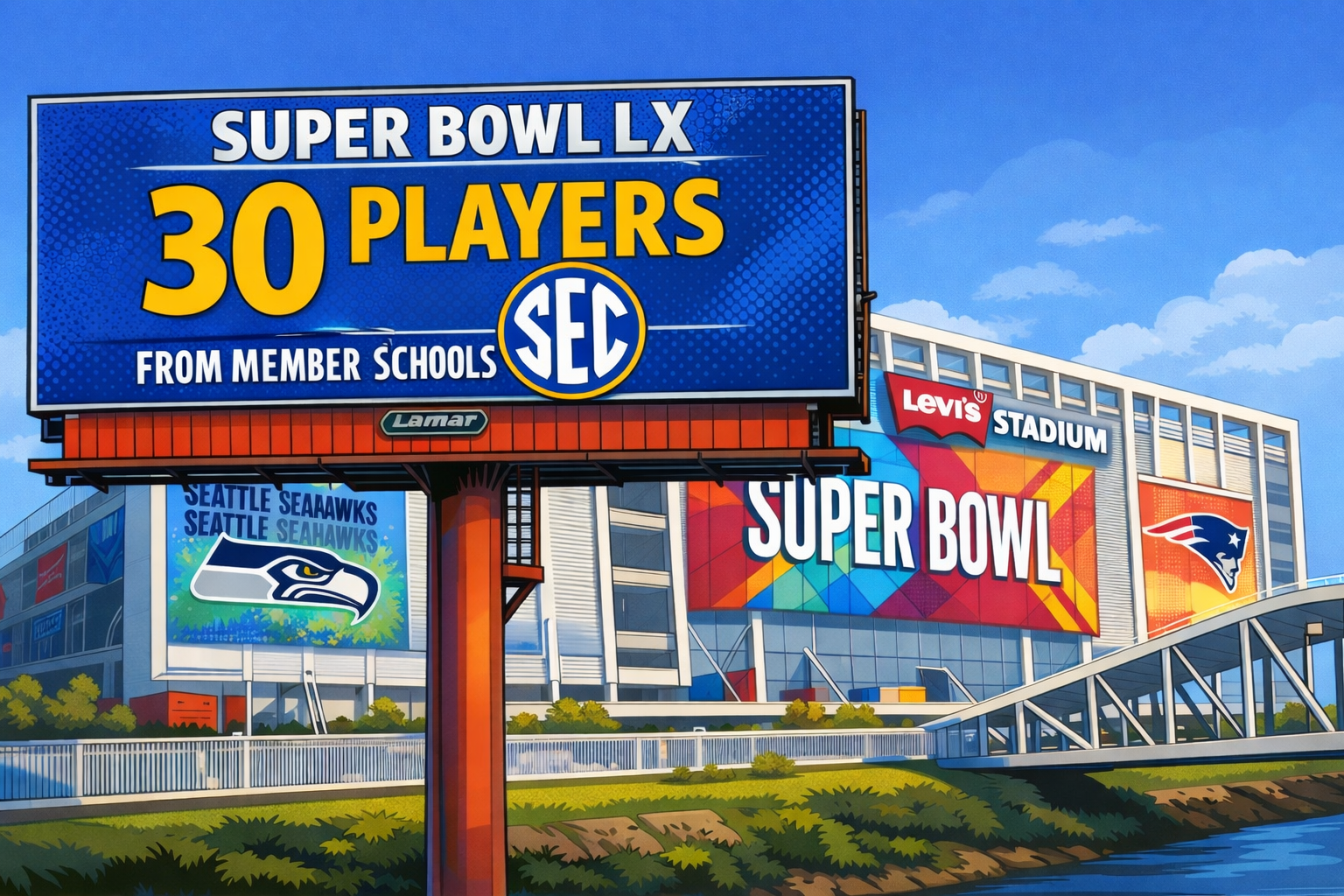
If Super Bowl LX feels less like a single matchup and more like a cross-country recruiting flex, that’s because it kind of is. When the Seattle Seahawks and New England Patriots kick off Sunday night in Santa Clara, they won’t just be playing for the Lombardi Trophy. They’ll also be settling an unofficial, extremely online argument about which college programs and conferences still own the NFL pipeline.
Spoiler alert. It’s the SEC. Again. Always the SEC.
Between Seattle and New England’s active rosters, 106 players trace their roots back to 64 different college programs. That’s a ridiculous amount of helmets represented on one field. But as usual, the power conferences separate themselves quickly, and no league shows up louder than the Southeastern Conference, which sends a staggering 30 players to Super Bowl LX. The Big Ten is the only conference even remotely keeping pace with 25, while everyone else is chasing the pack.
This game might decide a champion, but it also doubles as a three-hour reminder that college football’s blue bloods never stop feeding the NFL machine.
The SEC’s Annual Takeover Tour Continues
Thirty players. One Super Bowl. Same story.
The SEC once again leads all conferences in Super Bowl representation, extending a run that now stretches back a decade. It doesn’t matter which teams are playing. The SEC is always there, lurking on both sidelines, stretching, taping wrists, and generally reminding everyone how this whole thing works.
Alabama and LSU headline the charge, because of course they do. Alabama alone places seven former Crimson Tide players on the active rosters, four with Seattle and three with New England. That’s not depth. That’s a roster philosophy.
One of those names, Seahawks corner Josh Jobe, has quietly become a pillar of Seattle’s defense. Part of what teammates have nicknamed “The Dark Side,” Jobe put together the best season of his pro career with 54 tackles, 12 passes defended, and a timely interception. He’s not the loudest star in this game, but he’s exactly the type of Alabama-developed defender who thrives when the lights get brighter.
LSU isn’t far behind with five total players, four of whom suit up for the Patriots. That group includes left tackle Will Campbell, who has grown into a foundational piece for New England’s offensive line, and wide receiver Kayshon Boutte, who has emerged as one of Drake Maye’s most trusted targets. Boutte has already racked up 147 receiving yards this postseason, leading the team and proving that the big-game version of himself still exists when it matters most.
And because the SEC never travels light, even Oklahoma gets a cameo via running back Rhamondre Stevenson, who leads the Patriots in postseason rushing yards and brings a physical edge to an offense built around balance.
The Big Ten’s Quiet Power Move
If the SEC is loud dominance, the Big Ten is calculated influence.
Twenty-five Big Ten alumni will take the field Sunday, and several of them sit right at the heart of Seattle’s offense. This Seahawks run has been fueled by a trio of Big Ten products who control how games unfold snap by snap.
Sam Darnold has revived his career in Seattle, playing with confidence, rhythm, and just enough swagger to make it believable. Jaxon Smith-Njigba has become his go-to weapon, creating separation in ways that stress defensive coordinators into questionable life choices. And with Zach Charbonnet sidelined by a season-ending injury, Kenneth Walker III is set to shoulder the workload in the backfield, bringing burst and physicality to an offense that wants to punch before it dances.
Michigan also shows up strong, headlined by tight end AJ Barner, who quietly turned himself into one of Darnold’s favorite red-zone targets during the regular season. Six touchdowns later, Barner enters the Super Bowl with modest postseason numbers but a massive schematic role. Defenses can’t ignore him, and that attention creates space everywhere else.
USC matches Michigan with four players of its own, led by Darnold, who torched the Rams in the NFC Championship with 346 yards and three touchdowns. He’s been managing an oblique injury, but all signs point toward a full go. And if he’s right, Seattle’s offense becomes a very real problem.
The ACC’s New Franchise Face
Fourteen ACC players will be involved Sunday, but none loom larger than New England quarterback Drake Maye.
The Patriots drafted Maye second overall and handed him the keys immediately. He responded with a season that felt less like a rookie learning curve and more like a franchise announcement. Maye completed 72 percent of his passes, threw for 4,393 yards, and posted a 31-to-8 touchdown-to-interception ratio, leading New England to the No. 2 seed in the AFC.
He’s not just managing games. He’s dictating them. The Patriots trust him to attack downfield, change protections, and lead with authority well beyond his years. For a franchise transitioning out of one era and into another, Maye’s presence has accelerated the timeline.
If the Patriots win Sunday, it will feel less like a surprise and more like the beginning of something very familiar in Foxborough.
The Hidden Pipeline Nobody Talks About Enough
While the power conferences dominate headlines, Super Bowl LX also shines a light on football’s quieter pathways.
Thirteen players on the active rosters come from non-FBS programs, including FCS powers North Dakota State and Eastern Washington, which each place two players in the game. Division II even gets representation thanks to Seahawks wide receiver Dareke Young out of Lenoir-Rhyne.
These aren’t feel-good footnotes. They’re proof that elite talent still finds its way, even if it doesn’t start under the brightest lights. The NFL doesn’t care where you came from once you can play.
The Big 12 And The Defensive Difference
The Big 12 rounds out the top five conferences with seven players, led by Houston, which sends two alumni, one to each roster. On New England’s side, Marcus Jones has been a defensive tone-setter all season, earning Second Team All-Pro honors after posting three interceptions and 47 tackles.
Jones is exactly the kind of player who can flip a Super Bowl with one read, one jump, one moment. He’s not flashy every snap, but quarterbacks know where he is, and that alone changes decisions.
What It All Means When The Ball Finally Kicks
When the ball goes up Sunday night at Levi’s Stadium, the logos on the helmets won’t matter anymore. But the systems, cultures, and habits built in college absolutely will.
The SEC’s physicality. The Big Ten’s structure. The ACC’s emerging quarterback factory. The underdog grind from non-FBS programs. All of it collides in one game, on one field, under the brightest lights the sport has.
Super Bowl LX isn’t just Seahawks versus Patriots. It’s a snapshot of football’s ecosystem, compressed into 60 minutes and one very long halftime show.
And once again, when you zoom out far enough, the SEC is right there in the middle of it, doing what it always does.
Running the league.

Trusted By Programs Across The Country