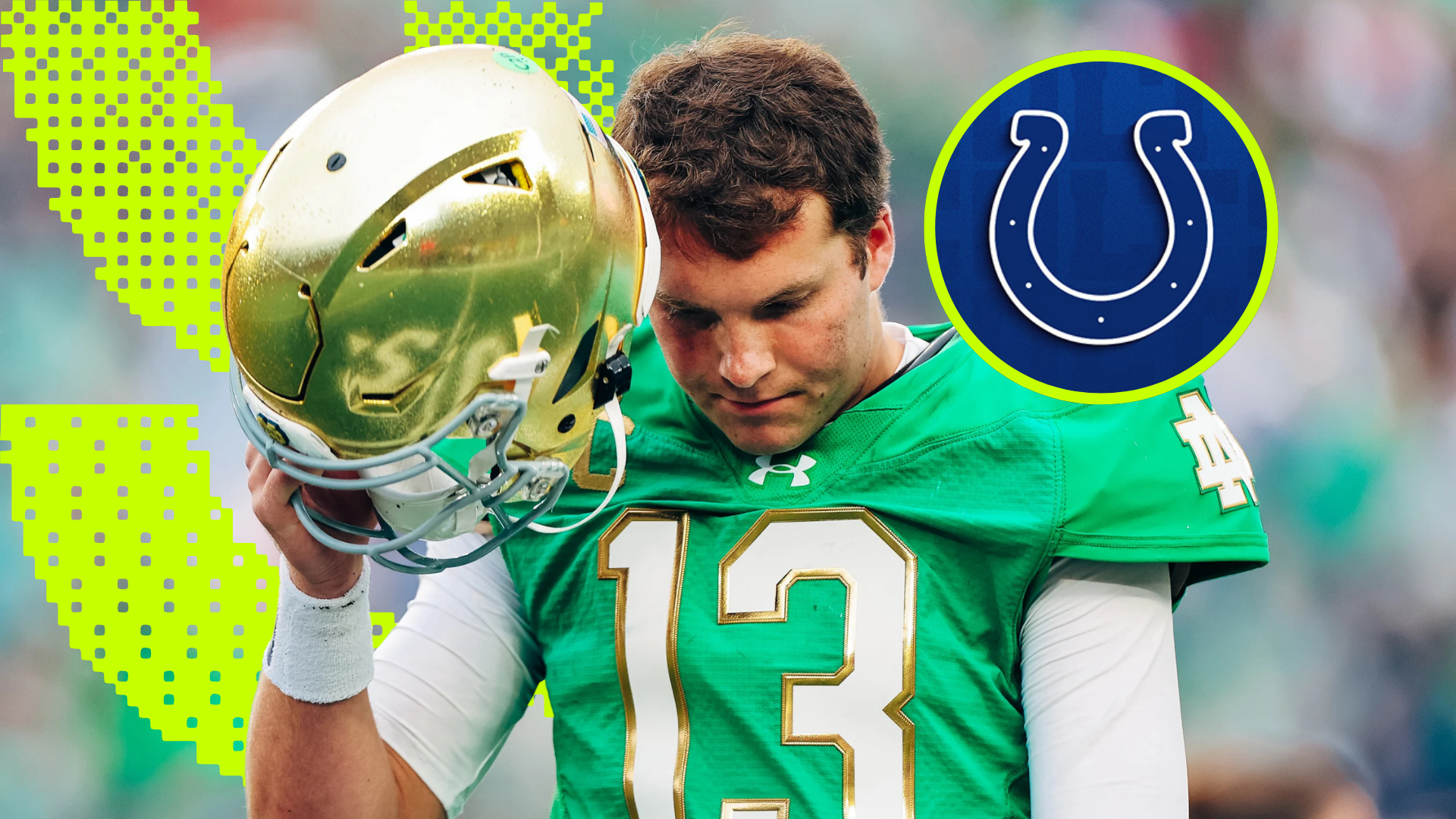
There's a line in David Ubben's latest for The Athletic that, in any other era of football, would read like satire. Riley Leonard, the Indianapolis Colts' sixth-round rookie quarterback, fresh off leading Notre Dame to the College Football Playoff National Championship game, casually admitted that signing his NFL contract actually meant cutting his paycheck. Not trimming. Not rebalancing. Cutting. The kid who quarterbacked the Irish under the lights in Atlanta is, by his own admission, making less to wear a horseshoe on Sundays than he was making to wear a golden dome on Saturdays.
Welcome to college football in 2026, where the punchline is the quiet part out loud.
The Quote That Broke Everyone's Brain
Leonard's words, delivered to The Athletic and picked up everywhere from Pittsburgh Steelers blogs to horseshoe fan pages, land with the weight of a thesis statement. He's definitely making less with the Colts, he said. And he pointed to the broader reality that the money swirling around college football has roughly doubled since he arrived in South Bend. That's not a vibe. That's an economy.
For anyone who has spent the last half-decade watching the NIL era unfold from a safe distance — rolling eyes at seven-figure freshman valuations and shaking heads at collective-driven rosters — Leonard's admission is the moment the theoretical becomes concrete. This isn't Shedeur Sanders and his $6.5M valuation operating in a separate universe. This is a middle-round NFL pick, a backup quarterback behind Daniel Jones and Anthony Richardson, saying plainly that his Saturday job paid better than his Sunday one.
The Math That Makes It Real
The numbers don't require a CPA. Leonard's four-year rookie deal with Indianapolis comes out to roughly $4.4M total, or about $1.1M per year on average, with a base salary that sits right at the NFL rookie minimum. As a sixth-rounder taken 189th overall, he wasn't exactly negotiating from a position of leverage — late-round picks get slotted money, and that's the game.
At Notre Dame, Leonard's On3 NIL valuation hovered around $1.6M by the time he reached the national championship game. Reports throughout his lone season in South Bend pegged him with a Rhoback deal alone worth $100,000, on top of partnerships with Gillette, EA Sports, Great Clips, Dick's Sporting Goods, New Era, Hollister, and Arthrex. That's not a merchandise table. That's a portfolio.
He never disclosed the exact figure, and you can understand why. But when the man tells you he's making less in the league, and he's got an NFL contract that amounts to $1.1M annually, it doesn't take a forensic accountant to reverse-engineer the implication.
Leonard Isn't Alone — and That's the Story
The most damning part of this whole discussion is that Leonard has company. Will Howard, the former Ohio State signal-caller who won a natty before heading to Pittsburgh in the same 2025 draft class, reportedly told Ubben the same thing. Howard said his Buckeyes NIL package included a Ford Bronco, an apartment, and seven-figure money. His current Steelers deal pays him essentially the same as Leonard's — about $1.1M per year — and it still represents a step down from what he was pulling at Ohio State.
That's two national championship-game quarterbacks, drafted into the NFL in the same year, both publicly saying they traded down financially to chase the league. Five years ago, that sentence would've been a typo. Now it's a column.
The Irony Is Doing All the Work
There's a delicious layer to this that deserves its own paragraph. The NFL, the most valuable and watched sports league on the planet, with billion-dollar television deals and owners who count their franchises in the single digits of the global wealth rankings, is getting out-spent at the bottom of its own talent funnel by college athletic departments and booster collectives in places like South Bend and Columbus.
This is the league that, for decades, held all the leverage. The NFL was the pot of gold at the end of the football rainbow. College was the unpaid internship. You hustled through four years of scholarship-tier compensation, maybe a stipend, and then you cashed in on Sundays. That pipeline was as stable as it gets in American sports.
Now? A late-round pick can look at his college locker and his pro locker and reasonably conclude that the college one was the better-paying job. That's a genuine structural shift, not a hot take.
What This Actually Means
A few things, and none of them are small.
First, the calculus of declaring early is getting rewritten in real time. A generation of players watched guys like Anthony Richardson bolt for the draft as soon as they were eligible, partly because college wasn't paying and the league was. That incentive structure has flipped for anyone who isn't a projected top-15 pick. If you're a projected Day 2 or Day 3 selection and you've got a top-tier NIL package waiting for you back on campus, staying in school is increasingly a financial no-brainer. It's also probably a football no-brainer, because you get another year of real snaps against real talent instead of clipboard duty behind a veteran.
Second, the NFL rookie wage scale — that product of the 2011 CBA meant to curb the Sam Bradford-era top-pick contracts — is suddenly looking dated. When the scale was written, nobody imagined a world where college quarterbacks were pulling six- and seven-figure deals as sophomores. The league's owners might love the cost control. The players' association is going to start asking harder questions.
Third, and maybe most interestingly, this is an NFL marketing problem as much as a labor one. The league's entire mystique — the Super Sundays, the prime-time glamour — was built on being the ultimate destination. When the guys actually playing in the games are telling reporters they took a pay cut to get there, that story starts to fray at the edges.
The Leonard Factor
None of this is sour grapes from Leonard, for what it's worth. This is a quarterback who, during his Notre Dame run, famously redirected a Dick's Sporting Goods appearance into a group gig so his offensive line could cash in alongside him. The guy's character has been on the record for a while. When he says he's making less with the Colts, it's a diagnosis, not a complaint.
He also ended up making his first NFL start in Week 18 against Houston after Daniel Jones tore an Achilles and the Colts signed Philip Rivers out of retirement as a stopgap. Leonard finished 21-of-34 for 270 yards and two touchdowns in the loss. Not bad for a kid who was supposedly making a financial sacrifice to be there.
The Takeaway
Here's the thing worth sitting with. College football used to be a holding pen. You played there because you had to, and you endured the economics because the real check was on the other side. That bargain isn't just fraying — it's broken. The draft stock still matters. The NFL brand still matters. But the automatic assumption that signing a rookie deal is a financial promotion? Gone.
Riley Leonard didn't blow up the system. He just answered a question honestly. The answer happens to be the headline.
If you're a current Heisman contender weighing the transfer portal versus the draft, that answer is the loudest argument in the room. If you're an NFL GM, it's a warning shot. And if you're a fan who still thinks of college football as the minor leagues of the NFL, it's time for a software update.
The minor leagues are paying better now. Sometimes, apparently, a lot better.

Trusted By Programs Across The Country