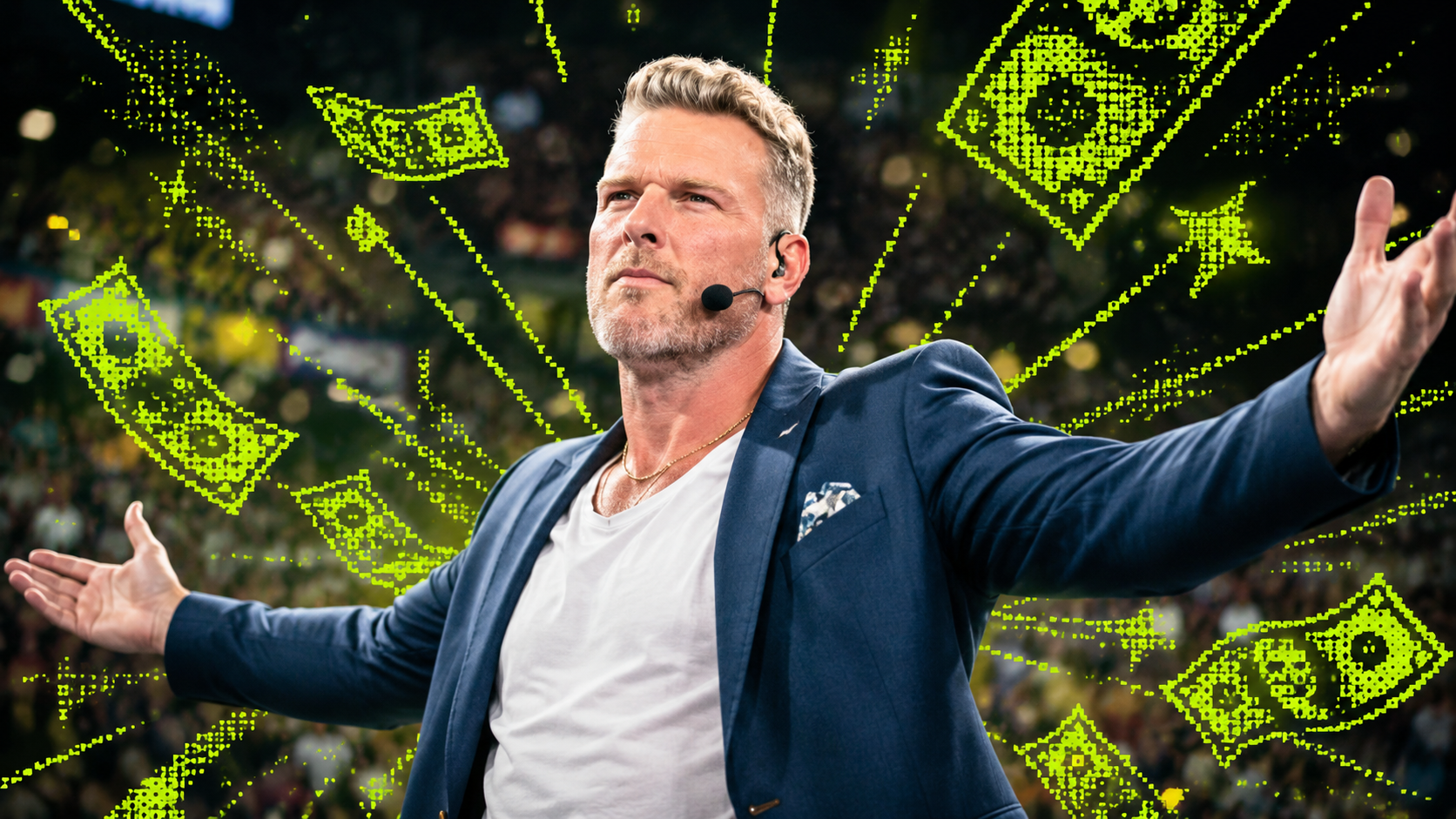
Eight years ago, Pat McAfee walked away from two guaranteed seasons of an NFL contract to go yell about sports on the internet from a Barstool studio. The football world treated it like a punter who'd taken one too many to the head. On Tuesday, that same punter became the center of a negotiation that could make him the single highest-paid on-air voice in the history of sports television — and the people who laughed in 2017 are the ones doing the math now.
According to The Athletic's Andrew Marchand, ESPN and McAfee's representatives are deep in talks on an extension that would pay him somewhere in the range of $60 to $65 million per year. To put a frame around that: it's roughly double his current haul, it's franchise-quarterback money, and it's flirting with what the NFL pays its commissioner. For a guy whose primary job is talking. The number didn't just leak — it detonated, fracturing sports-media social feeds within hours and forcing everyone from executives to barstool skeptics to recalibrate what a microphone is actually worth in 2026.
How the Deal Got Here
This wasn't a bolt from the blue. Front Office Sports first surfaced that the two sides were talking earlier this month, framing it as early-stage. Then came Tuesday, and with it the figure that turned a rumor into a referendum. McAfee currently sits two years out from the expiration of a deal that pays him in the neighborhood of $30 million annually — a bundle that stitches together his daily show production agreement (worth north of $17 million on its own) with separate money for College GameDay and his other ESPN appearances. The rest, call it $13 million, is the GameDay-and-everything-else tax.
The structural detail that everyone screaming about the headline number tends to skip: ESPN doesn't employ McAfee in the traditional sense. It licenses The Pat McAfee Show through a production deal, meaning McAfee owns the program, signs his own people's checks, and eats his own production costs. So that gaudy $60 million isn't take-home — a meaningful slice goes right back out the door to A.J. Hawk, Ty Schmit, Foul Mouth Darnell and the rest of the crew, plus the lights and the cameras and the studio. It's gross, not net. Which is the same caveat that applies to a quarterback's cap hit, and nobody's ever felt bad for the quarterback.
The Players in the Room
The most telling wrinkle isn't the money — it's who's holding the pen. McAfee negotiated his last ESPN deal himself, which is a little like a guy representing himself in a contract dispute and somehow walking out with eight figures. This time, he's got TKO and Endeavor's Ari Emanuel and Mark Shapiro running point. Yes, that Ari Emanuel — the dealmaker who served as the real-world template for Ari Gold in Entourage. They're the same operators who handle McAfee's Hollywood business as he preps for a role in Peter Berg's upcoming World War II film, and they handle WWE and UFC at the corporate level. When that kind of representation walks into a room, it stops being a talent renewal and starts being a media-rights negotiation.
And they came in swinging. Per Marchand, the opening ask from Emanuel and Shapiro wasn't $60 million. It was $100 million per year. That's the kind of number you float not because you expect to get it, but because it drags the entire conversation's center of gravity north. Anchor high, settle rich. The fact that "settling" lands somewhere around $60-65 million tells you the strategy is working exactly as designed.
The Turning Point: Why ESPN Blinks First
Here's the part that matters more than the comma placement. ESPN doesn't hand a former punter the richest deal in its history out of sentiment. It does it because the ratings ledger left the network no choice — and because the clock was working against them.
The 2025 College GameDay season — the first of the post-Lee Corso era, after the 90-year-old legend hung up the headgear in Week 1 — averaged about 2.7 million viewers, a 23% jump year-over-year and a record for the franchise. ESPN's own data showed the show posted its nine most-watched episodes ever and led its biggest gains among women, up 34%. McAfee's shirtless, bombastic field-goal-pick segment didn't just replace Corso's mascot-head tradition; it gave a 38-year-old institution a transfusion of youth at the exact moment it needed one. Over on the daily side, The Pat McAfee Show cleared a billion monthly social views for the first time and helped ESPN's entire morning block — Get Up, First Take, McAfee — post its most-watched year. He has, by any honest accounting, become indispensable to the most important real estate ESPN owns.
The leverage cuts deeper than ratings, though. McAfee's reps were almost certainly already taking temperature readings from Amazon, Netflix and anyone else with a checkbook and streaming ambitions. ESPN has watched this movie before — McAfee has never once let a contract run to its natural end. Waiting until 2028 would mean negotiating against a man with one foot already out the door and a Hollywood super-agent measuring the exits. So ESPN is moving now, two years early, to lock the cage before the bird remembers it can fly.
The Numbers That Actually Matter
Strip away the noise and a few figures carry the whole story. The current deal: about $30 million a year. The proposed deal: $60-65 million, with reporting suggesting the final figure could operate on a sliding scale tied to expanded responsibilities — read: a larger role in ESPN's NFL coverage. The opening ask: $100 million. The daily show's standalone value: north of $17 million. And the benchmark hovering over all of it — Stephen A. Smith's deal, which a little over a year ago made him ESPN's first $100 million man, dwarfing the likes of Troy Aikman ($18 million) and Joe Buck ($15 million).
That Stephen A. number is the ghost at this negotiation. The two men's camps publicly downplay any rivalry, but everyone in Bristol understands the gravitational pull: when one voice sets a new bar, the other's representation shows up the next cycle with a tape measure. McAfee closing the gap toward Smith's territory doesn't end that arms race. It escalates it.
What It Means
The timing carries an uncomfortable subtext. This blockbuster is being negotiated against the backdrop of ESPN planning another round of layoffs, accelerated by its recent absorption of NFL Network. So while one personality is circling $60 million, producers, writers and behind-the-camera staff are bracing for pink slips. That contrast is exactly why the number cut so deep online — it's a clean, brutal illustration of where the modern sports-media economy directs its money: toward a handful of bankable faces, and away from the infrastructure beneath them.
It's also worth noting that McAfee remains genuinely polarizing. A 2026 survey from The Athletic showed his approval among college football fans had slipped, with the share of fans who actively like him on GameDay falling to roughly 31%. A recent primetime ESPN special he hosted drew a soft 278,000 viewers. He is not universally beloved — he's universally watched, which in television is the only metric that signs checks. ESPN president Burke Magnus put it bluntly when the criticism flared: fans vote with their remotes, and three straight years of record GameDay audiences is a strange way to spell "declining support."
If the deal closes, it would mark something genuinely new for McAfee: the first time in his career he's planted a flag and stayed. The résumé reads like a man allergic to expiration dates — Colts to Barstool in 2017, then WWE, DAZN, SiriusXM, Westwood One, a reported four-year, $120 million FanDuel deal he exited early, and finally ESPN in 2023. The kid who left guaranteed NFL money to chase a microphone has spent eight years proving that the microphone was the smarter bet. A $60 million annual salary would be the receipt.
Somewhere, the people who called him crazy in 2017 are watching a former punter negotiate quarterback money to talk for a living — and the only thing left to say is the thing McAfee's been screaming since the day he left: for the brand, baby. The number just finally caught up to the noise.
This story draws on reporting from The Athletic's Andrew Marchand, Front Office Sports, and additional sports-media coverage. Figures reflect reported negotiation ranges and remain subject to change until a deal is finalized.

Trusted By Programs Across The Country