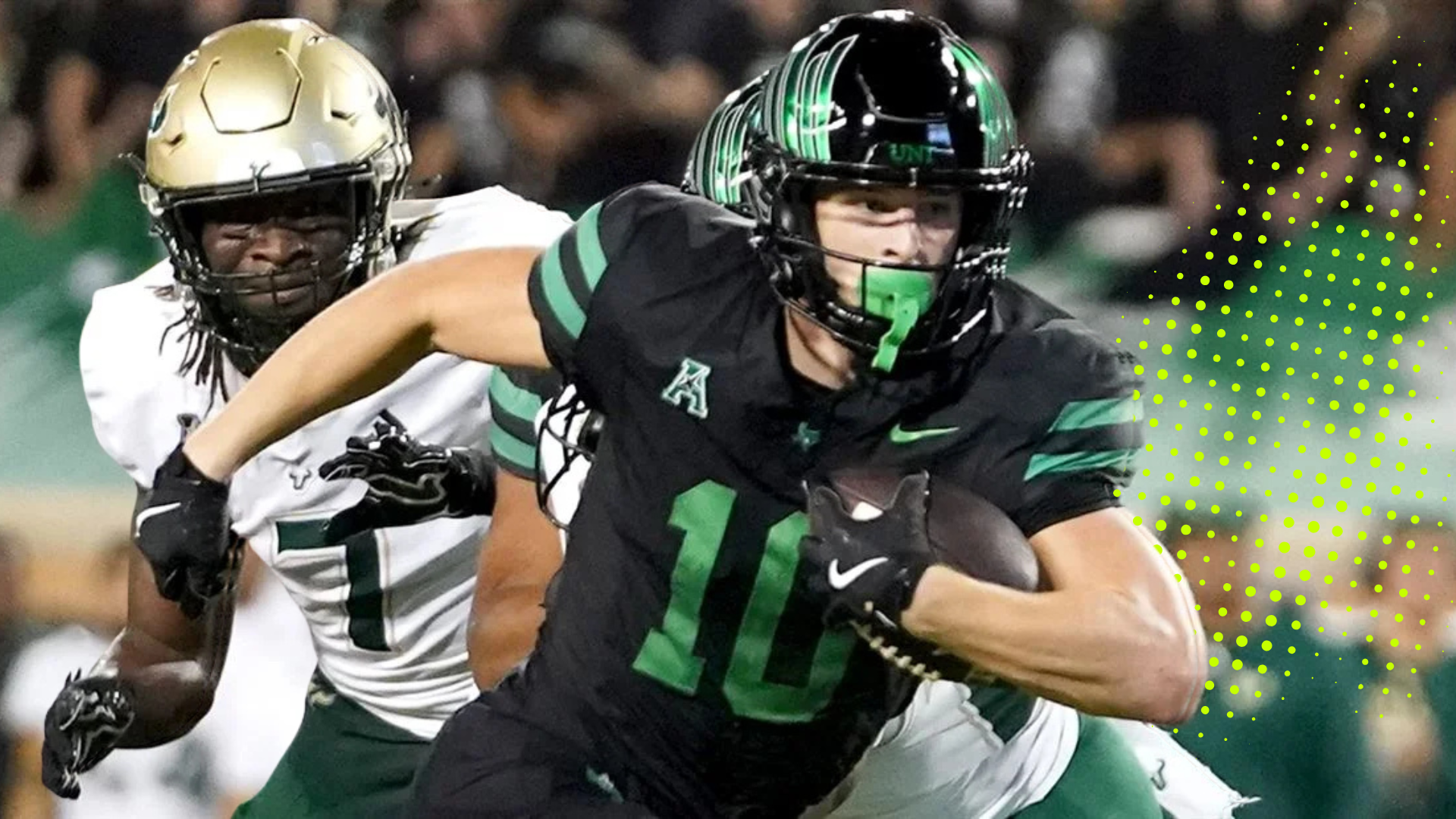
There is a specific kind of helplessness reserved for a defensive back who has done everything right. He read the route. He broke on the ball. He got there. And then the receiver caught a three-yard slant, hit a gear nobody warned him about, and turned a routine completion into a coast-to-coast sprint while the corner grabbed air and the stadium lost its mind. That moment, repeated dozens of times a season, is the entire reason yards after the catch has gone from nerd stat to one of the loudest tells in football.
PFF just dropped its ranking of the five most dangerous returning YAC threats heading into 2026, and it doubles as a scouting report on the offenses most likely to make defensive coordinators reach for the antacids. College football has always been a more forgiving place to run after the catch than the NFL, where tackling is cleaner and space is rationed like it's wartime. Down here, the screens, glances and crossers come fast and the open field is wide. The receivers who thrive in that chaos do not just run fast. They see the field a half-second ahead of everyone else, shrug off the first hit, and carry the ball like they already know they're scoring. So let's run it back.
1. Malachi Toney, Miami: the freshman who broke the curve
Start with the number that started the whole conversation: 841 yards after the catch. That was the national lead, and Toney put it up as a true freshman who reclassified into the 2025 class and was still 17 years old when the season kicked off. He was supposed to be a high school senior. Instead he was the most dangerous player on the field most Saturdays, and there is video evidence to prove it.
Toney finished his debut campaign with 109 catches for 1,211 yards, both Miami single-season records, and the way he got there should worry the ACC for years. He forced a nation-best 33 missed tackles on receptions and tacked on five more as a runner. He racked up 446 yards on screen passes alone, the second-most by any receiver since PFF started charting the college game in 2014, behind only the Malachi Corley season that turned "YAC king" into a draft-room cliche. Listed at a generous 188 pounds, Toney plays like a man who never got the memo about being small, finishing runs through contact and leading all returning Power Four receivers with 285 yards after contact.
The scary part for everyone else is the supporting cast. Toney now catches passes from Duke transfer Darian Mensah, who threw for nearly 4,000 yards and 34 touchdowns last fall, inside a Shannon Dawson offense engineered to feed the slot. The only real knock is ball security after three fumbles, the kind of nitpick you only bother making about generational talents. Otherwise, Toney is the blueprint, and Miami spent the offseason drawing up new ways to hand him the ball in space.
2. Wyatt Young, Oklahoma State: the slot bully comes to the Big 12
Young is the rare YAC merchant who is arguably more dangerous after you touch him than before. His 385 yards after contact led every receiver in the FBS last season, and he did it while playing a genuine downfield role rather than living on manufactured touches. His average depth of target out of the slot was 11.1 yards, compared to Toney's 6.8. Translation: Young is not just catching layups and turning upfield. He's winning down the field and then making you tackle him, which, good luck.
His 89.9 PFF receiving grade trailed only Jeremiah Smith and Makai Lemon among all returning receivers, and he forced 32 missed tackles, one shy of Toney's national lead. Now the whole North Texas show packs up and moves to Stillwater. Young followed head coach Eric Morris and quarterback Drew Mestemaker to Oklahoma State after the Mean Green went 12-2 and fielded the nation's most ridiculous offense at 512 yards and 45 points a game. He was the third-leading receiver in all of FBS last year with 1,264 yards and double-digit touchdowns, including a conference-record 295-yard explosion against Rice.
The catch, and there's always a catch, is the Big 12 will test him in a way Conference USA never could, starting with an early matchup against an Oregon defense a lot of people consider the best in the country. He sits 51st on PFF's 2027 Big Board, and a strong season in a brighter spotlight is exactly the kind of thing that nudges a slot receiver up draft boards in a hurry.
3. Jalen Jones, Texas Tech: the FCS rocket nobody saw coming
Here is your wild card. Jones led every wide receiver in college football with 13.4 yards after the catch per reception, which is less a statistic than a dare. He arrives in Lubbock from Alabama State, where he was an unranked recruit who quietly turned into an HBCU All-American, posting 1,167 yards and nine scores while averaging nearly 23 yards a catch, tops in all of FCS.
Texas Tech, fresh off its first outright Big 12 title since the Eisenhower administration and a Playoff quarterfinal run, has built a brand on finding talent wherever it hides and trusting Joey McGuire's staff to mold it. They need it now, with draft-bound starters Caleb Douglas and Reggie Virgil gone. At 5-foot-8 and 175 pounds, Jones is a track-meet deep threat more than a contested-catch bully. He logged exactly one contested catch last season, and the jump from the SWAC to the Big 12 is a canyon, not a step. But the Red Raiders led the conference in YAC last season, the system is built for exactly his skill set, and a guy who turns short throws into 60-yard sprints only needs a few touches a game to flip a scoreboard. If even a fraction of that FCS production translates, defenses are in trouble.
4. Mario Craver, Texas A&M: small school of one
Craver is what happens when a 5-foot-9, 165-pound receiver decides that tackling him is a suggestion. Among 184 Power Four receivers with at least 40 targets, he led the entire group in yards after the catch per reception at 9.8, forced 22 missed tackles, and piled up 250 yards after contact. He did most of that damage underneath, where only 14 percent of his targets traveled more than 20 yards downfield. Screens, hitches, drags, the boring stuff on the call sheet, all turned into explosive gains the second the ball hit his hands.
That kind of efficiency is why he checks in at 59th on PFF's 2027 Big Board despite a frame that scouts would generously call "compact." In an Aggies offense that needs reliable yards, Craver is the cheat code who manufactures them out of nothing.
5. Ryan Coleman-Williams, Alabama: the talent that needs the targets
No honest YAC list leaves off Coleman-Williams, even after a 2025 that took a small step back. Over the past two seasons he ranks third among returning Power Four receivers in yards after the catch, second in yards after contact, and fourth in forced missed tackles. The ability has never been the question. The opportunity has.
He went for three catches or fewer in seven games last year, and 10 drops did not help his case for more volume. Yet ball security has somehow never been an issue, with exactly one fumble on more than 100 career touches, and his 75-yard touchdown against Georgia remains a clinic in balance, burst and change of direction. Alabama is sorting through a reshuffled receiver room, and if Coleman-Williams gets the looks, the after-the-catch production is the last thing anyone's worried about.
What it all means
The thread connecting all five is the same lesson modern offenses keep relearning: in the college game, the catch is just the appetizer. Three of these names changed schools this offseason, two of them following the coaches who unlocked them, which tells you how much programs now value the ability to manufacture yards in space. Toney sets the ceiling. Young brings proven Big 12-ready production. Jones is the lottery ticket. Craver is the efficiency machine. Coleman-Williams is the boom-or-bust blue-chipper waiting on volume.
The defenses that figure out how to tackle in space will survive the fall. The ones that don't are going to spend a lot of Saturdays watching a small guy in the slot disappear into the secondary while 80,000 people scream. Pour one out for the defensive backs. They did everything right, and it still won't be enough.

Trusted By Programs Across The Country