College football’s arms race just picked up a new weapon, and this one comes with a W-2.
In a move that feels less like tax policy and more like a fourth-quarter blitz, the Mississippi House has passed a bill that would exempt college athletes’ NIL earnings from state income tax. If it clears the state Senate and lands on the desk of Tate Reeves for a signature, Mississippi could soon become one of the most aggressive recruiting battlegrounds in the country.
The message from lawmakers was simple: if you can’t outspend the SEC, at least outmaneuver it.
And with multimillion-dollar NIL deals now the norm for elite quarterbacks and five-star prospects, that maneuver might matter more than ever.
The Bill: A Recruiting Pitch Wrapped in Tax Code
The legislation would remove name, image and likeness compensation from an athlete’s gross income for Mississippi state tax purposes. Translation: if you’re a star quarterback signing a $5 million NIL package in Oxford or Starkville, the state won’t take a cut.
You’ll still owe Uncle Sam. Federal taxes aren’t going anywhere. But at the state level? That check gets lighter.
Rep. Trey Lamar, a Republican from Senatobia, framed the move as a necessary adaptation to the new reality of college sports.
“NIL is taking the country by storm,” Lamar said during debate. “Other states are doing it, and I believe it’s time that Mississippi starts doing this as well.”
He’s not wrong about the storm. Since the NCAA opened the floodgates in July 2021, NIL has transformed from a long-overdue player rights correction into a full-blown financial ecosystem. Collectives, booster-backed funds, brand partnerships, and now revenue-sharing agreements have turned Saturday football into something closer to a publicly traded enterprise.
Mississippi doesn’t want to be the only team at the table paying retail.
The SEC Chessboard: Follow the Money
Let’s be honest. This isn’t about fairness. It’s about Florida.
And Texas. And Tennessee. And Arkansas.
Three of those states, Florida, Texas, and Tennessee, don’t have a state income tax at all. If you’re a quarterback choosing between Gainesville, Austin, Knoxville, or Oxford, that’s not just a lifestyle decision. That’s a line item.
Arkansas added fuel to the fire in 2025 by passing its own law exempting NIL income from state taxes. That made it the first state to specifically carve out NIL earnings, giving the Razorbacks a shiny new recruiting bullet point.
Meanwhile, programs in tax-friendly states have been stacking NIL war chests like they’re collecting Infinity Stones. According to NCAA estimates entering the 2025 season, Arkansas, Tennessee, Florida, Texas A&M, and Texas were all among the top 25 programs nationally in NIL resources. Each boasted at least $11.5 million in estimated support, with the Longhorns topping out around $22 million.
Mississippi schools, including Ole Miss, have been aggressive players in the NIL marketplace. And they’ve had to be. In the SEC, you’re either spending or you’re explaining why you’re not.
Enter Trinidad Chambliss: The $5 Million Example
If you want a face to attach to this legislation, it’s Trinidad Chambliss.
The Ole Miss quarterback, fresh off winning an eligibility case against the NCAA, is set to return next season with a reported NIL haul of around $5 million. That number alone would make some NFL rookies blink.
Under the proposed Mississippi law, that $5 million would be exempt from state income tax. In pure financial terms, that’s a significant swing compared to states that still tax NIL as ordinary income.
For recruits and their families, these details matter. The difference between net earnings in two otherwise similar programs could reach six figures. In a world where players have agents, accountants, and transfer portal leverage, no advantage is too small.
And this isn’t happening in a vacuum. Following the landmark House vs. NCAA settlement, Division I schools are now permitted to share up to $20.5 million annually in revenue with athletes for the 2025–26 season. That revenue-sharing number doesn’t even include traditional NIL deals layered on top.
So now imagine stacking a revenue-sharing check, booster-backed NIL, and a state tax exemption.
Mississippi is trying to turn itself into a fiscal safe haven for quarterbacks.
The Pushback: Why Special Treatment?
Not everyone in the House was ready to roll out the red carpet.
Rep. Dan Eubanks of Walls questioned why student-athletes should receive preferential treatment compared to other earners in the state.
“Why would they not be taxed like any other employee?” he asked during debate. “Is the only incentive for us doing this because other states are doing it?”
That question cuts to the philosophical heart of the NIL era. College athletes are, in theory, students. They are also, increasingly, high-value economic actors generating millions for universities, media partners, and local economies.
But so are influencers. So are student musicians with viral songs. So are business majors launching startups from their dorm rooms.
Why carve out athletes?
Supporters argue this is about competitive balance. Opponents argue it’s about favoritism.
Both can be true.
NIL vs. “NIL”: The Legal Gray Zone
Here’s where it gets even messier.
NIL, as originally conceived, is tied to the right of publicity. That’s the legal principle that allows individuals to control and monetize the commercial use of their name, image, likeness, and related identifiers. Think endorsement deals. Commercial appearances. Merch collaborations.
The concept isn’t new. Even celebrities outside sports have long protected and licensed their identity. The late Johnny Carson famously sued a company that branded itself “Here’s Johnny Portable Toilets,” arguing that the phrase was uniquely tied to him.
But in college football’s modern ecosystem, not all NIL deals look like traditional endorsements. Some are clearly tied to on-field performance or to keeping a player at a particular school.
Collectives and booster groups often structure deals as NIL, but critics argue some arrangements resemble pay-for-play agreements more than marketing partnerships.
If Mississippi exempts NIL income from state taxes, what happens when a tax official decides a deal wasn’t really about licensing a player’s image, but rather compensation for services rendered on Saturdays?
In that scenario, audits could follow. Reclassification battles could emerge. And suddenly that “tax-free” money gets more complicated.
Equal Protection and the Lawsuit Potential
There’s also a constitutional subplot brewing.
Non-athlete college students who earn income from their own right of publicity or entrepreneurial efforts would still be subject to state income tax. If athletes are exempted, that differential treatment could raise equal protection questions under the 14th Amendment.
The U.S. Supreme Court has struck down state tax laws that unreasonably treat similarly situated citizens differently. It has also upheld others when a rational basis exists.
Would attracting top football recruits qualify as a rational basis? Possibly. States enjoy broad discretion in tax policy.
But if you think NIL litigation peaked in 2021, think again. The courtroom may once again become college football’s unofficial conference commissioner.
The Bigger Picture: Mississippi’s Long Game
Zoom out for a second.
Mississippi is already on a path to eliminating state income tax entirely over the next decade. In that context, exempting NIL earnings could be viewed as a transitional step.
It’s also a signal.
The SEC is not just a sports conference. It’s an economic engine. Game days in Oxford and Starkville pump millions into local economies. National exposure drives applications, donations, and brand value.
If shaving state taxes helps land one extra five-star defensive end or retain a quarterback like Chambliss, lawmakers see that as an investment.
Critics might call it corporate welfare in shoulder pads. Supporters call it staying alive in a hyper-competitive marketplace.
In the NIL era, states aren’t just legislating. They’re recruiting.
What This Means for Ole Miss and Mississippi State
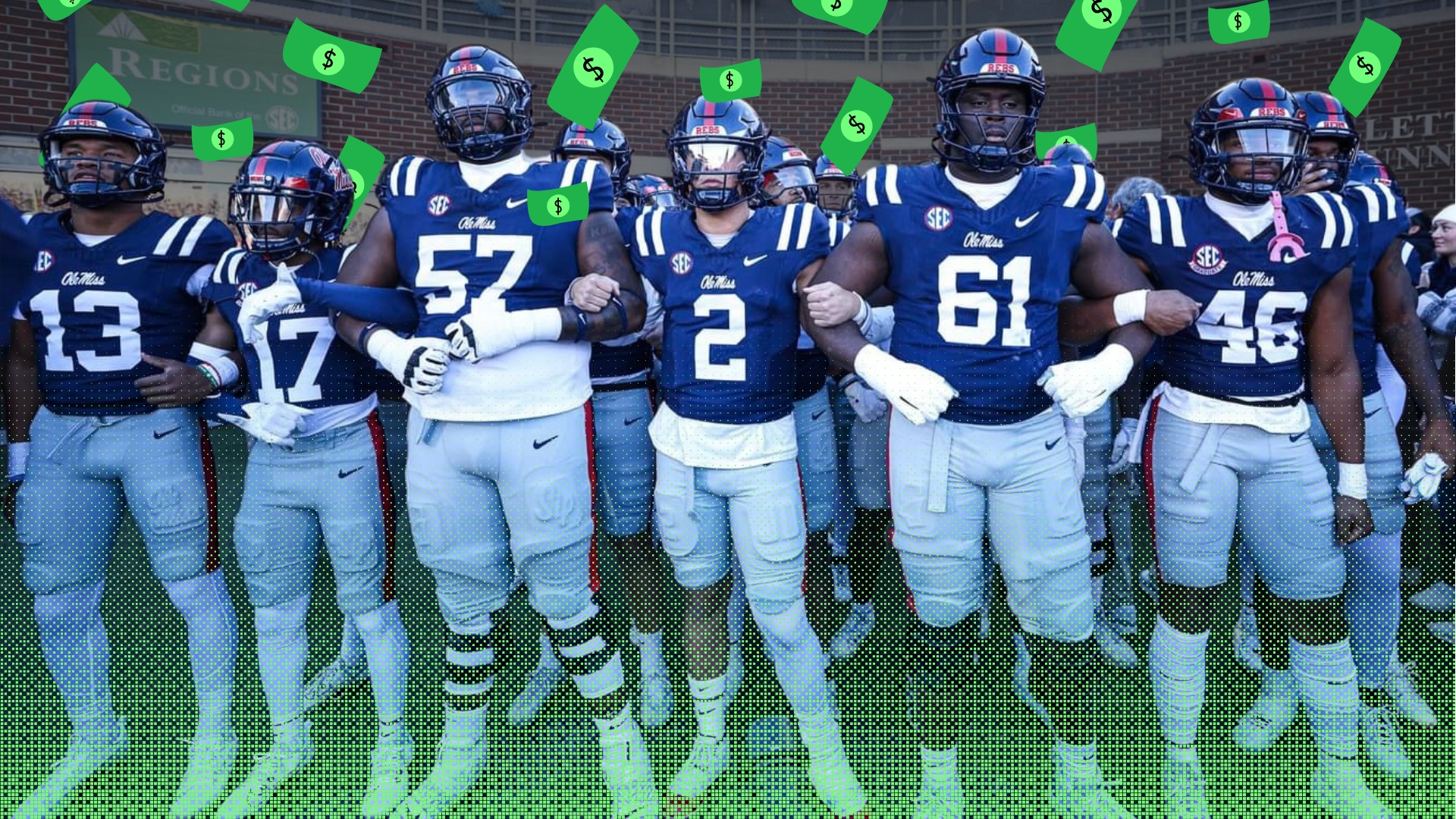
For Ole Miss, the optics are clear. The Rebels have leaned hard into the NIL game, positioning themselves as modern, aggressive, and unafraid to play in the gray areas.
A state-backed tax exemption becomes another line in the recruiting pitch:
Come to Oxford. Get paid. Keep more of it.
Mississippi State benefits too, of course, but in the SEC hierarchy, momentum matters. A few elite recruiting classes can reshape perception for years.
The gap between the haves and have-nots in college football isn’t shrinking. It’s calcifying. If Mississippi doesn’t compete financially, it risks drifting toward the wrong side of that divide.
The Reality Check
Even with a state exemption, athletes remain subject to federal income tax. And if they sign deals in states that still tax NIL income, they may owe there as well.
There is no such thing as completely tax-free stardom.
But perception is powerful. And in recruiting, perception often matters as much as reality.
When 17-year-olds and their families weigh offers, they’re looking at facilities, coaching staffs, development pipelines, and now, spreadsheets.
Mississippi just decided to sweeten the spreadsheet.
Final Take: Welcome to the Fiscal Transfer Portal
College football used to be about tradition, marching bands, and rivalry trophies. Now it’s about collective bargaining, revenue sharing, and tax strategy.
If this bill becomes law, Mississippi won’t just be competing on Saturdays. It’ll be competing in accounting offices.
The NIL era was always going to reshape the sport. What we’re seeing now is the next evolution: states themselves entering the recruiting chat.
Some will call it innovative. Others will call it desperate. Either way, the SEC just added another front in its war for talent.
And if you think this stops here, you haven’t been paying attention.
The fiscal transfer portal is officially open.

Trusted By Programs Across The Country