
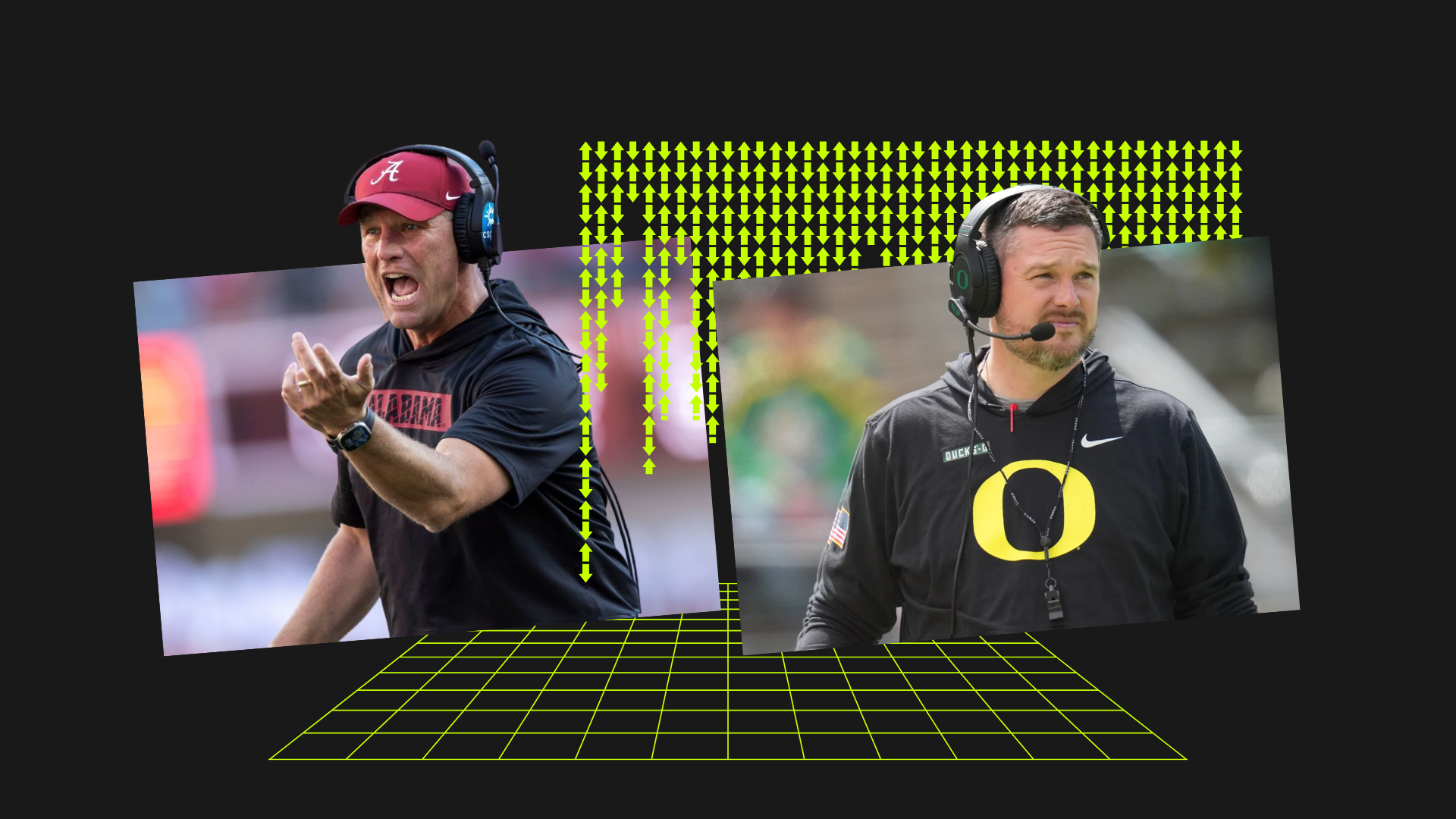
College football has always been a sport of gut feelings, laminated play sheets, and coaches trusting the instincts they built over decades. But in the modern era, there’s a new voice whispering in those headsets. It’s not a coordinator. It’s not a graduate assistant. It’s the math.
Analytics have quietly become one of the most influential forces shaping college football strategy. More than 100 FBS programs now rely on analytical game management systems, often referred to simply as “the book.” These tools break down situations like fourth downs, two point conversions, and late game clock management using probability models built from thousands of plays.
And while it may feel like a new age revolution, a lot of these strategies are simply logical conclusions that some coaches were already discovering decades ago.
One of the clearest examples comes from a game played more than 50 years ago.
The 2-Point Conversion Strategy That Isn’t Actually New
One of the most talked about analytical recommendations involves a scenario that pops up late in close games: a team trailing by 14 points scores a touchdown.
Traditional football logic says kick the extra point. Cut the deficit to seven. Do the same thing again on the next touchdown and head to overtime.
Analytics says something different. Go for two.
Here’s the reasoning.
Two point conversions succeed roughly 50 percent of the time. If a team converts on the first attempt after scoring, the next touchdown plus an extra point wins the game outright. If the first attempt fails, the team can try another two point conversion after the second touchdown to tie the game.
Either way, the odds are roughly the same as playing for overtime, which itself is basically a coin flip. The aggressive decision doesn’t just add upside. It preserves the same probability of tying the game while creating a path to win it outright.
It sounds like a cutting edge strategy pulled from a modern analytics spreadsheet. But the concept actually showed up in one of the most famous games in college football history.
In 1969, Texas head coach Darrell K. Royal made the exact call during a legendary showdown against Arkansas. The game, often referred to as the “Game of the Century,” featured the No. 1 Longhorns and No. 2 Razorbacks in a matchup that had the entire country watching. President Richard Nixon even attended.
Texas trailed 14-0 late in the fourth quarter before finally breaking through with a touchdown. Instead of kicking the extra point, Royal sent his offense back out to attempt a two point conversion. They got it.
Moments later Texas scored again. The Longhorns kicked the extra point and walked away with a stunning 15-14 win.
At the time, the decision barely registered as revolutionary. Today, it’s exactly what modern analytics recommend.
The lesson? Sometimes “new” thinking is just old logic rediscovered.
The Hidden Reality of Possessions
Another analytical concept that is reshaping decision making revolves around something most fans rarely think about during a game: the number of possessions remaining.
Football games move slowly, but the number of actual drives each team gets is surprisingly small. Once the second half begins, the clock becomes a critical factor in how aggressive teams need to be.
Imagine a team trailing by 10 points with about five minutes left in the third quarter. Conventional thinking might encourage caution. Punt the ball away on fourth down, trust the defense, and hope for good field position later.
Analytics paints a different picture.
There might only be two or three meaningful possessions left in the game. That means a team needs to start maximizing every opportunity immediately. Waiting for the “perfect moment” to be aggressive might mean that moment never arrives.
Oregon head coach Dan Lanning has spoken about how this mindset shifts decision making.
When a coach understands that only a handful of possessions remain, the calculus changes. Suddenly a fourth down decision in the third quarter might matter just as much as one in the final minutes.
Aggression becomes less about risk and more about necessity.
The Fourth Down Mindset Shift
Fourth down decisions are probably the area where analytics has made the most visible impact.
For decades, the default move was simple: punt the ball unless you were in obvious short yardage territory or the game was on the line.
Data has challenged that tradition.
Take a common scenario: fourth and one around your own 34 yard line. Historically, most coaches would punt without hesitation. The idea of giving the opponent a short field felt reckless.
But the numbers tell a different story.
Teams convert fourth and one more than 70 percent of the time. When you weigh the benefit of extending drives against the downside of the occasional failure, analytics suggest the positive outcomes outweigh the negatives.
The key concept analysts emphasize is something called the “sum positive.” Even if a team fails once, that doesn’t change the underlying probability of success the next time.
Former Montana State coach Rob Ash, who now works in analytics consulting, explains it simply. If a team has a 75 percent chance of converting a fourth and one, that probability remains the same regardless of previous outcomes.
Success isn’t determined by memory or momentum. It’s determined by math.
Army head coach Jeff Monken has seen this play out in real games. His team has even attempted fourth and one plays deep in its own territory. In one stretch, Army went for it three times from around its own 10 yard line. Two attempts worked. On the third, the defense forced a stop and the opponent missed a field goal.
The lesson is clear: aggression often pays off more than caution.
When the Right Decision Still Looks Wrong
Analytics doesn’t always tell coaches to go for it. Sometimes it actually recommends the opposite.
That nuance can make certain decisions look baffling in the moment.
One example came during the 2025 national championship game. Notre Dame trailed Ohio State by 16 points late in the fourth quarter and faced fourth and goal from the 9 yard line.
Instead of going for the touchdown, Irish head coach Marcus Freeman chose to kick a field goal.
The kick missed. Notre Dame later scored a touchdown and added a two point conversion to cut the deficit to eight. Suddenly the earlier field goal attempt looked like a massive mistake.
But according to analytical models, Freeman’s decision was actually correct.
An eight point deficit might look like a one possession game to fans, but the probability of converting a two point attempt complicates that math. Likewise, a 16 point deficit isn’t truly a two possession game in terms of win probability.
The odds of scoring two touchdowns, converting both two point attempts, and then winning in overtime are extremely low. Under most models, the chance sits below 10 percent.
Even when a decision feels wrong emotionally, the numbers sometimes say otherwise.
The Psychological Side of Analytics
Analytics isn’t just about raw probability. It also considers how decisions affect the opponent’s mindset.
One of the most fascinating examples involves late game field goals.
Imagine a team leading by three points with only a few minutes remaining and facing fourth and short. The safe option is to kick a field goal and extend the lead to six.
But analytics often recommends going for it.
Why?
Because the psychology of the game changes.
If the field goal makes the score a six point game, the opposing team knows it must score a touchdown. That urgency pushes offenses to become more aggressive and creative. They take deeper shots and operate with maximum urgency.
But if the offense fails on fourth down and the score stays a three point game, the opponent suddenly has options. A field goal can send the game to overtime. That possibility tends to slow down play calling and reduce desperation.
In other words, not kicking the field goal can actually make the opponent less dangerous.
Houston head coach Willie Fritz learned that lesson firsthand during his time at Georgia Southern. In one game his team kicked a short field goal late while leading by three. The opponent responded with a game winning touchdown drive moments later.
Analytics suggested that going for the first down would have been the better move.
The Future of Game Management
The rise of analytics hasn’t replaced coaching instincts. It has simply added another layer to the decision making process.
Coaches still need to read momentum, trust their players, and manage the emotional chaos of a live game. But now they also have access to models that crunch thousands of scenarios instantly.
And as more programs adopt these tools, the strategic landscape of college football continues to evolve.
Fans might still yell at their TVs when a coach goes for two or refuses to punt on fourth down. But increasingly, those decisions aren’t reckless.
They’re calculated.
The math is just finally getting a voice on the sideline.

Trusted By Programs Across The Country