If you've ever wanted to watch a perfectly normal Tuesday dissolve into a screaming match between a Florida fan and an LSU fan in the comment section, just drop a quarterback ranking list and walk away. ESPN analyst Bill Connelly did exactly that with his updated top 100 college quarterbacks of the 2000s — and the ripple effects were predictable, justified, and deeply entertaining all at once.
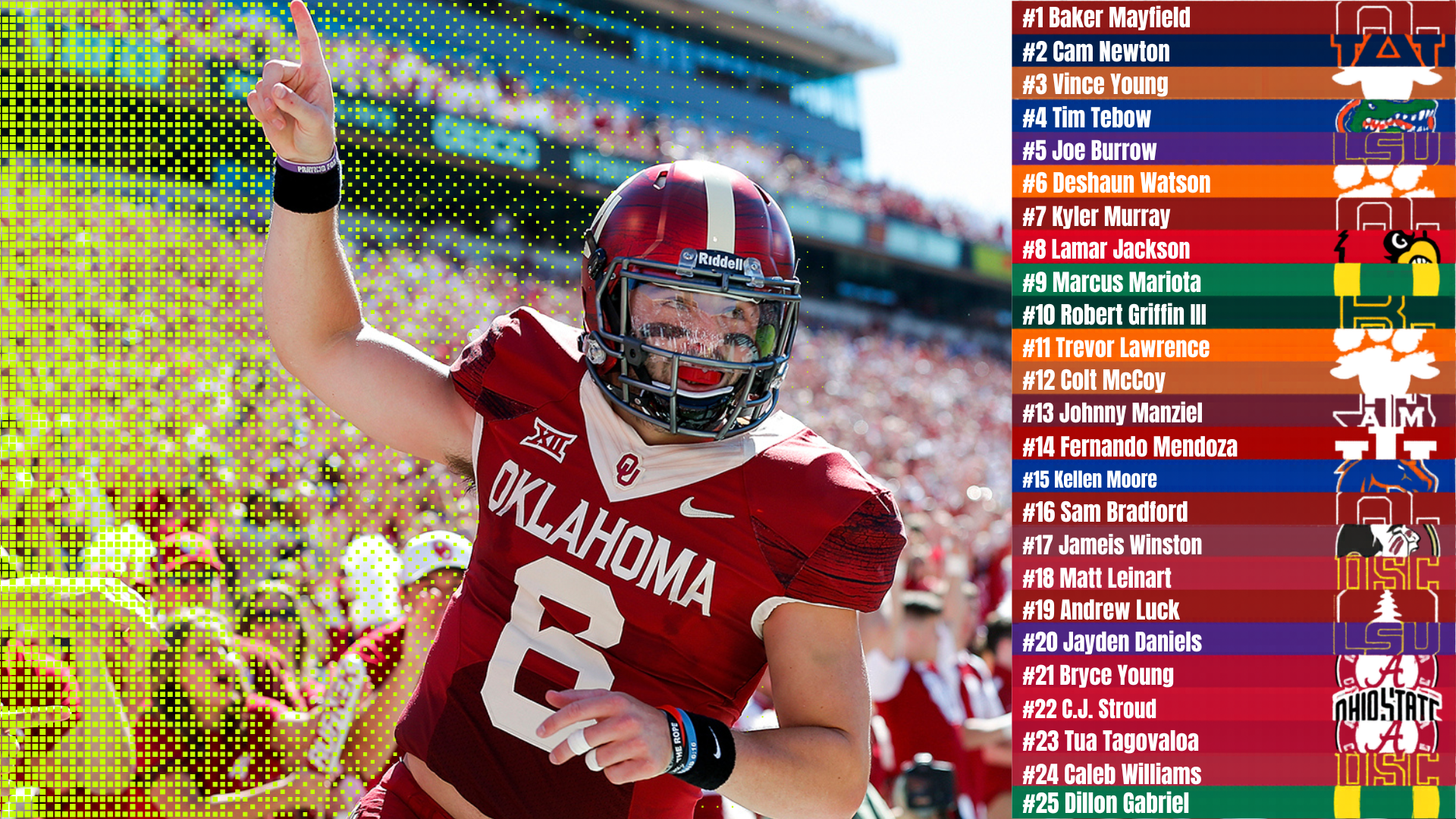
The image making the rounds on social media captures the top 50, and it is dense. Heisman trophies. National championships. One of the most improbable walk-on stories in college football history planted firmly at the top. Fifty names representing the full sweep of 21st-century college football — from Tim Tebow's faith-and-fury era at Florida to Bo Nix's five-year odyssey across three time zones. Every slot is a take waiting to happen. So let's take them.
The Kingmaker Case for Baker Mayfield
ESPN writer Bill Connelly put it simply when justifying the top spot: "Newton, Young and Burrow had the best seasons. Mayfield had the best career."
And he's right. What makes Mayfield's placement at No. 1 so defensible — and so maddening for everyone else's fan base — is that it's not based on one shining moment. It's the whole arc. It began with him walking on at Texas Tech, quickly winning the starting job and throwing for 413 yards in his debut. He lost his job to injury, then transferred to Oklahoma, where the Sooners hadn't won an outright conference title since 2010 — and he led them to three in a row, with three top-five finishes and two CFP bids.
His 2017 Heisman Trophy campaign capped a storybook run in which he accounted for 4,938 total yards and 48 touchdowns, and he remains the only original walk-on to win the Heisman Trophy. He finished his college career with 14,607 passing yards, a 69% completion rate, 131 touchdown passes and just 30 interceptions, adding 1,083 rushing yards and 21 rushing touchdowns.
The Baker Mayfield argument isn't about peak. It's about sustained, methodical, championship-caliber excellence across multiple seasons at a program he elevated — not inherited. When you're not a five-star, not a legacy recruit, and not handed a throne, every yard you earn means more. That's the Mayfield thesis. It holds.
The Top Five and the Takes That Come With Them
Cam Newton at No. 2 is correct and barely debatable. His 2010 season at Auburn was a category of its own — a 49-touchdown, 2,854-rushing-yard wrecking ball that broke football and somehow still lost the Heisman conversation for a moment before winning it by a landslide. He won a national championship. He was unstoppable. The argument for him at No. 1 is real. The argument for Mayfield just edges it.
Vince Young at No. 3 gives you the greatest single-game performance in BCS title game history: the 2006 Rose Bowl, 200 yards rushing, the walk-in touchdown to beat USC, and a moment so good it still lives rent-free in every college football fan's long-term memory. If the ranking were purely about one night, Young wins the whole thing.
Tim Tebow at No. 4 will infuriate people who have confused his NFL career with his college one. At Florida, the man was a menace — a two-time national champion, a Heisman winner, and the inventor of an entire offensive identity that the sport had never seen before and hasn't quite replicated since. He was singular. No. 4 feels correct.
And then there's Joe Burrow at No. 5, which might be the most underrated placement on the entire list. The 2019 LSU season Burrow authored was perhaps the greatest individual quarterback season in the history of college football — 60 touchdowns, 5,671 yards, a national championship, and a Heisman that wasn't even close. The fact that Connelly only counts career totals is the only reason Burrow isn't No. 1 on anyone's list who watched that team play.
The Names That Deserve More Attention
Scroll past the obvious legends and the list gets genuinely interesting.
Kellen Moore at No. 15 is a name that doesn't get the mainstream love it deserves. Boise State's record with Moore behind center was 50-3. The Broncos went 6-0 against power conference teams, and Moore was ruthlessly efficient for four straight years. Fifty and three. In any other market, that's a legendary story. In Boise, it's quietly one of the best sustained runs by any quarterback in college football history.
Lamar Jackson at No. 8 feels like it could be a conversation-ender. He won the Heisman at Louisville while practically doing it alone, in a conference that didn't know how to stop him and an offense that asked him to do everything. His college tape still doesn't look real. Eight feels low, honestly.
Robert Griffin III at No. 10 had one of the most absurdly efficient Heisman seasons in history at Baylor in 2011 — and he did it in the Big 12, which is not a place for the faint-hearted. The fact that he's behind a couple of names on this list is a reminder of how loaded this era truly was.
The Oklahoma Factor
You cannot look at this list without acknowledging what Norman, Oklahoma has meant to this era of college football quarterback play. According to Connelly's ranking, the Sooners lead all schools with eight signal-callers making the top 100 — a dominance that underscores OU's reputation as a quarterback factory, particularly under coaches Bob Stoops and Lincoln Riley.
Baker Mayfield (No. 1), Kyler Murray (No. 7), Sam Bradford (No. 16), Caleb Williams (No. 24), Dillon Gabriel (No. 25), Jalen Hurts (No. 29), Landry Jones (No. 46), Jason White (No. 39) — that's a murderer's row of talent that passed through one program. It's the kind of pipeline that makes every other program's fan base genuinely angry.
The Placement Arguments Worth Having
No list like this exists without controversy, and Connelly knows that going in. But a few spots deserve scrutiny.
Fernando Mendoza at No. 14 might raise eyebrows at first — until you remember that he won the Heisman at Indiana, threw 41 touchdown passes, and led the Hoosiers to their first national championship. That's not a stat line. That's a miracle wrapped in a box score.
Bo Nix at No. 30 lands in a spot that'll stir up Auburn fans and Oregon fans simultaneously. Nix's career was genuinely excellent — an all-time passing career that evolved dramatically from Auburn to Oregon, where he finally had the system and coaching to unlock his potential. Whether 30 is right probably depends entirely on which version of Bo Nix you watched most closely.
Jalen Hurts at No. 29 feels criminal. A two-program starter who led Alabama and Oklahoma, made three conference championship games, and played with a composure that made him look 35 years old his entire college career. Twenty-nine is not the right number.
What This List Is Actually Saying
At its core, Connelly's ranking is a document about the evolution of college football's most important position. In 2000, only 10 FBS quarterbacks threw for more than 3,000 yards. In 2025, 37 did — including five freshmen. The position has fundamentally changed, and the players on this list represent every phase of that transformation.
You've got the pre-spread giants like Vince Young and Cam Newton, who won with athleticism before the terminology caught up. You've got the Air Raid product Kellen Moore, who made efficiency an art form. You've got the modern era dual-threats like Lamar Jackson and Kyler Murray, who turned the position into something the NFL eventually had to redesign its defensive playbooks to handle.
The top 50 is also a clear message about what matters most in these debates: championships and consistency beat flash. Of the top 25 in the full list, there are 14 Heisman winners, 10 No. 1 picks, and 10 national champions. Peak matters, but it matters less when someone else was peaking for four straight years.
The Bigger Picture
Lists like this one matter because college football's history is fragmented across conferences, coaching trees, and eras in a way that makes apples-to-apples comparison genuinely hard. Connelly's methodology — career evaluation, completed college careers only, 2000s only — creates a framework that actually holds up. It's not perfect, but it's consistent, and consistency earns respect.
The real takeaway isn't whether Baker Mayfield or Joe Burrow deserves the top spot. It's that we've been living through one of the greatest eras of quarterback talent in the sport's history, and the list proves it. Trevor Lawrence, Justin Fields, Bryce Young, C.J. Stroud — players who would have been franchise cornerstones in any other decade are sitting in the 20s and 30s on this list. That's not a knock on them. That's a compliment to the company they're keeping.
College football has given us fifty names worth arguing about. That's the whole point. Pull up the list, text your most insufferable college football friend, and get to work.
The comment section is waiting for you.

Trusted By Programs Across The Country