One hundred and eleven days ago, confetti was still on the floor in Miami. One hundred and eleven days from today, we will be staring down the start of another college football season. That's the math. We are officially at the offseason's halfway point — the exact middle of the void — and somehow, the months without games may have been louder than the season itself.
Coaches got fired in October. Then got hired in November. Then the buyout lawyers got rich. LSU emptied a vault. Michigan poached a future Hall of Famer. Penn State watched its recruiting class get shoplifted by the guy they just paid to leave. A Big 12 favorite lost its quarterback to a gambling investigation. Indiana — yes, Indiana — built the best offseason in the sport while still drinking from the national title trophy. Bill Belichick's NFL-coach-to-college experiment in Chapel Hill collapsed faster than a card table at a tailgate. And somewhere in Texas, Arch Manning's foot got more headlines than most starting quarterbacks.
Take a breath. We are not even to summer yet.
The carousel that ate the calendar
Thirty-two head coaching jobs opened. Seventeen of them at the Power Four level. Six in the SEC alone. Over the last three cycles, 93 of the 136 FBS programs have changed head coaches — that is not a sport with a coaching carousel anymore, that is a sport that is the carousel. Three coaches who led teams to the College Football Playoff last fall took different jobs before the snow melted. If you mapped this carousel on a whiteboard, it would look less like a sport and more like a corporate restructuring chart drawn by someone with anger issues.
The defining domino, the one that knocked over half the league, was LSU. Brian Kelly was fired on October 26 after a 49–25 home loss to Texas A&M dropped the Tigers to 5–3 and ended any realistic playoff conversation. The buyout — a reported $54 million — became a Louisiana political event, complete with Governor Jeff Landry publicly objecting and the school paying it anyway. Kelly is on television now, which feels like the calmest possible ending to a tenure that never quite landed the punch the program demanded. He went 34–14 in Baton Rouge with zero playoff appearances. In modern LSU math, that is a firing offense before lunch.
Lane Kiffin's $40 million Manhattan Project
LSU's reset target was never a secret. Lane Kiffin spent five years turning Ole Miss into a top-shelf program and the Rebels' first ever national semifinalist, then walked out of Oxford mid-playoff run to take the LSU job. The exit was messy. The hire was inevitable. Kiffin signed a seven-year, $13 million-per-year deal, the second-richest contract in the sport, and immediately began spending like a man who plans to use every dollar before the next audit.
According to Kelly himself — who, having been fired by LSU, has approximately zero reason to undersell what came next — Kiffin's 2026 roster is over $40 million. That is not a typo and that is not the program. That is one team's roster. He landed the No. 1 transfer portal class, headlined by former Arizona State quarterback Sam Leavitt, plus the top-rated offensive lineman and the top-rated edge rusher in the portal. Forty-plus transfers in total. The first thing Kiffin has to do is win games. The second, and possibly harder, thing is to get 40 strangers to play like teammates by Labor Day.
Kiffin's buyout in his new contract is reportedly $73 million — bigger than Kelly's was — which, given LSU's track record, is less of a contract clause and more of a long-term liability disclosure. Paul Finebaum has already promised that if LSU misses the playoff, Kiffin tops his overrated coaches list. The over/under on Finebaum saying that on air this season is set at "already happened."
Michigan finds an adult
Then there's Michigan. The Wolverines fired Sherrone Moore in December for cause amid a personal scandal that has now spilled into the criminal courts — Moore is facing felony home invasion and stalking charges. Athletic director Warde Manuel, himself reportedly on the warm seat, somehow landed exactly the kind of grown-up the program needed. Kyle Whittingham — 177 wins at Utah, a perfect 13–0 season on his résumé, a clean reputation in a department that has been anything but — left Salt Lake mid-bowl-prep, took a five-year, $8.2 million-a-year deal, and started filling out a staff with BYU's Jay Hill as defensive coordinator.
It is, transparently, a short-term hire dressed up as a long-term answer. Whittingham is 66. He spent over three decades at Utah and could have ridden into the sunset with the program's defensive coordinator Morgan Scalley ready to take over. Instead he chose Ann Arbor, a school in the middle of an external review of its own athletic department, with no permanent university president, with an AD under fire. That is either a complete misread of the moment or a deeply confident move from a guy who is done being patient. The early read is the second one.
His job in 2026 is simpler than it looks: keep five-star sophomore quarterback Bryce Underwood healthy, keep the building quiet, and beat Ohio State once. Underwood, as a true freshman, accounted for more than 2,500 total yards and 14 touchdowns. He is the most important non-Manning, non-Carr quarterback in the sport.
James Franklin's Blacksburg heist
And in the offseason's most unexpected plot twist, James Franklin landed in Blacksburg. Penn State fired him in mid-October after the Nittany Lions started 0–3 in Big Ten play and dropped two straight as 20-point favorites — the first team to do that since 1978. Penn State had finally invested at the level Franklin demanded, the team had reached the College Football Playoff semifinals the previous season, and the floor still fell out in six weeks.
The original buyout was a reported $49 million, the second-largest in college athletics history at the time. Franklin signed at Virginia Tech 30 days later, and because of offset language baked into his Penn State deal, the Nittany Lions only owed him $9 million on the way out. The Hokies got an A-list coach for ACC pricing, on the back of a Board of Visitors decision to pump $229 million more into athletics over four years. Whit Babcock called Franklin a "dynamic leader and relentless recruiter." Within 72 hours of his introductory press conference, Franklin proved both halves of that sentence.
Then, in the kind of cold-blooded sequence that defines this sport now, Franklin flipped 11 of his old Penn State commits to Virginia Tech in two weeks. Quarterback Troy Huhn. Running back Messiah Mickens. ESPN 300 receivers and defenders he had recruited for years under a different shield. In total, 17 commits in 12 days. Penn State's 2026 class disintegrated. The Hokies' class went from unranked to 21st nationally. Re-Established 2026, the marketing material says. The recruiting board agrees.
Penn State, meanwhile, watched the building Franklin built collapse in front of a 58-day coaching search. They reportedly missed on Matt Rhule and Curt Cignetti — both got raises to stay put — before eventually landing Matt Campbell out of Iowa State. Campbell is a great coach. He is also being asked to rebuild a roster while his predecessor scoops out the foundation from 367 miles away. Different cast, same play, worse setting.
The Belichick experiment in Chapel Hill
Don't sleep on the slow-motion disaster at North Carolina. Bill Belichick's college experiment — pitched as a transformation, marketed as a once-in-a-lifetime story, covered as much for the Hudson narrative as the football — has, by every available report, fizzled fast. The hype that landed Belichick in Chapel Hill has not translated to recruiting wins, roster cohesion, or any of the obvious indicators that the operation is humming. The pressure on Year 1 from a guy who has won six Super Bowls is its own kind of trap. It is going to be one of the most fascinating watches of the season for reasons that have nothing to do with X's and O's.
The Sorsby bombshell
If LSU was the headline of the early offseason, Texas Tech was the headline of the late one — and not the way Joey McGuire wanted. Brendan Sorsby, the $5 million-plus transfer the Red Raiders pried from Cincinnati to chase a Big 12 repeat and a deeper playoff run, took an indefinite leave from the program in late April to enter inpatient treatment for a gambling addiction.
The NCAA opened an investigation into thousands of online bets allegedly placed through a sportsbook app. According to multiple reports, those bets included wagers on collegiate sporting events during Sorsby's time at Indiana in 2022, as well as on professional baseball and UFC. The NCAA's 2023 enforcement guidelines call for permanent loss of eligibility for any athlete betting on their own school or other sports at their school. The compliance phrase is "zero tolerance." The math is not subtle.
Sorsby has hired Jeffrey Kessler — the same attorney who beat the NCAA in House v. NCAA — to negotiate a resolution or, failing that, fight it in court. There is also chatter, depending on the source, of a Texas state court injunction route if negotiation fails. The smart money still says Sorsby is unlikely to suit up in 2026. Sorsby threw for 2,800 yards and 27 touchdowns at Cincinnati last season, added nine rushing scores, and was being projected as a potential Day 2 NFL pick before his name landed in the headlines for the wrong reason.
Backup Will Hammond is working back from a knee injury and is not expected to be ready for Week 1, which leaves Tech reaching for a third option for a team that, on paper, was a dark-horse national title contender. The Red Raiders also lost a school-record six NFL Draft picks from their defensive front. The schedule remains favorable enough that Lubbock could still win the Big 12. The vibes do not.
Indiana keeps printing
The reigning national champions did not get bored. ESPN ranked Indiana's offseason as the best in the entire Power Four — ahead of Miami, Texas, Oregon, and LSU. That is not a typo and that is not a regional bias. Curt Cignetti held his entire staff together, including Broyles Award–winning defensive coordinator Bryant Haines, replacing only his quarterbacks coach (Chandler Whitmer, returning to the NFL) with Tino Sunseri, a familiar face from the 2024 staff.
On the field, Cignetti replaced departed starter Fernando Mendoza with TCU transfer Josh Hoover, added receiver Nick Marsh and edge Tobi Osunsanmi, and reloaded the defensive front with true freshman linemen — Gabriel Hill, Cameron McHaney, Kevontay Hugan — who already look ready. The Hoosiers lost cornerback D'Angelo Ponds, receiver Omar Cooper Jr., and a few key reserves to the portal, but kept the bones of a national championship roster intact. They are not coasting on a banner. They are recruiting like a program that intends to be in the playoff every January from now on. Whether the rest of the Big Ten cares to let that happen is the next question.
The supporting cast
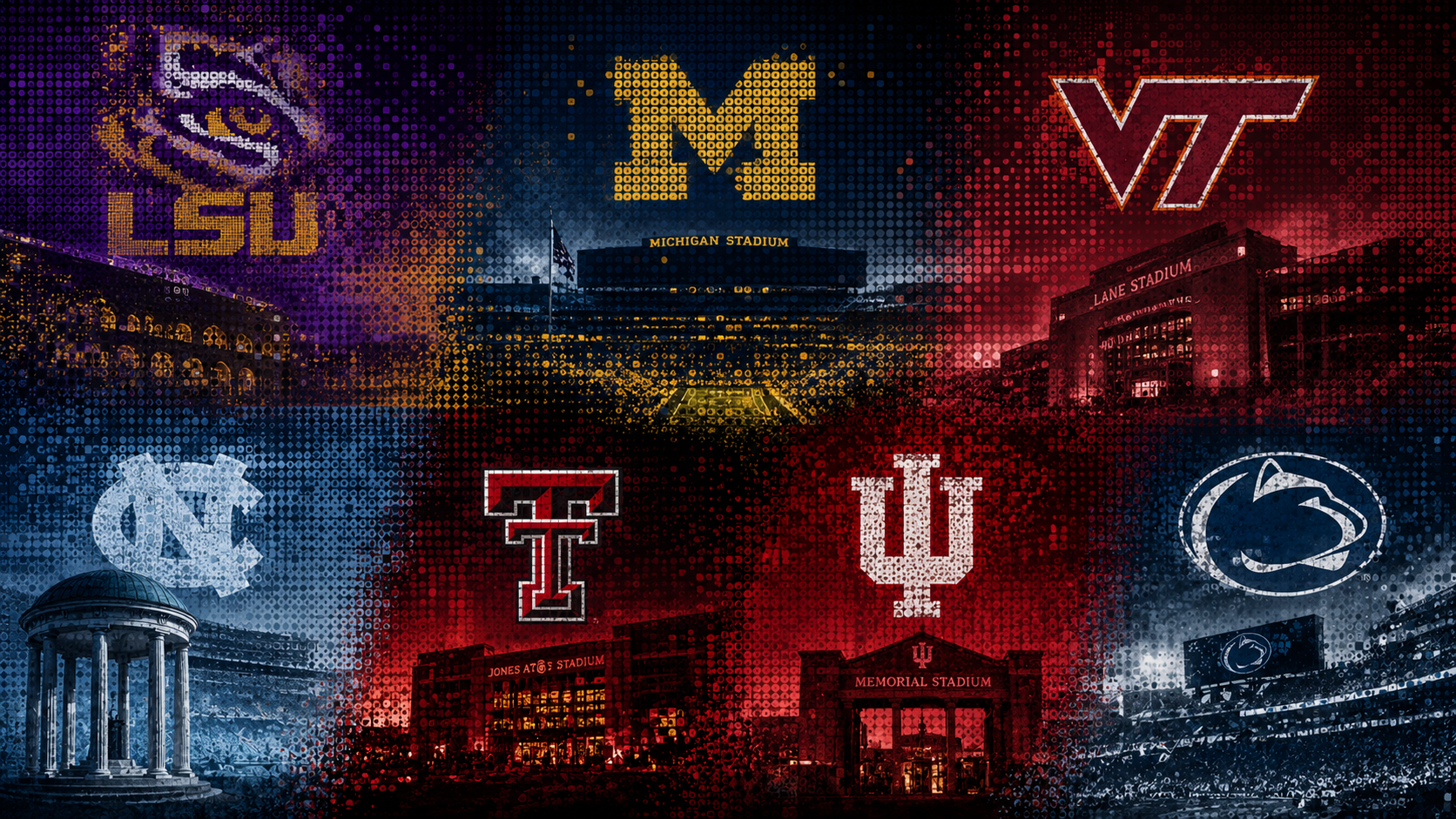
The headlines belonged to LSU, Michigan, Virginia Tech, Texas Tech, and Indiana. The rest of the country did not sit quietly.
Pete Golding inherits Ole Miss after Kiffin's exit and pulled the No. 2 transfer portal class. The bigger win was a local judge granting quarterback Trinidad Chambliss a sixth year of eligibility in February. The Rebels also return star running back Kewan Lacy. Year 1 under Golding starts with a real roster.
Alabama is still figuring out its quarterback room. Keelon Russell appears to have the edge over Austin Mack, and confidence in Kalen DeBoer's third year took a hit when NC State transfer Hollywood Smothers flipped his commitment to Texas. Texas A&M's defense, by all spring accounts, looked elite, with Northwestern transfer Anto Saka described as "unblockable" by Aggie staffers — though senior captain linebacker Daymion Sanford suffered a spring-game leg injury that may cost him part of the season.
USC enters Year 5 under Lincoln Riley with what may be his best roster in Los Angeles, anchored by Maiava and a wave of incoming receivers. The Trojans still have zero playoff appearances on Riley's résumé in LA. That ends or it doesn't, and Riley's seat will be evaluated accordingly.
Tennessee under Joey Halzle, Oregon's reload around what Dan Lanning has built, Notre Dame returning a defense that may be the best unit in the sport, Ohio State as the consensus preseason No. 1 — none of those programs blinked, and most of them got better.
What's still pending
This is the part of the offseason where the story isn't done. A few threads still hanging:
- Sorsby's ruling. The NCAA gambling decision will land before fall camp, and it shapes the entire Big 12 race. Watch for Kessler vs. NCAA to escalate to a Texas courtroom and become the next House-level legal fight.
- Arch Manning's recovery. Texas's Heisman favorite was limited this spring after offseason foot surgery and held out of a live scrimmage. Sarkisian says he's good to go. The Longhorns' Week 2 home game against Ohio State will tell us the truth, and may decide the entire season.
- Chemistry experiments. LSU is blending 40-plus transfers. Ole Miss is asking Trinidad Chambliss to lead a roster Pete Golding mostly inherited. Michigan is installing an entirely new staff. Penn State is starting over under Campbell. None of these clocks slow down between now and August.
- The Sorsby ripple at quarterback elsewhere. A supplemental draft has not happened since 2019. Don't be shocked if the conversation around one quietly returns. Sorsby could also pursue non-NCAA football if the NCAA hammer comes down.
- Spring transfer fallout. Sophomore portal entries, decommitments, and revenue-share recalculations will run all summer. The roster you see in August will not be the roster anyone projected in April. That is now a fact of the sport, not a footnote.
- The buyout reckoning. Between Kelly, Franklin, Moore, and the rest, programs paid out close to $200 million this cycle to coaches not to coach. Athletic directors are quietly redesigning contracts with revenue-sharing in mind. The next coach fired will not be the last to test what "offset language" really means.
The closing take
Eleven months ago, the loudest argument in the sport was whether the 12-team Playoff was too big. Now the loudest argument is whether $40 million for one roster is too much, whether a $73 million buyout is too brave or too dumb, whether the NCAA can actually enforce its own gambling rules, and whether the gentlemen's-agreement era of college football was just a memory we made up to feel better about ourselves. The answer, mostly, is yes.
Coaches are mercenaries. Players are free agents. Recruits flip in 48 hours when a logo changes. Boosters operate like venture capital firms. Buyouts have offset language. And the NCAA, the body theoretically running the whole thing, hires an antitrust attorney with one of its own star quarterbacks. It is messier than it used to be, and it is more fun than it has been in a decade. Both things are true.
One hundred and eleven days down. One hundred and eleven days to go. The games will get here. The chaos already did.

Trusted By Programs Across The Country