The Sport That Makes Its Own Mythology
College football doesn't need a screenwriter. It doesn't need a mythology department or a PR team spinning tales of destiny and irony. The sport generates its own lore at a pace that would embarrass any fiction writer — strange, specific, verifiable facts that somehow exist at the intersection of history, coincidence, and pure chaos.
You want proof? Oklahoma was playing football 12 years before Oklahoma was even a state. A Michigan State defensive back broke his hip scoring the most improbable game-winning touchdown in the sport's modern era. A Clemson quarterback-slash-outfielder set a record that will almost certainly never be broken, in two sports simultaneously, in the same academic year.
This is college football. The facts are the story.
Before There Was a State, There Were Sooners
Let's start with something that sounds impossible until you look at a calendar. Oklahoma football kicked off its first season in 1895. Oklahoma Territory wouldn't earn statehood until November 16, 1907 — a full 12 years later. That means the Sooners were suiting up, running plays, and competing as an organized program while their home turf was still a federal territory without voting representation in Congress.
In a sport obsessed with tradition and history, that's as foundational as it gets. Oklahoma didn't wait for a state seal or a Senate confirmation. They just played ball.
It's also a useful frame for understanding the OU program's DNA. A program that existed before the state itself has a certain stubbornness baked in — the kind that produces 47-game winning streaks, Heisman trophies, and a fanbase that treats autumn Saturdays like a civic obligation.
The 20-20 Nobody Saw Coming
In the 2009-10 academic year, Clemson's Kyle Parker set a record so specific and so complete that no one has come close to touching it in the decade-plus since. As the Tigers' starting quarterback, Parker threw for 20 touchdowns during the fall football season — helping Dabo Swinney's program to its first ACC Atlantic Division title and a top-25 finish. Then, that spring, he stepped into the batter's box for Clemson baseball and launched 20 home runs, leading the Tigers to the College World Series.
No Division I athlete in history had ever reached even a 20-15 combination of touchdown passes and home runs in the same academic year. Parker didn't just clear the bar — he set it at a height that made the previous attempts look like a warm-up.
When Colorado drafted him 26th overall in the 2010 MLB Draft and offered him $2.2 million to give up football immediately, Parker turned it down. He signed for less money — $1.4 million — just so he could play one more season at quarterback for the Tigers. That's either the most loyal thing an athlete has ever done for a college program, or the most unhinged financial decision in sports history. Probably both.
Parker remains the only player in NCAA Division I history with 20 passing touchdowns and 20 home runs in the same academic year. The record has been confirmed by Clemson's athletic department through research spanning every Division I program in the country. It stands alone.
Jalen Watts-Jackson: The Price of Glory
The 2015 Michigan State-Michigan rivalry game produced what ESPN Sport Science later called the most improbable play in college football history. With the Spartans trailing 23-21 and time expiring, Michigan punter Blake O'Neill mishandled the snap. Jalen Watts-Jackson, a redshirt freshman defensive back playing almost exclusively on special teams, scooped up the loose ball and sprinted 38 yards into the end zone as the clock hit zero. Michigan State won 27-23. The stadium erupted. The Spartan Nation lost its collective mind.
Then Watts-Jackson didn't get up.
The celebration dogpile — teammates absolutely losing it on the maize "M" at midfield — landed directly on a player who had already fractured and dislocated his hip during the play itself. He was carted off the field and taken directly to the hospital. Surgery followed the next morning.
When he finally spoke to reporters from a wheelchair a few days later, he said he'd do it all over again. The play was named the No. 1 play in college football history by NFL.com shortly after it happened. It was also named the No. 1 play of the 2015 season at the ESPN College Football Awards. Watts-Jackson eventually recovered, played a few more seasons, and ultimately gave up football to join the United States Air Force — a career pivot that tells you everything you need to know about the kind of person he was all along.
Tannehill: The Only Player With Both
Ryan Tannehill played wide receiver at Texas A&M for two years before transitioning to quarterback midway through his junior season in 2010. In his first career start under center, he threw for a school-record 449 yards against Texas Tech. By his senior year, he was a consensus first-round NFL Draft prospect.
But here's the fact that doesn't get enough airtime: Tannehill is the only player in FBS history with both a 400-yard passing game and a 200-yard receiving game on his career résumé. He's also the only player in FBS history with more than 3,000 career passing yards and more than 1,500 career receiving yards. As a wide receiver earlier in his college career, he piled up 1,596 receiving yards and 10 touchdowns. Then he threw for 5,450 yards and 42 touchdowns as a quarterback.
The 8th overall pick of the 2012 NFL Draft spent years as a capable-but-underrated starter in Miami before a trade to Tennessee turned him into a Pro Bowl quarterback and a legitimate MVP candidate in 2019. The narrative arc of his career mirrors the strangeness of his college stats — understated until suddenly, undeniably, impossible to ignore.
Baylor Had Two Robert Griffins Drafted the Same Year
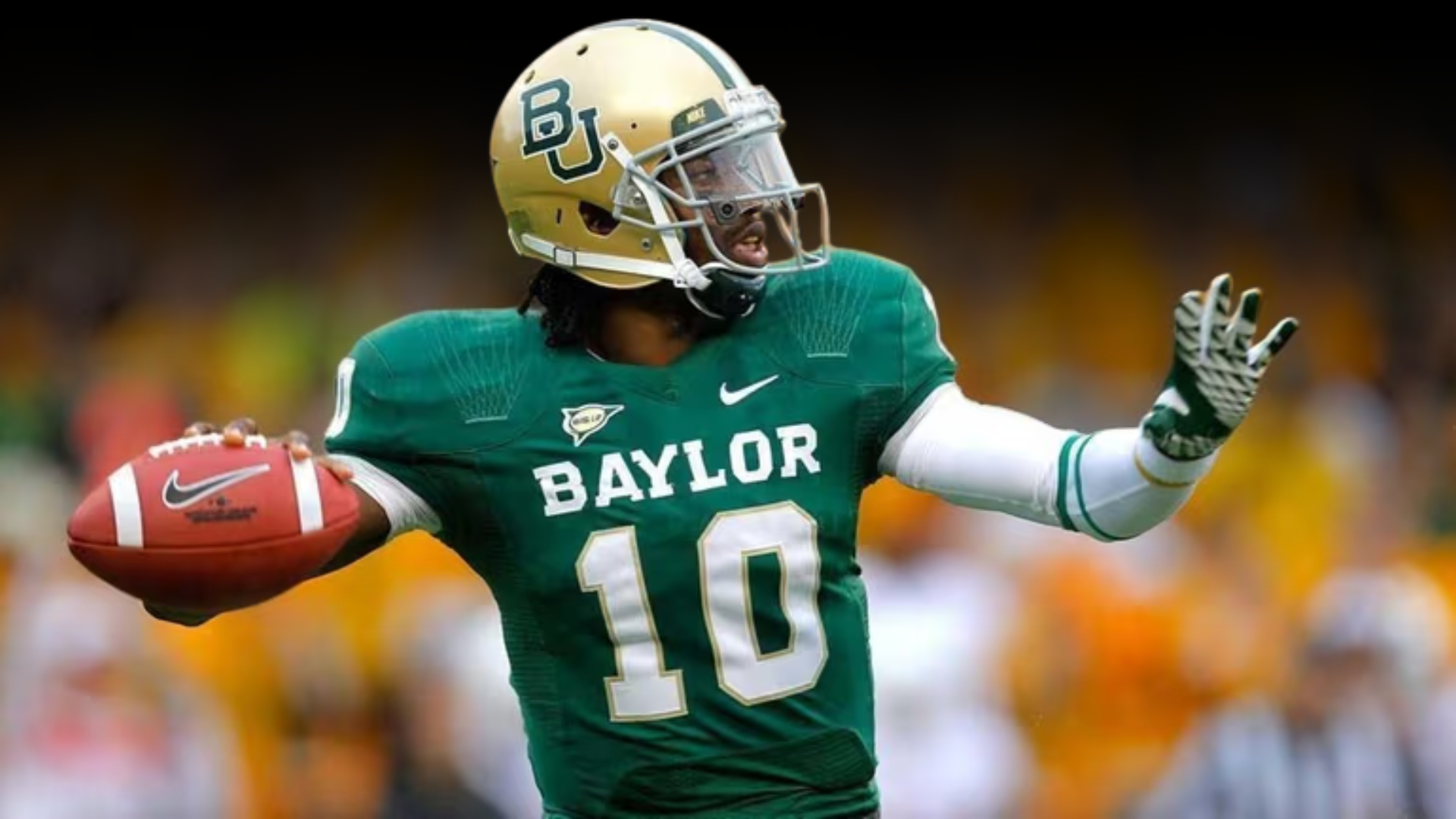
In the 2012 NFL Draft, the Washington Redskins used the second overall pick on Baylor quarterback Robert Griffin III. In that same draft, another player from Baylor — an offensive lineman named Robert Griffin — was also selected. Same school, same draft, same name. The offensive lineman wore No. 79, while RG3 wore No. 10. Both Griffins, both Bears, both drafted in 2012.
It is the kind of coincidence that makes you wonder if the universe has a sense of humor and simply forgot to tell us.
Oberlin College Beat Ohio State. In 1921.
The last in-state school to beat Ohio State wasn't Cincinnati. It wasn't Toledo. It wasn't Akron or Bowling Green or any program that currently occupies a respectable place in college football's power structure. It was Oberlin College — a small liberal arts school in north-central Ohio — who knocked off the Buckeyes 7-6 in October 1921. The headline from a local paper that day read "OBERLIN BEATS STATE BY 7-6 SCORE."
More than a century has passed since any Ohio school repeated the feat. The Buckeyes have since gone on to produce Heisman Trophy winners, national championships, and more NFL first-round picks than most programs produce starters, but Oberlin got theirs first — and they still have it.
Nebraska QBs: A Curious Naming Convention
From 2001 to 2009, every single Nebraska quarterback who started Game 1 of the season was named Martinez, Lee, or Armstrong. Not just one or two of those names — all of them, rotating through that three-name cycle across nine consecutive seasons. Nebraska football has always had its own mythology, built on sellout streaks and tunnel walks and a fanbase that treats the program like a civic institution. But the notion that the same three surnames cycled through the QB depth chart for nearly a decade? That's not tradition — that's fate doing paperwork.
Urban Meyer and Jim Harbaugh: Toledo Origin Story
Urban Meyer was born on July 10, 1964. Jim Harbaugh was born on December 23, 1963. The gap between them is roughly 200 days. They were born in the same hospital in Toledo, Ohio. The two coaches who defined the Ohio State-Michigan rivalry for a full decade — who spent years locked in one of the most personally intense coaching rivalries in the sport — entered the world within months of each other, in the same building, in the same city.
Neither of them grew up to be from Toledo in any meaningful cultural sense. But Toledo made them both. The city that birthed two of college football's defining figures of the 2010s deserves at least a small bronze plaque somewhere in a hospital hallway.
Todd Gurley Threw the Ball
In 2014, Georgia's longest completed pass of the season — 50 yards — wasn't thrown by the Bulldogs' starting quarterback. It was thrown by running back Todd Gurley, who at the time was one of the best ball-carriers in the entire country and would eventually become a first-round NFL pick. Whatever opposing defense was in the secondary that day, they have a story nobody else in college football can claim: they got burned by a running back for 50 yards.
Why This All Matters
These facts don't require embellishment. They don't need a dramatic voiceover or a slow-motion replay to land. The sport's history is dense enough, strange enough, and specific enough that the truth is funnier and more compelling than anything manufactured.
College football works because of the specificity of its geography, the weight of its traditions, and the relentless human drama that emerges from 18-to-22-year-olds playing the biggest games of their lives in front of 100,000 people. Kyle Parker said no to $2.2 million to play one more season. Jalen Watts-Jackson said he'd do it again from a wheelchair. Urban Meyer and Jim Harbaugh came from the same hospital hallway before spending their careers trying to destroy each other.
You genuinely cannot make this sport up. And you don't have to.

Trusted By Programs Across The Country