There's a moment every offseason when college football fans stop celebrating who left and start asking who's next. Draft night is electric. The confetti, the handshakes, the suits. But once the weekend ends, the real work begins — for coaches, for rosters, and for the next wave of players who've been waiting in the shadows.
This year's 2026 NFL Draft was stacked. First-round offensive tackles, Heisman-winning quarterbacks, elite edge rushers, and shutdown defensive backs all heard their names called early. Every departure is both a celebration and a problem. And across the country, programs are staring down some serious voids that need to be filled before Labor Day weekend arrives.
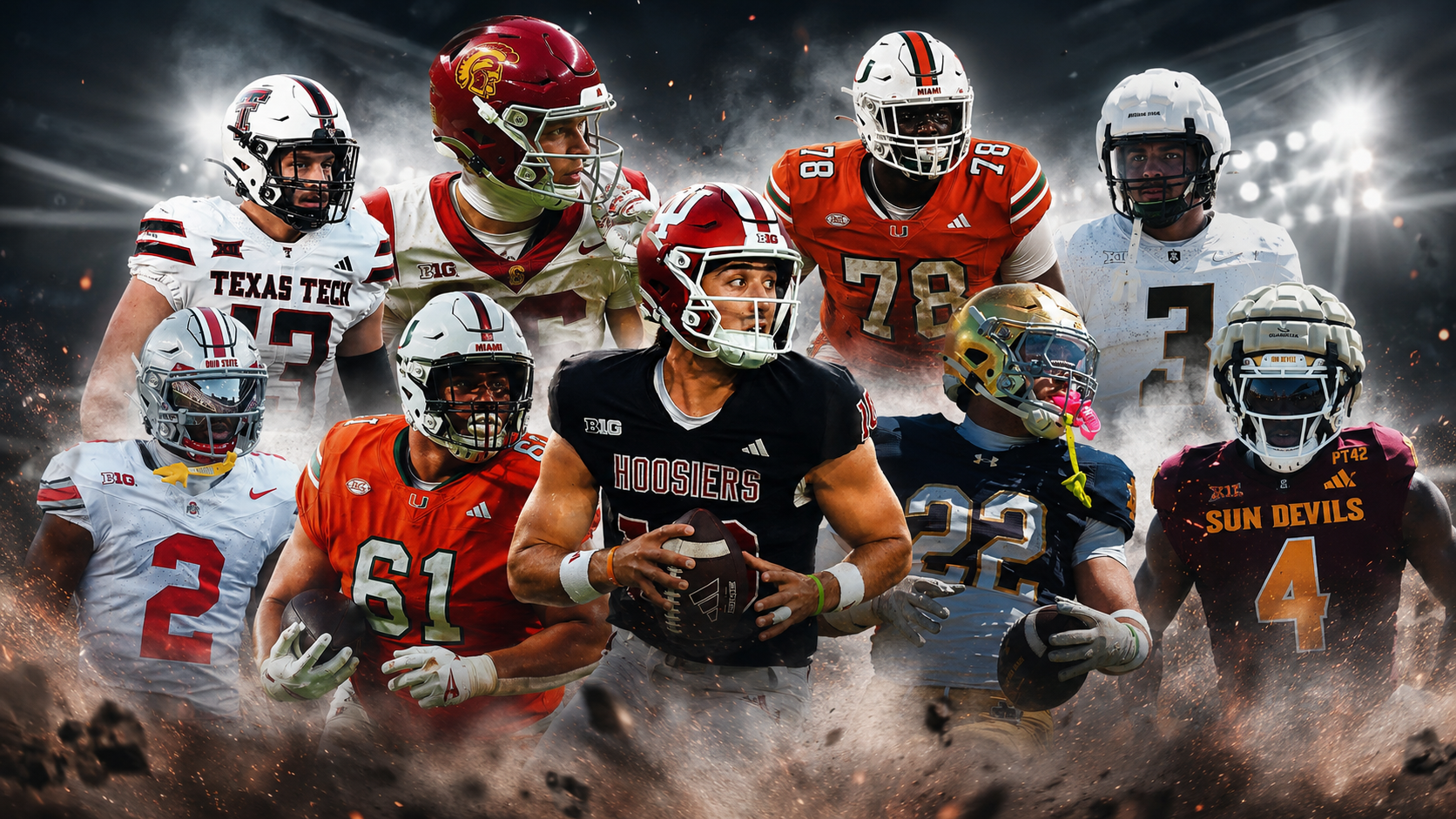
Here's a look at nine players tasked with replacing some of last season's biggest college football names — and why, in several cases, the case for optimism is stronger than you might think.
Josh Hoover, QB — Indiana Hoosiers
Replacing: QB Fernando Mendoza
Replacing a Heisman Trophy winner who went No. 1 overall in the NFL Draft is the kind of task that sends offensive coordinators to therapy. Fernando Mendoza's 2025 season at Indiana was one of the great single-year performances in college football history — a former two-star recruit who turned Bloomington into a national title contender. Now Josh Hoover walks into Memorial Stadium and has to somehow keep that engine running.
The transfer from TCU isn't a stranger to impossible predecessor situations. At Fort Worth, he took over for Heisman finalist Max Duggan, delivered two strong seasons, and broke the Horned Frogs' single-season passing record. His most recent campaign produced 3,472 yards and 29 touchdowns despite being asked to do far too much in a thin supporting cast. The decision-making concerns are real — he threw 24 interceptions over his final two seasons — but that's precisely where Indiana's coaching staff comes in.
Mike Shanahan's offense turned Mendoza's interception rate from a concerning 4.1% down to 1.7%. If Shanahan can work that same magic on Hoover, the Hoosiers could have a genuine Heisman candidate. Add the fact that receivers Charlie Becker and Nick Marsh are already being discussed as potential first-round picks in 2027, and Hoover is walking into the best supporting cast of his college career. The kid from Rockwall-Heath didn't come to Indiana to maintain the standard. He came to raise it.
Damon Wilson III, EDGE — Miami Hurricanes
Replacing: EDGE Rueben Bain Jr.
Miami's 2025 national runner-up run was built on one of the most terrifying defensive fronts in recent college football memory. Rueben Bain Jr. and Akheem Mesidor combined for 22 sacks and 33 tackles for loss as the Hurricanes steamrolled through the ACC. Both are now NFL Draft picks. Both are gone. That's a problem.
Enter Damon Wilson III, a former five-star recruit who made stops at Georgia and Missouri before landing in Coral Gables. His lone season with the Tigers was a statement: nine sacks and 54 quarterback pressures — numbers that ranked third in the SEC and tied for 10th nationally, per Pro Football Focus. He's 6-foot-4, 250 pounds, he's already been under the tutelage of elite programs, and Mario Cristobal secured him over LSU and Texas Tech. This wasn't a desperation move. This was a calculated upgrade.
Wilson will line up alongside returning Hurricanes edge Marquise Lightfoot, who quietly put together a solid 2025 season with 5.5 tackles for loss and a clutch play in the Cotton Bowl. Mario Cristobal's staff developed Bain and Mesidor into first-rounders. If the track record means anything, Damon Wilson III is about to have the season of his career.
Aneyas Williams, RB — Notre Dame Fighting Irish
Replacing: RB Jeremiyah Love
Nobody is replacing Jeremiyah Love. The Arizona Cardinals made that crystal clear when they took him No. 3 overall. His running mate Jadarian Price went late in the first round too, making Notre Dame the first program to have two backs selected at that level simultaneously. Marcus Freeman said it plainly: you don't replace Love with one guy. You replace him with a system.
Aneyas Williams has been patiently waiting for this exact opportunity. The junior from Hannibal, Missouri averaged 9.3 yards per carry last season on limited touches — a backfield where being third string meant standing behind two eventual first-round picks. When Love went down in the Stanford game last year, Williams stepped in and delivered two touchdowns. That's not luck. That's a player who's been ready.
Offensive coordinator Mike Denbrock has been direct about what Williams brings: every time he's gotten the ball, something positive has happened. Williams himself made his intentions clear this spring, playing through a limited situation and competing as though the starting job was something to be earned, not handed. With CJ Carr returning at quarterback and one of college football's better offensive lines in front of him, Williams inherits a situation built for a running back to thrive. Notre Dame doesn't need him to be Jeremiyah Love. They need him to be exactly who he's always been.
Ben Roberts, LB — Texas Tech Red Raiders
Replacing: LB Jacob Rodriguez
Jacob Rodriguez was arguably the best defensive player in college football last year. He was the engine, the communicator, the quarterback of Texas Tech's Big 12 championship defense — the kind of presence that masked everyone else around him. Ben Roberts was that everyone else, and he's been waiting for his moment in the spotlight.
The stats are there. Roberts finished second on the team last season with 90 tackles, matched Rodriguez with four interceptions, and added five pass breakups, three quarterback pressures, and two forced fumbles. The knock was always that Rodriguez was eating up the recognition for the unit's excellence. Now, with Rodriguez gone, Roberts gets to own the room.
Texas Tech also added linebacker Austin Romaine from Kansas State and edge Trey White from San Diego State to rebuild the defensive rotation. But Roberts is the one analysts are watching. One national scout put him in the conversation for first-team All-America honors in 2026 — a dark horse candidate who's been playing elite football in someone else's shadow.
Terry Moore, S — Ohio State Buckeyes
Replacing: S Caleb Downs
Caleb Downs was a two-time First-Team All-American who played like a defensive coordinator on the field. No one is replacing that in year one. But Ohio State went out and found the best available option — and Terry Moore's story is genuinely compelling.
The Duke transfer starred as a dual-threat running back in high school before converting to safety. In 2024, he recorded 71 tackles, 7.0 tackles for loss, four interceptions, and two forced fumbles — a performance that earned him second-team All-ACC and second-team All-America recognition from multiple outlets. Then he tore his ACL in Duke's bowl game. He missed all of 2025, took a medical redshirt, and transferred to Ohio State specifically to compete with Ryan Day's program for one final season.
The health is the only real question. Reports from spring practice indicate Moore shed his black stripe, fought through competition with redshirt sophomore Leroy Roker III, and eventually earned the starting nod by the spring game. His combination of range, physicality, and ball skills makes him the ideal profile for what Ohio State's defense asks of its safeties. If he comes back at full strength, the Buckeyes may have quietly landed one of the best portal steals in the country.
Omarion Miller, WR — Arizona State Sun Devils
Replacing: WR Jordyn Tyson
Jordyn Tyson's departure created the biggest skill position hole in the Big 12. The two-time All-Big 12 receiver accounted for 44% of Arizona State's wide receiver yardage and 62% of their receiving touchdowns over two seasons. That's not a player. That's a system. And Kenny Dillingham went to the transfer portal and found the closest thing available.
Omarion Miller arrives from Colorado with 66 career receptions for 1,258 yards and 10 touchdowns — including an 808-yard, eight-touchdown sophomore campaign that earned him second-team All-Big 12 honors last season. At 6-foot-2 and 210 pounds, with a conference-leading 18 yards per catch in 2025, he profiles similarly to Tyson in versatility, size, and the ability to win at all three levels of the field.
The parallel between these two players is almost eerie — both arrived at Arizona State via transfer from Colorado, both carried first-round draft buzz, and both were charged with transforming a program's passing game. Miller has openly said his goal is to outperform Tyson's draft stock. That level of healthy competition is exactly what a program trying to stay relevant in the Big 12 needs. With Athlon Sports already naming him to their 2026 All-Big 12 team, the expectations are locked in.
Tanook Hines, WR — USC Trojans
Replacing: WR Makai Lemon
Makai Lemon won the Biletnikoff Award and went in the first round. Ja'Kobi Lane added 16 touchdowns across two seasons and also heard his name called. USC's entire top two receivers disappeared into the NFL Draft in a single offseason. What's left? Tanook Hines, a true sophomore from Houston who quietly put together one of the better freshman receiving seasons in the country despite being listed third on the depth chart all year.
Hines caught 34 passes for 561 yards and two touchdowns in 2025. In the Alamo Bowl — with both Lemon and Lane opting out — he went off for 163 yards on six receptions against TCU and was, in Lincoln Riley's own words, nearly unguardable. Riley has spent the offseason pointing to Hines as the example of what every young receiver in the room can become.
ESPN ranked him the seventh most irreplaceable non-quarterback in the Big Ten heading into 2026. He's the only returning USC receiver with more than 22 receptions from last season's entire roster. That's a lot of empty target share, and Hines already has built-in chemistry with quarterback Jayden Maiava. The Trojans don't just need Hines to step up — their entire offensive ceiling depends on it.
Koi Perich, S — Oregon Ducks
Replacing: S Dillon Thieneman
Oregon has now done this back-to-back. Last offseason they pulled Dillon Thieneman from Purdue, handed him a starting job, and watched him become a First-Team All-American and a first-round pick — selected 25th overall by the Chicago Bears. This offseason, they went back to the Big Ten portal and found Koi Perich from Minnesota, who comes with a nearly identical profile and identical ambition.
Perich was the top-rated safety in the entire transfer portal cycle. He played 128 tackles, six interceptions, two forced fumbles, and a sack across two seasons at Minnesota, and is a legitimate special teams weapon — 813 career kick return yards with a 23.2-yard average. Dan Lanning made the parallel between Perich and Thieneman explicit at his first spring media session: film-obsessed, process-driven, football-first.
Perich was blunt about why he chose Oregon: he wanted to compete for a national championship and raise his draft stock. Oregon has been in the College Football Playoff every season under Lanning. The program is a proven pipeline. If Perich can replicate Thieneman's trajectory, the Ducks will have pulled off the same trick twice in a row — and college football will officially need to start watching Autzen Stadium's secondary the way they watch the offensive side of the ball.
Matthew McCoy, OT — Miami Hurricanes
Replacing: OT Francis Mauigoa
Francis Mauigoa was selected 10th overall by the New York Giants. Let that number sink in. He was a consensus All-American, the winner of the ACC's Jacobs Blocking Trophy, and the anchor of an offensive line that powered Miami's run to the national title game. McCoy has been alongside him for three years, starting at left guard in both 2024 and 2025, learning from one of the better offensive line rooms in the country under Mario Cristobal's staff.
The five-year starter isn't inheriting a position from across the country — he's moving laterally within the same building, from guard to tackle. Per ESPN's Andrea Adelson, McCoy is the projected starter at right tackle heading into 2026. He was a four-star recruit who drew offers from Florida, Florida State, and Missouri, and has developed steadily while anchoring a line that ranked fifth nationally in blocking grade during Miami's playoff run.
The transition from interior guard to edge protector carries inherent uncertainty. But McCoy has the benefit of continuity in the system, familiarity with the scheme, and a coaching staff that has consistently developed offensive linemen into NFL players. He won't be Mauigoa. But after three years in the same room with him, he might be better prepared than anyone to fill those shoes.
The Bigger Picture
What these nine players share isn't a guarantee — it's readiness. Each of them has spent months or years preparing for an opportunity that looked impossible to grab because someone better was in the way. College football rewards patience about as often as it rewards talent, and right now, across nine programs and multiple conferences, there's a group of players who've done both the waiting and the work.
The 2026 season will tell us everything. By January, some of these names will be household. Others will have fallen short of the billing. But that's the thing about the next man up: the job was never about replication. It was always about becoming something new.
The shoes are empty. The stage is set. Now go earn it.

Trusted By Programs Across The Country