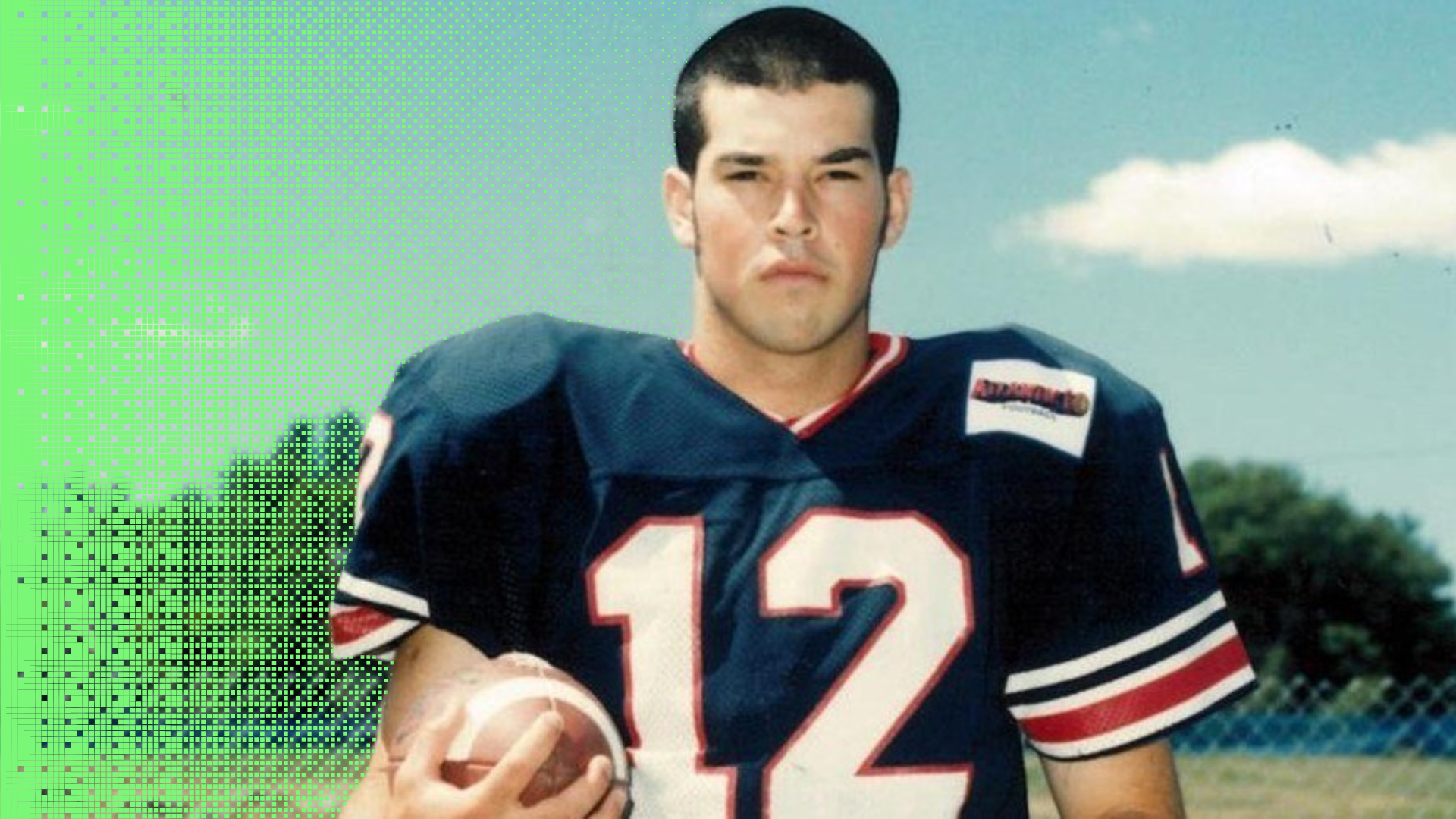
Every head coach in the Big Ten has a biography that starts with wins and losses, bowl games and championships, the recruiting classes and the press conferences. But before any of that, every one of them had a different kind of biography — one written in shoulder pads. These were players first. Some were legitimate studs. Some were role players grinding for four years on a roster that barely noticed them. A few never even got a photo taken. All of it matters, because you can draw a straight line from who they were on the field to the programs they run today.
Here's who they were before the headsets.
Ryan Day — Quarterback/Linebacker, New Hampshire (1998–2001)
Before Ryan Day became the Ohio State head coach who delivered the Buckeyes their first national championship since 2014, he was a dual-role player at the University of New Hampshire — lining up at both quarterback and linebacker for the Wildcats at the FCS level. That's not a footnote. That's the entire blueprint. Day wasn't a blue-chip recruit. He played in a system that demanded mental flexibility, the ability to learn multiple positions, and a film-room discipline that most players at that level never develop. New Hampshire football wasn't Ohio Stadium, but the competitiveness that has defined Day's coaching career didn't materialize out of thin air — it was built on those cold New England practice fields in the late 1990s.
Curt Cignetti — Quarterback, West Virginia (1979–1982)
Curt Cignetti played quarterback at West Virginia during an era when option football was still in full swing and the passing game was a luxury, not a given. His time with the Mountaineers from 1979 to 1982 came before the program's major national breakthrough moments of the late 1980s, and he was part of the building blocks of a program that would eventually make it to the conversation of national relevance. What Cignetti took from those years wasn't polish — it was process. He has now won 130 games as a head coach across multiple programs, including one of the most jaw-dropping single-season turnarounds in recent memory at Indiana, where the Hoosiers went from afterthought to College Football Playoff qualifier in his first year on the job. The West Virginia years planted the seed.
Dan Lanning — Linebacker, William Jewell College (2004–2007)
This one hits differently. Dan Lanning — the coach who has built Oregon into a back-to-back College Football Playoff program and is widely regarded as one of the best young coaches in the sport — played Division II linebacker at William Jewell College in Liberty, Missouri. William Jewell has a student body of roughly 1,100 people. It does not appear in college football highlight reels. Lanning played there because that was the level where he could compete, and he made the most of every rep he got. His trajectory from D-II linebacker to architect of one of college football's most feared programs is not a fluke. It's the result of a man who understood from day one that the room you're in matters far less than what you do inside it.
Kyle Whittingham — Linebacker, BYU (1978–1981)
Now Michigan's head coach after more than two decades of sustained excellence at Utah, Kyle Whittingham was a linebacker for BYU from 1978 to 1981 — playing for the Cougars in the era before LaVell Edwards turned Provo into an aerial circus. Whittingham was a trench guy before the spread offense made trench guys seem obsolete. He played a physical, assignment-sound style of football that would become the hallmark of every defense he ever coached. His Utah teams were built on that same identity — disciplined, physical, and capable of beating teams with far more resources. When Michigan hired him to replace the void left after back-to-back national championship-adjacent runs, they were betting on a man whose football philosophy has been consistent since the late 1970s.
Lincoln Riley — Quarterback, Texas Tech (2002)
Lincoln Riley's playing career at Texas Tech lasted exactly one season — 2002 — and it did not produce the kind of film that gets shown at quarterback camps. But what Riley absorbed at Texas Tech was something more valuable: Mike Leach's Air Raid offense from the inside out. He was a quarterback inside one of the most innovative offensive systems in the history of college football, learning the spacing concepts, the route combinations, and the quarterback decision-making processes that Leach had refined into something close to art. Riley went on to win four straight Big 12 titles at Oklahoma and produce three Heisman Trophy winners. The DNA of the Air Raid is in everything he has ever called. It started in Lubbock.
Kirk Ferentz — Linebacker, UConn (1974–1976)
Kirk Ferentz played linebacker at UConn from 1974 to 1976, in an era so far removed from modern college football that no photographs appear to exist. That detail is somehow perfectly on-brand for the longest-tenured active head coach in FBS football. Ferentz has spent 26 years at Iowa doing things quietly and correctly — racking up more than 200 wins, three Big Ten West Division titles, and the kind of institutional trust that most coaches never earn once, let alone maintain across three decades. His UConn playing days were equally unheralded. He was a linebacker on a program that was not yet at the level it would eventually reach, learning football from the ground up. That foundational understanding of what it takes to build something — not inherit it — has defined every year of his tenure in Iowa City.
Bret Bielema — Nose Guard, Iowa (1989–1992)
Bret Bielema played nose guard for Iowa from 1989 to 1992, and if you need evidence of where his football worldview originated, the fact that he was a 300-pound defensive lineman for a Hayden Fry program tells you everything. Iowa under Fry was run-and-hit football — physical, disciplined, smash-mouth. Bielema spent four years as one of the big bodies in the middle of that defense, competing in Big Ten games at a time when the conference was built on the offensive and defensive lines. He went on to win three straight Big Ten titles at Wisconsin and is now in the middle of a legitimate rebuild at Illinois. When Bielema talks about physicality and winning at the line of scrimmage, he isn't reciting a coaching cliché. He's describing what he lived.
Matt Campbell — Defensive Lineman, Pittsburgh / Mount Union (1998–2002)
Matt Campbell started his college career as a defensive lineman at the University of Pittsburgh before transferring to Mount Union — a Division III program in Alliance, Ohio, that happens to be one of the most decorated small-college football programs in American history. Mount Union won national championships. Campbell fit right in. He was a D-III defensive lineman who outworked his environment until coaching became the next frontier. He rebuilt Iowa State into a perennial bowl program and is now the head coach at Penn State, inheriting a program that James Franklin had positioned as a consistent Big Ten contender. Campbell's ceiling has always been set by his own preparation, not by the level of school printed on his jersey.
Matt Rhule — Linebacker, Penn State (1994–1997)
Matt Rhule wore No. 98 and played linebacker at Penn State from 1994 to 1997 under Joe Paterno, which means he learned football in one of the most disciplined, process-driven environments the sport has ever produced. Rhule wasn't a star at Penn State, but he was a contributor on a program that understood what sustained success actually requires. He took those lessons and applied them as a head coach who has made a career out of rebuilding broken programs — taking Temple from 2-10 to a conference title, Baylor from 11 losses to 11 wins within three seasons, and is now working through the same process at Nebraska. That Penn State background isn't incidental. It's the model.
Pat Fitzgerald — Linebacker, Northwestern (1993–1996)
Pat Fitzgerald didn't just play at Northwestern. He is arguably the greatest player in program history, and one of the most decorated defensive players of his era in the entire country. A two-time consensus All-American, two-time Big Ten Defensive Player of the Year, two-time winner of both the Bednarik Award and Nagurski Trophy — Fitzgerald was a legitimate defensive force who accumulated 299 career tackles and 20 tackles for loss as the anchor of a Northwestern defense that led the nation in scoring defense in 1995. That Wildcats team went 10-1 and made the Rose Bowl for the first time in 47 years. Fitzgerald suffered a broken leg in the second-to-last regular season game and still suited up for the bowl. He was inducted into the College Football Hall of Fame in 2008 as a player. He signed with the Dallas Cowboys as an undrafted free agent, played two preseason games, and shifted immediately to coaching. Northwestern eventually got him back, and he became the program's head coach at 31 years old.
Luke Fickell — Nose Guard, Ohio State (1993–1996)
Luke Fickell walked on at Ohio State in 1992, redshirted his first year after breaking his leg in practice, and then went on to start a school-record 50 consecutive games at nose guard from 1993 to 1996. He finished his career with 212 tackles, 26 for loss, and six sacks — numbers that don't jump off the page for a defensive lineman, but the context does. He played every single game through those four seasons, including starting the 1997 Rose Bowl with a torn left pectoral muscle. The Buckeyes went 41-8-1 during his starting tenure and won two Big Ten co-championships. Fickell lined up next to Orlando Pace — a future Pro Football Hall of Famer — and held his ground. He then came back to Ohio State as a coach, served as interim head coach under the most chaotic circumstances imaginable in 2011, and eventually built Cincinnati into a College Football Playoff program and Wisconsin into a Big Ten contender. None of that surprises anyone who watched him play.
PJ Fleck — Wide Receiver, Northern Illinois (1999–2003)
PJ Fleck was a wide receiver at Northern Illinois from 1999 to 2003, playing in the MAC and learning the game under a program that has historically punched well above its recruiting weight. Fleck was a pass-catcher in a system that demanded precise route running and toughness over the middle — the kind of player whose value wasn't in the box score as much as in his willingness to do the dirty work of getting open. He signed as an undrafted free agent with the San Francisco 49ers, appeared in three NFL seasons across multiple teams, and then pivoted to coaching with an intensity that has made him one of the most polarizing and effective coaches in the country. Minnesota has been to five bowls under Fleck and hasn't lost one. Row the Boat started on a Northern Illinois practice field.
Greg Schiano — Linebacker, Bucknell (1985–1987)
Greg Schiano played linebacker at Bucknell — a Patriot League program in Lewisburg, Pennsylvania — from 1985 to 1987. Bucknell is not where national coaching careers are supposed to start. But Schiano took what he learned there, built one of the most successful runs in Rutgers history during his first stint as head coach, took his knowledge to the NFL as a defensive coordinator and head coach with the Tampa Bay Buccaneers, and came back to Piscataway to do it all again. His defensive background as a player has followed him everywhere. Rutgers defenses under Schiano are built on the same principles he absorbed as a linebacker — assignment-sound, physical, and relentless in pursuit.
Barry Odom — Linebacker, Missouri (1996–1999)
Barry Odom played linebacker for Missouri from 1996 to 1999, which means he was part of a Tigers program that was still a decade away from its late-2000s peak under Gary Pinkel. Odom was a defensive player in a developmental program, learning the game without the advantage of playing alongside elite talent or in a nationally prominent system. He went on to become Missouri's defensive coordinator and eventually its head coach before landing coordinator roles at Arkansas and Memphis and eventually the head coaching job at Purdue. His entire coaching identity is defensive — he's a gap-fitter, a pursuit coach, a guy who builds from the back end forward. That all traces back to those four years in Columbia wearing gold.
Bob Chesney — Defensive Back, Dickinson (1996–1999)
Bob Chesney played defensive back at Dickinson College — a Division III program in Carlisle, Pennsylvania — from 1996 to 1999. The path from D-III defensive back to Big Ten head coach isn't one that gets mapped out in recruiting guides, but Chesney walked it. He coached at Holy Cross, James Madison, and several other stops before landing the UCLA job, where he becomes one of the few coaches in the modern era of the sport who can say with full honesty that they played at every level below the one they now coach. His playing background at Dickinson didn't define what he could become. It just meant he had to work longer to prove it.
David Braun — Defensive Lineman, Winona State (2004–2007)
David Braun played defensive line at Winona State — a Division II program in Minnesota — from 2004 to 2007. He took over Northwestern under circumstances that had nothing to do with football, stepping in as interim head coach in the wake of the program's hazing scandal and then earning the permanent job. Braun's playing background at the Division II level mirrors what he has brought to the sideline: a coach who doesn't rely on pedigree and doesn't need a marquee backstory to build credibility with players. He built it the hard way, and he coaches the same way.
Mike Locksley — Defensive Back, Towson (1988–1992)
Mike Locksley was a defensive back at Towson from 1988 to 1992, playing for a program that competes at the FCS level and has historically developed players and coaches who go on to outperform their recruiting circumstances. Locksley played through four full seasons in Baltimore, developing the defensive instincts and film study habits that would eventually make him one of the more sought-after offensive coordinators in college football — a position switch that speaks to how deeply he understood the game from both sides. He's been Maryland's head coach since 2019, leading the Terrapins through the kind of program-building process that looks a lot more familiar to a Towson defensive back than it does to a five-star recruit.
The Line That Runs Through All of It
The Big Ten is college football's most powerful conference right now — back-to-back national champions, the biggest media deal in the sport's history, and a coaching landscape that includes some of the highest-paid and most scrutinized men in American athletics. But when you trace each of these coaches back to where they started, a pattern emerges that no recruiting ranking or portal metric can capture.
Dan Lanning at William Jewell. Bob Chesney at Dickinson. David Braun at Winona State. Matt Campbell at Mount Union. These are D-II and D-III linebackers who are now running Power Four programs. Then there's Pat Fitzgerald, who was literally a College Football Hall of Famer as a player, and Luke Fickell, who started 50 straight games at Ohio State through injury and still isn't the most celebrated guy from that era of Buckeye football. The point isn't that playing level predicts coaching level. The point is that the men who run this conference understand the game from the inside — from the jersey, from the huddle, from the film sessions nobody watched and the fourth-quarter drives in front of crowds that didn't matter nationally but felt like everything in the moment.
Every head coach in the Big Ten earned a helmet before they earned a headset. That part of the story doesn't show up on the scoreboard. But it's in everything they do.

Trusted By Programs Across The Country