The 2027 Draft Board Is Already Stacked — And the Schools Leading It Will Shock No One
Before a single snap of the 2026 college football season has been played, the NFL is already watching. The 2027 NFL Draft consensus big board has taken shape, aggregated from dozens of scouts, analysts, and evaluators across the football landscape, and the picture it paints is both thrilling and, for most fan bases, completely unsurprising. Oregon and Texas lead the pack in terms of sheer volume of prospects in the top 100. But the real story isn't just about which program has the most names on the board — it's about the magnitude of what's coming, the rivalry between blue-blood programs for draft supremacy, and one player at the very top of this class who carries the weight of football royalty on his shoulder pads.
Welcome to the earliest and most exciting chapter of the 2027 NFL Draft cycle. Grab a seat.
Texas and Oregon Set the Pace
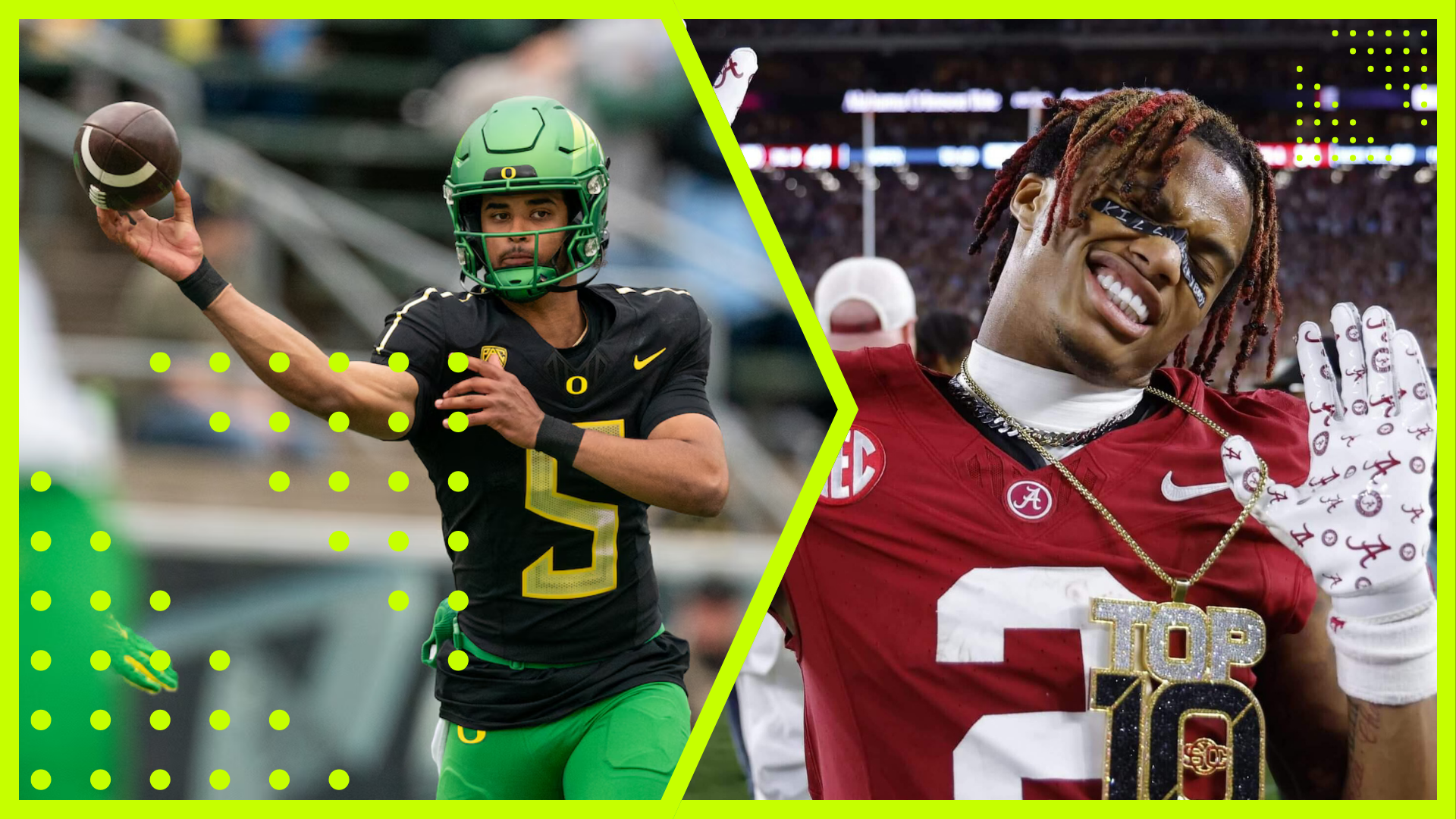
Nine players. That's how many Oregon Ducks currently appear on the 2027 consensus big board top 100, making them the program with the most NFL-caliber talent in this early evaluation window. It's a remarkable flex for Dan Lanning's program, which has quietly turned Eugene into one of the most productive NFL pipelines in the country. Leading the charge for Oregon is quarterback Dante Moore, slotted at No. 2 on the consensus board — a player who turned down a shot at the 2026 draft, returned for another season, and is now locked in a legitimate battle with a certain Manning to be the first name called in Washington, D.C. next April. Moore is complemented by edge rusher Matayo Uiagalelei, defensive lineman A'Mauri Washington, tight end Jamari Johnson, safety Koi Perich, quarterback Dylan Raiola, interior offensive lineman Iapani Laloulu, defensive lineman Bear Alexander, and defensive end Teitum Tuioti. That's not a depth chart, that's a first-round buffet.
Hot on Oregon's heels are the Texas Longhorns, who sit at eight players in the top 100 — and, crucially, have the No. 1 overall prospect in the class. Arch Manning, the third-generation quarterback from a family that has already sent two Super Bowl champions and a Hall of Famer to the league, is the consensus QB1 for 2027 and the early betting favorite to go first overall. Manning has emerged as the early favorite to be selected No. 1 overall in the 2027 NFL Draft, a projection reflecting both his potential and the growing belief in his development at Texas. Alongside Manning on the Texas roster is edge rusher Colin Simmons at No. 4, wide receiver Cam Coleman at No. 8, offensive tackle Trevor Goosby at No. 10, wide receiver Ryan Wingo at No. 50, linebacker Rasheem Biles, safety Jelani McDonald, and defensive lineman Maraad Watson. Steve Sarkisian isn't just coaching a college football team — he's operating a finishing school for NFL talent.
The Manning Factor: Hype, Legacy, and Legitimate Skill
Let's not dance around the elephant in the room wearing burnt orange. Arch Manning is the gravitational center of the 2027 draft universe right now, and the conversation around him is exactly what you'd expect — complicated. On one hand, the hype is real and rooted in something tangible. After redshirting his freshman season and sitting behind one of the best quarterbacks in college football, Manning broke out in his third season, racking up 3,163 yards and 26 touchdowns to just seven interceptions. He improved dramatically down the stretch of 2025, posting 20 total touchdowns against just two turnovers in his final six games. His coach, Steve Sarkisian, put it bluntly: most quarterbacks would have folded under the pressure Manning navigated as a sophomore starter. Manning got stronger instead.
On the other hand, the skeptics aren't wrong to pump the brakes. Manning has completed 311 of 499 passes (62.3 percent) in his college career, which is functional but not elite for a presumptive No. 1 pick. The 2026 class was supposed to be a QB bonanza too, and Fernando Mendoza — a player nobody was discussing as a generational talent a year ago — ended up going first overall. The draft has a way of humbling the hype machine.
Still, there's something different about Manning. He's 6-foot-4, built like a franchise quarterback, and plays with an effortless downfield feel that scouts drool over. Add in the fact that Texas now has Cam Coleman — one of the most physically gifted wide receivers in college football, transferred in from Auburn — lining up opposite him, and the environment around Manning in 2026 is dramatically improved from a year ago. If everything clicks in Austin, the first overall pick conversation writes itself.
LSU, Notre Dame, and the Rest of the Field
Behind the top two programs, a fascinating group of schools is staking their claim to draft relevance. LSU brings seven players to the table under Brian Kelly, headlined by offensive tackle Jordan Seaton sitting at No. 9 on the consensus board — which makes him the highest-ranked offensive lineman in the class. Tight end Trey'Dez Green, defensive lineman Jordan Ross, quarterback Sam Leavitt, defensive end Princewill Umanmielen, safety Ty Benefield, and safety Dashawn Spears round out a Tigers contingent that speaks to how Kelly has reloaded the Baton Rouge pipeline after the mass exodus of the Orgeron era.
Notre Dame checks in with six prospects, led by cornerback Leonard Moore at No. 6 overall — a player who was a Thorpe Award finalist and All-American as a true sophomore, possessing the size, movement skills, and instincts NFL teams covet at cornerback. Quarterback CJ Carr, linebacker Kyngstonn Viliamu-Asa, safety Brauntae Johnson, offensive tackle Anthonie Knapp, and defensive end Boubacar Traore join Moore on a Fighting Irish board that reflects Marcus Freeman's program ascending back to draft-day prominence.
Miami also claims six spots, featuring quarterback Darian Mensah at No. 14 — a name that flew under the radar before landing in Coral Gables, but is now firmly on scouts' radar as a legitimate first-round arm. Defensive linemen Ahmad Moten Sr. and Justin Scott, defensive end Damon Wilson Jr., cornerback OJ Frederique Jr., and running back Mark Fletcher round out a Hurricanes contingent that suggests the U is very much back as a program, not just as a marketing campaign.
The Middle Tier: Indiana, Clemson, Texas Tech, and More
Indiana's stunning rise under the Heisman-winning Fernando Mendoza era has left a talent residue that the scouts are still cataloguing. The Hoosiers put five players in the top 100, including wide receiver Nick Marsh, offensive tackle Carter Smith, wide receiver Charlie Becker, quarterback Josh Hoover — the TCU transfer stepping into a tough act — and Jamari Sharpe. Five prospects from Indiana would have been a punchline five years ago. Now it's a testament to how quickly the program has transformed.
Clemson also checks in with five, led by linebacker Sammy Brown and wide receiver TJ Moore, alongside cornerback Ashton Hampton, defensive end Will Heldt, and wide receiver Bryant Wesco. The Tigers don't dominate these early boards the way they once did under Dabo Swinney's peak years, but the pipeline hasn't dried up — it's just operating at a different altitude.
Texas Tech is the surprise of the bunch with five prospects as well, highlighted by quarterback Brendan Sorsby* — a name that's been generating buzz in Big 12 circles as a legitimate NFL arm, though one currently dealing with the kind of off-field noise that can derail a draft stock in a hurry. Defensive linemen A.J. Holmes Jr. and Mateen Ibirogba, cornerback Brice Pollock, and tight end Terrance Carter round out the Red Raiders' representation.
Ohio State, Alabama, Ole Miss, and the Brand Names
Ohio State brings four, but what four they are. Wide receiver Jeremiah Smith — perhaps the most physically gifted receiver in college football regardless of class — sits at No. 3 on the consensus board. Smith has a frame and game that scouts project as a rare receiver capable of competing at the NFL level immediately, with over 2,500 yards and 29 total touchdowns in just 29 games. Quarterback Julian Sayin is No. 5, making the Buckeyes the only program in America with two top-five picks currently projected from the same roster. Offensive tackle Austin Siereveld and defensive end Kenyatta Jackson round out Columbus's contribution to what's shaping up as one of the most loaded draft classes in recent memory.
Alabama posts four, headlined by wide receiver Ryan Williams at No. 15 — a prospect who wasn't eligible for the 2026 draft and would have been among the first receivers selected if he had been. Cornerback Zabien Brown, defensive end Yhonzae Pierre, and safety Bray Hubbard give the Crimson Tide a respectable showing even as they navigate the transition away from the Nick Saban dynasty.
Ole Miss contributes four prospects of their own — quarterback Trinidad Chambliss, running back Kewan Lacy, defensive lineman William Echoles, and linebacker Suntarine Perkins — a group that reflects Lane Kiffin's continued success in developing NFL talent in Oxford. South Carolina, Georgia, Minnesota, Michigan, and Florida all clock in with three prospects apiece, ensuring the depth of this class is distributed across conferences and time zones.
What It All Means
What does the 2027 consensus big board tell us before a single game of the new season is played? A few things, none of them subtle. First, the SEC is still the dominant force in producing NFL talent, with Texas, LSU, Alabama, Georgia, Ole Miss, South Carolina, Miami, and Florida all holding significant real estate on the board. The conference's depth is not a talking point — it's a verifiable fact that scouts confirm with their own rankings.
Second, the Big Ten is punching at a high level in this cycle. Oregon, Ohio State, Indiana, Minnesota, and Michigan all have representation, and the conference's expansion has clearly not diluted its talent concentration. If anything, Oregon's arrival has added a new superpower to what was already a formidable group.
Third, and most importantly: this draft class has a genuine superstar at the top. Whether it ends up being Arch Manning, Dante Moore, or Julian Sayin who hears their name first in Washington D.C. next April, the quarterback race alone is appointment television. The Manning legacy, the Moore efficiency, the Sayin ceiling — it's a three-way conversation that's going to dominate the next twelve months of college football discourse.
The 2026 season hasn't started. The big board will look completely different by January. Players will rise. Others will fall. Injuries will upend projections. A quarterback nobody's talking about right now might win the Heisman and crash the party — just like Mendoza did a year ago.
But right now, in this moment, Oregon and Texas are setting the standard. And Arch Manning — legacy, talent, pressure, and all — is the name at the top. The rest of the board is just details.

Trusted By Programs Across The Country