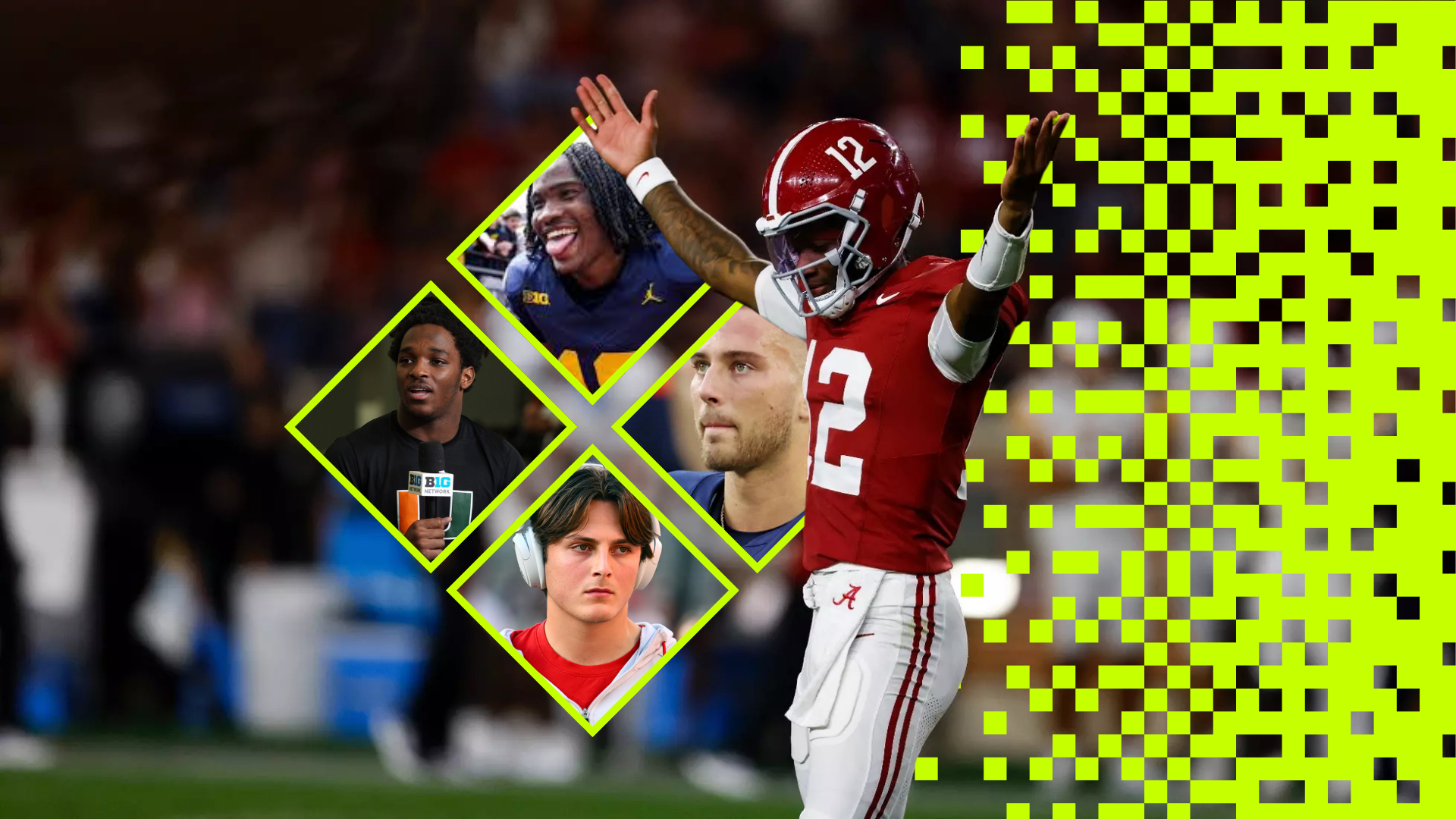
The Heisman Trophy does not come with a manual. There is no formula, no guaranteed path, and no amount of recruiting stars that substitutes for what actually happens when the lights come on and the season is real. But there are players you can see coming. Players who carry a gravitational pull that makes you lean forward before they even take their first snap of a new season. The 2026 Heisman race has five of them — and none of them has been in college for more than two years.
These are not projections built on potential alone. Each of these players has already made a statement. Here is what they did, what they are stepping into, and why 2026 could be the year their name gets called in New York.
Bryce Underwood, QB, Michigan
There is no player in the country carrying more weight per snap than Bryce Underwood. The No. 1 overall recruit in the 2025 class flipped his LSU commitment to stay home and play for Michigan — and arrived with a $12.5 million NIL deal before he had thrown a single college pass. That is either a setup for a legendary story or an enormous amount of pressure for a teenager. His freshman season suggested it might be both.
Underwood finished 2025 with 2,428 passing yards, 11 touchdowns, 9 interceptions, and 392 rushing yards with six more scores on the ground. The dual-threat ability was never in question. The turnover issues in high-leverage moments, particularly a brutal stretch of late interceptions in the Citrus Bowl loss to Texas, gave critics exactly what they needed. Michigan went 9-4, fell short of CFP contention, and lost its head coach in the offseason, with Kyle Whittingham coming in to rebuild from the outside.
Here is what those critics are missing. Underwood is 18 years old, started as a true freshman at one of college football's most demanding programs, and still produced dual-threat numbers that would make most second-year starters envious. The ceiling on this kid is legitimately scary. With a year of game reps behind him, a new offensive coordinator in Beck, and a program that desperately needs him to ascend, 2026 is the year Underwood either locks in or the narrative turns. The talent says he locks in. At 6-foot-4 and 228 pounds, he is already built like an NFL starter. If the interceptions clean up even modestly, Michigan is a playoff team and Underwood is in the Heisman conversation from September.
Malachi Toney, WR, Miami
Non-quarterbacks do not win the Heisman often. The voters tend to gravitate toward signal callers, and the last wide receiver to take home the trophy was Desmond Howard in 1991. That history is real. But it has never met a player quite like Malachi Toney.
Toney was 17 years old when he enrolled at Miami in January 2025 — a reclassified 2026 recruit who was technically still supposed to be in high school. What he did instead was lead the nation in receptions (109), set Miami's single-season records in both catches and receiving yards (1,211), earn AP second-team All-American honors, win ACC Rookie of the Year, and take the Hurricanes to the national championship game. He had no drops on 84 catchable targets according to PFF, led the Power Four in yards after the catch at 623, threw two touchdown passes in Wildcat packages, and scored the game-winning touchdown on a jet sweep in Miami's first-ever CFP victory. He was 17 years old for part of this.
The argument against Toney winning the Heisman is structural, not performance-based — receivers need historically absurd production to overcome the positional bias. The argument for him is that the structural bias has a ceiling, and Toney appears to be approaching it. Miami brings back new quarterback Cam Mensah, who was built to maximize exactly the kind of playmaker Toney is. If Toney puts up 1,400 receiving yards, crosses 12 touchdowns, and Miami is competing for the ACC title in November, the voters will be forced to have the conversation in earnest. At 18 years old entering his sophomore season, he is already the most complete receiver in college football. The question is just whether the voters catch up with the reality.
Julian Sayin, QB, Ohio State
Julian Sayin walked into the most talented roster in college football as a redshirt freshman starter and proceeded to be historically accurate. He completed 77 percent of his passes in 2025 — the third-highest completion rate in the history of college football, trailing only Bo Nix in 2023 and Mac Jones in 2020. He threw for 3,610 yards, 32 touchdowns, and just 8 interceptions. He led Ohio State to a perfect 12-0 regular season, a Big Ten Freshman of the Year award, the Shaun Alexander National Freshman of the Year award, and a spot as one of four Heisman finalists. He was a Heisman finalist as a first-year starter.
The case against Sayin entering 2026 is the same case that was made against him entering 2025: he is not a huge rushing threat, and the Heisman has increasingly gone to players who can hurt you with their legs as well as their arm. The counter to that is his 2025 résumé, which speaks loudly enough to challenge the conventional wisdom. Sayin's accuracy is not a system product — it is a skill set. His 82.5 percent adjusted completion rate ranked fifth in PFF College history. He enters 2026 as a junior with two years of starting experience, the same weapons around him, and something to prove after Ohio State's CFP run ended in the Cotton Bowl against Miami. He was a Heisman finalist last year. It is not hard to construct a path from finalist to winner, especially with the stage Ohio State provides every single season. The trophy has been in Columbus before. Sayin has the arm talent and the résumé to bring it back.
CJ Carr, QB, Notre Dame
CJ Carr's grandfather Lloyd is in the College Football Hall of Fame. His other grandfather, Tom Curtis, played varsity football at Michigan in the late 1960s. Football royalty is baked into his DNA — and after his freshman season at Notre Dame, it looks like the gene passed down.
Carr started all 12 regular season games as a redshirt freshman, throwing for 2,741 yards, 24 touchdowns, and just 6 interceptions on a 67 percent completion rate. His QBR of 83.1 ranked eighth nationally. He threw a touchdown in all 12 starts — the longest streak by a Notre Dame quarterback since 2014. His 354-yard, four-touchdown performance at Arkansas was the most passing yards by an Irish quarterback since Jack Coan's 2022 Fiesta Bowl. He threw multiple touchdown passes in nine of his twelve starts. Marcus Freeman called him a rare competitor before the season started, and by midseason, Carr was appearing in the Heisman Top 10 despite being a true first-year starter.
What makes Carr's 2026 case compelling is what surrounds him. Notre Dame lost running back Jeremiyah Love and several key offensive pieces, but Carr himself is back with a full season of starting experience and a coaching staff that knows how to develop quarterbacks — offensive coordinator Mike Denbrock has already coached a Heisman winner in Jayden Daniels at LSU. Notre Dame plays a schedule that will produce marquee moments, and Carr has already shown he performs on the biggest stages. The Irish open the 2026 season at home against Miami, a genuine revenge game after last year's road loss to the Hurricanes. If Carr handles that moment the way his freshman season suggested he is capable of, the Heisman conversation is going to start in week one and not stop.
Keelon Russell, QB, Alabama
Keelon Russell is the wildcard on this list — and arguably the most intriguing. He barely played in 2025, appearing in just two games behind starter Ty Simpson and completing 11 of 15 passes for 143 yards and two scores. The stat line is irrelevant. What matters is what happens now that Simpson has declared for the NFL Draft and the Alabama starting job is open.
Russell was the Gatorade National Football Player of the Year as a high school senior from Duncanville, Texas. He won back-to-back 6A Division 1 state championships. He completed 72 percent of his passes as a junior for 3,483 yards and 38 touchdowns with three interceptions. He chose Alabama over the entire country, and came in as the most highly rated quarterback recruit the program had signed since Bryce Young in 2020. For context on what that comparison means: Young redshirted, became the starter the following season, and won the Heisman. The parallel is not perfect — nothing ever is — but it is the template Alabama is hoping Keelon Russell follows.
Winning the Heisman from Alabama is practically a tradition at this point. The program has produced more Heisman winners than any other school in the modern era, and the infrastructure around the quarterback in Tuscaloosa, from the receivers to the play-callers to the national spotlight, is built to support exactly this kind of individual award run. If Russell wins the starting job in fall camp, stays clean with the ball, and Alabama is relevant in October and November, his name will be on the board. He has not proven anything yet at this level. That is also exactly why 2026 feels like the year he does.
The bottom line
Five players, five different situations, five different paths to New York. Sayin has the most established case coming off a Heisman finalist season. Toney has the most physically dominant production. Carr has the most favorable narrative setup entering year two. Underwood has the highest ceiling of anyone in the country if the growth curve bends the right way. And Russell is the bet-on-the-talent long shot who plays for a program that has turned long shots into trophy winners before.
The 2026 Heisman race is already one of the more interesting ones in recent memory, and a single snap of actual football has not been played yet. Which of these five do you have? Drop it in the comments.

Trusted By Programs Across The Country