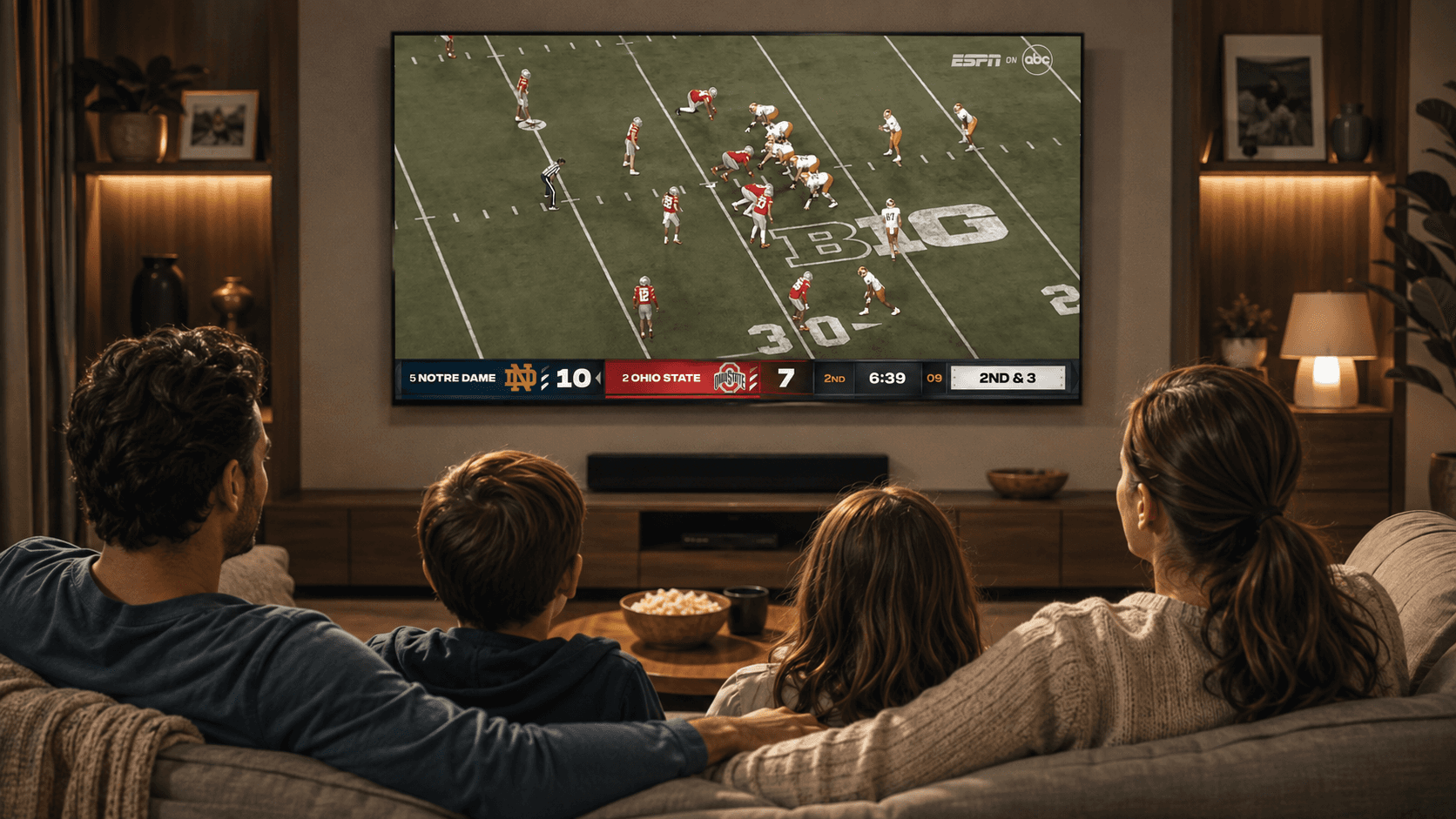
There is a specific muscle memory every college football fan built without meaning to. Your team is up 10 in the third, the offense is huddling, and your eyes drift south. Not to your phone. To the bottom of the screen. That thin black band crawling right to left, feeding you a Big 12 upset in progress, a MAC score you had no business caring about, and a Mountain West final at 1:47 a.m. that you absorbed anyway because it was there.
That band is going away.
ESPN is pulling the BottomLine off its college football broadcasts starting this season. Not for a special event. Not for the Playoff only. For everything: ABC, ESPN, ESPN2, ESPNU, ESPNews, SEC Network and ACC Network, regular season included. The scoreboard that has been scrolling underneath your Saturdays since the mid-1990s is being switched off during live action, and the reasoning is exactly as tidy as you would expect from Bristol. The network says the goal is "creating a cleaner presentation that keeps the focus where it belongs", which is a sentence engineered in a lab to be impossible to argue with and impossible to feel anything about.
Fans, of course, feel plenty.
The Slow Fade Nobody Was Supposed to Notice
This did not arrive out of nowhere. ESPN has been quietly running the experiment in public for a while now, and if you were paying attention you already saw the ending.
The Playoff went ticker-free. The NBA postseason went ticker-free. The NHL postseason went ticker-free. Every time the network put on its good clothes for a marquee window, the BottomLine got left in the closet. The message was subtle but consistent: the ticker is what we use when the game is not the main event. Remove it, and the broadcast reads as prestige.
So the regular season falling in line is less a surprise than a confirmation. ESPN spent two years training viewers to associate a clean bottom third with the biggest nights of the year, then extended that look to a random Thursday night in Boone. The corporate word for that is consistency. The honest word for it is that the Playoff broadcast tested well and somebody in a conference room said, do that always.
What makes the timing loud is the calendar. This lands days before the season opens with North Carolina and TCU playing in Dublin, which means there is no soft rollout, no easing anyone into it. Week 1 is the first draft and the final version at the same time.
What Actually Disappears, and What Does Not
Worth being precise here, because the internet already flattened this into "ESPN is hiding the scores from you," and that is not quite what is happening.
The persistent scroll is dead during live play. That is the real loss. The ambient, always-on, glance-down-whenever-you-want feed of every other game in the country is what viewers are actually mourning, and no, there is not a replacement for it.
What survives is a scheduled version. Score alerts will still surface at set points inside each quarter, so you get periodic drops rather than a constant crawl. There will also be updates positioned near the score bug and in the top right of the screen, largely built to handle the logistical chaos that defines a college football Saturday: your game is running long, the next one has already kicked on a different channel, go here, do this.
So it is not a blackout. It is a shift from a firehose to a faucet somebody else controls. Which, depending on how you watch football, is either a mild inconvenience or a fundamental change to the entire experience.
The Case For: Your Phone Already Won This Argument
Here is the uncomfortable truth for anyone about to type "boomer" or "grandpa" under this post, and also for anyone about to receive that comment.
The BottomLine was invented for a world that no longer exists. It launched in an era when the alternative to the ticker was waiting for the next SportsCenter, or being the guy in the room who kept getting up to check Teletext. It was genuinely revolutionary. It solved a real problem.
That problem has been solved four other ways since. Every viewer in America is holding a device that will push them a score alert before ESPN's own graphic can render it. Multiview exists. Second screens exist. Group chats exist, and they are faster and meaner than any ticker. The ambient scoreboard stopped being the fastest source of information roughly a decade ago and has been coasting on habit ever since.
There is also the aesthetic argument, and it is stronger than people give it credit for. College football broadcasts have quietly become the most cluttered product in American television. You have got the score bug, the drive summary, the down and distance, the network bug, the conference bug, the sponsor read, the betting line, the pop-up promo for the game happening after this game, and then the ticker underneath all of it. At a certain point the field becomes a window in the middle of a dashboard. Cutting one full band off the bottom is the first real reduction in on-screen furniture in years.
And it gives ESPN room. Room for its own graphics, its own stat packages, its own storytelling. Which brings us to the part where the skeptics start clearing their throats.
The Case Against: This Is Not Really About the Field
The cynical read landed within about an hour of the news breaking, and it is not unreasonable.
Removing the ticker does not just create clean space. It creates valuable clean space. Whatever fills that real estate, whether it is sponsored graphics, betting integrations, or promos steering you toward the network's streaming product, is inventory that did not exist yesterday. The stated reason is the viewer experience. The structural reality is that ESPN just cleared the most consistently occupied strip of screen on its most valuable regular-season property.
The optics did not help. The announcement arrived in the same news cycle as reports of price increases on ESPN's streaming tiers, and the internet is not built to hold those two facts separately. Fair or not, "we are removing a free convenience for your benefit" plays differently in a week that also includes "and it costs more now."
Then there is the cultural loss, which is harder to quantify but real. The ticker was a discovery engine. It was the reason you knew a mid-major was hanging with an SEC team. It was how a boring blowout suddenly turned into a reason to flip channels. It gave the sport a sense of simultaneity, the feeling that you were not watching a game but watching a day. Take it away and each broadcast becomes more self-contained, more siloed, more like a product you consume alone rather than a shared national scoreboard.
You can dismiss that as nostalgia. Plenty of nostalgia is worth defending.
What It Means for the Rest of the Industry
ESPN is not the innovator here so much as the last big holdout. Fox, CBS and NBC already run ticker-free during games on their broadcast networks. Big Ten Network dropped it. FS1 has kept it around. What ESPN's move does is settle the argument at scale, because when the network that airs the majority of college football decides the ticker is clutter, the ticker is clutter.
The open question is whether the logic stops at football. The BottomLine still runs across ESPN's other live properties, and it is not obvious why the case for a cleaner presentation applies to a Saturday in November but not a Tuesday in February. If college football is the test case and viewers shrug, expect the scroll to start disappearing everywhere.
The Closing Take
The BottomLine is not being removed because it failed. It is being removed because it succeeded so completely that the culture built five better versions of it, and ESPN finally noticed the original was still running.
Still, there is something a little sad about it. The ticker was the last piece of appointment television that behaved like ambient radio. You did not choose it, you did not tap it, you did not have to think about it. It just ran, and it kept you tethered to every other stadium in the country while you sat with your one game.
Now you get the field, unobstructed, exactly the way the network says you always wanted it. Whether you actually wanted it is a question that gets answered on Saturday, roughly nine seconds after the first time you look down out of habit and find nothing there.
There is a specific muscle memory every college football fan built without meaning to. Your team is up 10 in the third, the offense is huddling, and your eyes drift south. Not to your phone. To the bottom of the screen. That thin black band crawling right to left, feeding you a Big 12 upset in progress, a MAC score you had no business caring about, and a Mountain West final at 1:47 a.m. that you absorbed anyway because it was there.
That band is going away.
ESPN is pulling the BottomLine off its college football broadcasts starting this season. Not for a special event. Not for the Playoff only. For everything: ABC, ESPN, ESPN2, ESPNU, ESPNews, SEC Network and ACC Network, regular season included. The scoreboard that has been scrolling underneath your Saturdays since the mid-1990s is being switched off during live action, and the reasoning is exactly as tidy as you would expect from Bristol. The network says the goal is "creating a cleaner presentation that keeps the focus where it belongs", which is a sentence engineered in a lab to be impossible to argue with and impossible to feel anything about.
Fans, of course, feel plenty.
The Slow Fade Nobody Was Supposed to Notice
This did not arrive out of nowhere. ESPN has been quietly running the experiment in public for a while now, and if you were paying attention you already saw the ending.
The Playoff went ticker-free. The NBA postseason went ticker-free. The NHL postseason went ticker-free. Every time the network put on its good clothes for a marquee window, the BottomLine got left in the closet. The message was subtle but consistent: the ticker is what we use when the game is not the main event. Remove it, and the broadcast reads as prestige.
So the regular season falling in line is less a surprise than a confirmation. ESPN spent two years training viewers to associate a clean bottom third with the biggest nights of the year, then extended that look to a random Thursday night in Boone. The corporate word for that is consistency. The honest word for it is that the Playoff broadcast tested well and somebody in a conference room said, do that always.
What makes the timing loud is the calendar. This lands days before the season opens with North Carolina and TCU playing in Dublin, which means there is no soft rollout, no easing anyone into it. Week 1 is the first draft and the final version at the same time.
What Actually Disappears, and What Does Not
Worth being precise here, because the internet already flattened this into "ESPN is hiding the scores from you," and that is not quite what is happening.
The persistent scroll is dead during live play. That is the real loss. The ambient, always-on, glance-down-whenever-you-want feed of every other game in the country is what viewers are actually mourning, and no, there is not a replacement for it.
What survives is a scheduled version. Score alerts will still surface at set points inside each quarter, so you get periodic drops rather than a constant crawl. There will also be updates positioned near the score bug and in the top right of the screen, largely built to handle the logistical chaos that defines a college football Saturday: your game is running long, the next one has already kicked on a different channel, go here, do this.
So it is not a blackout. It is a shift from a firehose to a faucet somebody else controls. Which, depending on how you watch football, is either a mild inconvenience or a fundamental change to the entire experience.
The Case For: Your Phone Already Won This Argument
Here is the uncomfortable truth for anyone about to type "boomer" or "grandpa" under this post, and also for anyone about to receive that comment.
The BottomLine was invented for a world that no longer exists. It launched in an era when the alternative to the ticker was waiting for the next SportsCenter, or being the guy in the room who kept getting up to check Teletext. It was genuinely revolutionary. It solved a real problem.
That problem has been solved four other ways since. Every viewer in America is holding a device that will push them a score alert before ESPN's own graphic can render it. Multiview exists. Second screens exist. Group chats exist, and they are faster and meaner than any ticker. The ambient scoreboard stopped being the fastest source of information roughly a decade ago and has been coasting on habit ever since.
There is also the aesthetic argument, and it is stronger than people give it credit for. College football broadcasts have quietly become the most cluttered product in American television. You have got the score bug, the drive summary, the down and distance, the network bug, the conference bug, the sponsor read, the betting line, the pop-up promo for the game happening after this game, and then the ticker underneath all of it. At a certain point the field becomes a window in the middle of a dashboard. Cutting one full band off the bottom is the first real reduction in on-screen furniture in years.
And it gives ESPN room. Room for its own graphics, its own stat packages, its own storytelling. Which brings us to the part where the skeptics start clearing their throats.
The Case Against: This Is Not Really About the Field
The cynical read landed within about an hour of the news breaking, and it is not unreasonable.
Removing the ticker does not just create clean space. It creates valuable clean space. Whatever fills that real estate, whether it is sponsored graphics, betting integrations, or promos steering you toward the network's streaming product, is inventory that did not exist yesterday. The stated reason is the viewer experience. The structural reality is that ESPN just cleared the most consistently occupied strip of screen on its most valuable regular-season property.
The optics did not help. The announcement arrived in the same news cycle as reports of price increases on ESPN's streaming tiers, and the internet is not built to hold those two facts separately. Fair or not, "we are removing a free convenience for your benefit" plays differently in a week that also includes "and it costs more now."
Then there is the cultural loss, which is harder to quantify but real. The ticker was a discovery engine. It was the reason you knew a mid-major was hanging with an SEC team. It was how a boring blowout suddenly turned into a reason to flip channels. It gave the sport a sense of simultaneity, the feeling that you were not watching a game but watching a day. Take it away and each broadcast becomes more self-contained, more siloed, more like a product you consume alone rather than a shared national scoreboard.
You can dismiss that as nostalgia. Plenty of nostalgia is worth defending.
What It Means for the Rest of the Industry
ESPN is not the innovator here so much as the last big holdout. Fox, CBS and NBC already run ticker-free during games on their broadcast networks. Big Ten Network dropped it. FS1 has kept it around. What ESPN's move does is settle the argument at scale, because when the network that airs the majority of college football decides the ticker is clutter, the ticker is clutter.
The open question is whether the logic stops at football. The BottomLine still runs across ESPN's other live properties, and it is not obvious why the case for a cleaner presentation applies to a Saturday in November but not a Tuesday in February. If college football is the test case and viewers shrug, expect the scroll to start disappearing everywhere.
The Closing Take
The BottomLine is not being removed because it failed. It is being removed because it succeeded so completely that the culture built five better versions of it, and ESPN finally noticed the original was still running.
Still, there is something a little sad about it. The ticker was the last piece of appointment television that behaved like ambient radio. You did not choose it, you did not tap it, you did not have to think about it. It just ran, and it kept you tethered to every other stadium in the country while you sat with your one game.
Now you get the field, unobstructed, exactly the way the network says you always wanted it. Whether you actually wanted it is a question that gets answered on Saturday, roughly nine seconds after the first time you look down out of habit and find nothing there.
Share this story
C
CFB Team
CFB Team
The most trusted college football team.
The most trusted college football team.
More College Football Stories
More College Football Stories

Ole Miss Called in the FBI to Debug Its Own Building After Lane Kiffin Bolted for LSU
Ole Miss Called in the FBI to Debug Its Own Building After Lane Kiffin Bolted for LSU

From Homecoming Ghost Town to the Hottest Ticket in the Midwest: Indiana Football Sells Out Every Home Game for the First Time Since 1969
From Homecoming Ghost Town to the Hottest Ticket in the Midwest: Indiana Football Sells Out Every Home Game for the First Time Since 1969

CFB
Ahmad Hardy Won't Play Missouri's Opener — But the Real Story Is How Close He Came Back
Ahmad Hardy Won't Play Missouri's Opener — But the Real Story Is How Close He Came Back
Keep Reading
Never Miss The Next Alert
Real-time college football news, NIL moves, and recruiting intel — delivered the moment it breaks.
Keep Reading
Never Miss The Next Alert
Real-time college football news, NIL moves, and recruiting intel — delivered the moment it breaks.
Coast To Coast
Trusted By Programs Across The Country


Coast To Coast
Trusted By Programs Across The Country

