Blog / Article
11 College Football Breakout Players Who Could Define the 2026 Season
11 College Football Breakout Players Who Could Define the 2026 Season
C
CFB Team
August 7, 2026
Sponsored by


College football spends August selling certainty.
The quarterback with the Heisman odds. The five-star receiver already starring in national commercials. The defensive end who has been mocked into the first round approximately 6,000 times before playing his next snap.
Then September arrives and somebody nobody outside his own conference was talking about suddenly has 160 yards on national television.
That is the fun part.
The most interesting breakout candidates entering 2026 are not necessarily unknown players. Some have already produced. Some have started. One is already a preseason All-American. Others have barely played at all. What connects them is opportunity. Their roles, surroundings or stages are about to become significantly bigger.
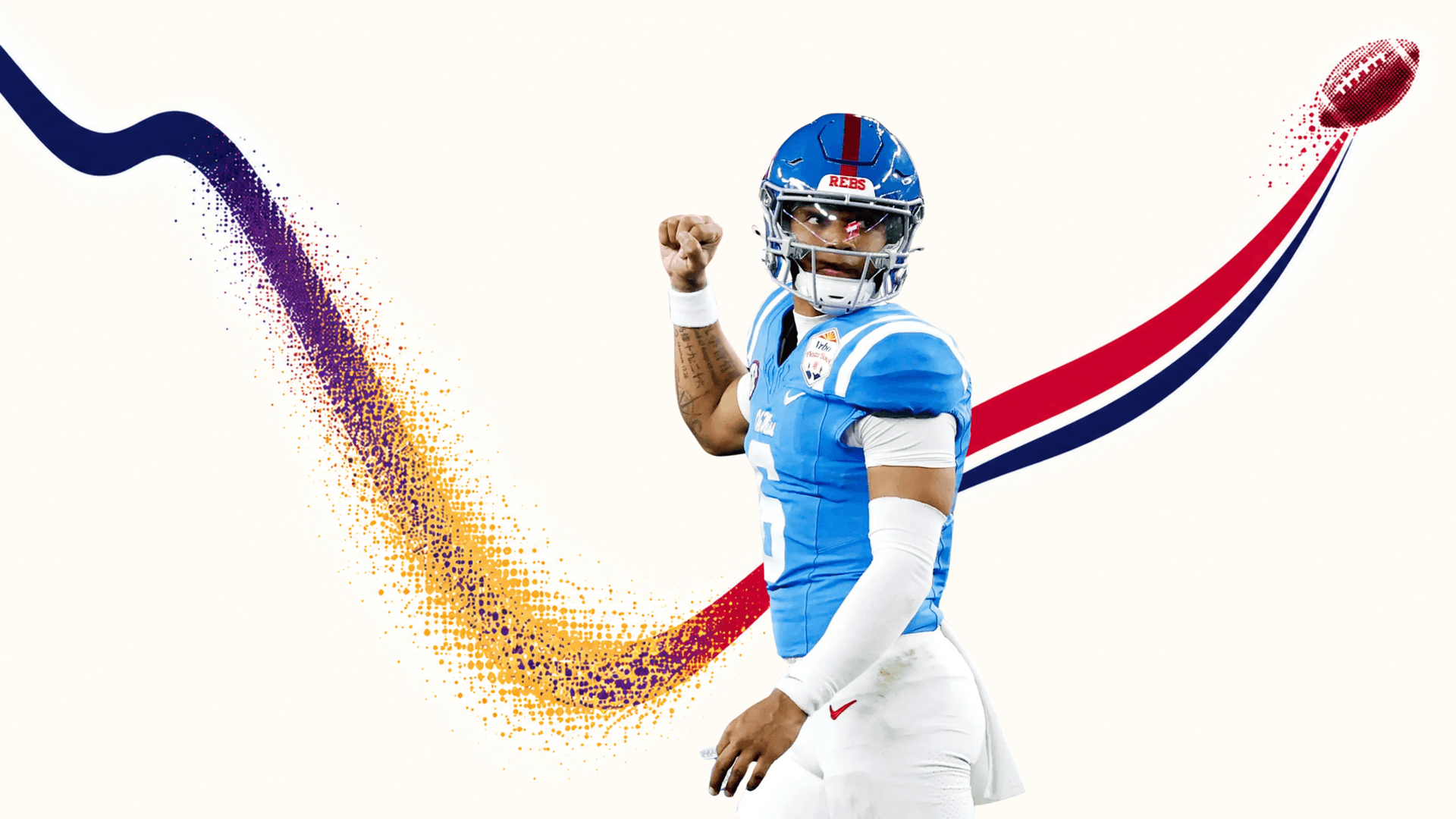
Using current rosters and production through the 2025 season, here are 11 players from the group pictured above who have legitimate opportunities to become much larger names in 2026.
The Backfields Are About To Change Hands
Aneyas Williams might have the strangest stat line of anybody on this list.
Notre Dame's junior running back touched the ball only 24 times as a runner last season. He somehow turned those carries into 224 yards and five touchdowns.
That is 9.3 yards per carry.
No, Notre Dame probably cannot just multiply that by 200 attempts and pencil Williams in for 1,860 yards. Football has not been hacked quite that badly. But the efficiency matters because Williams repeatedly showed that his limited opportunities did not look wasted.
His biggest flashes came late. Williams ran for 72 yards and a touchdown on five carries against Navy, then closed the regular season with 83 yards and two touchdowns on 10 attempts at Stanford. He also caught two passes for 40 yards during the season.
Now he enters 2026 as a 210-pound junior instead of a change-of-pace option buried behind established stars. That distinction matters.
The question is not whether Williams can average nine yards per carry for an entire season. He will not. The question is whether the explosiveness survives when 24 carries become 100, 130 or more.
If it does, Notre Dame may have spent the last two seasons hiding another problem for opposing defenses in plain sight.
Then there is Javin Gordon, who enters a dramatically different situation.
Gordon is now at Tennessee after transferring from Tulane, where he was already much more than a developmental freshman. He played all 14 games during Tulane's 2025 College Football Playoff season, started six and finished with 516 rushing yards and five touchdowns on 128 carries.
The sneaky number is 362.
That is how many of Gordon's 516 rushing yards came after contact, according to Tennessee's official bio. Roughly 70 percent of his rushing production came after somebody had already gotten a hand on him. He also caught 13 passes for 93 yards and another touchdown, giving him 609 yards from scrimmage as a freshman.
At 5-foot-10 and 212 pounds, Gordon gives Tennessee a compact back who has already shown he can absorb real workload. He does not have to arrive in Knoxville and immediately become RB1 to break out nationally. Tennessee's offense creates enough rushing opportunities for multiple backs to matter.
If Gordon turns 10 touches per game into 70 or 80 meaningful yards often enough, he becomes one of those players whose box score starts looking suspiciously productive by October.
The Pass Catchers Ready For More
If there is one player on this list already halfway through the breakout, it is Jamari Johnson.
The Oregon tight end caught 32 passes for 510 yards and three touchdowns last season. His 510 receiving yards ranked sixth in program history for a tight end, and he caught at least one pass in Oregon's final 14 games.
Most importantly, his production grew when the games got bigger. Two of Johnson's three touchdown catches came during the College Football Playoff.
He played 600 offensive snaps, earned All-Big Ten honorable mention from the league's coaches and enters 2026 as a Walter Camp preseason second-team All-American.
So, yes, calling him a "breakout" player requires some context.
This is less about discovering Johnson and more about the rest of the country catching up. There is a difference between being a productive tight end on a loaded Oregon roster and becoming one of the names broadcast crews circle on the opposing team's game plan every Saturday.
Johnson has already crossed the first bridge.
A 700-plus-yard season, a heavier red-zone role and Oregon remaining in the national-title conversation could take care of the second.
USC sophomore Tanook Hines has an even more obvious runway.
Hines was productive immediately as a true freshman, catching 34 passes for 561 yards and two touchdowns while appearing in all 13 games and starting eight. His 16.5 yards per reception tells you what kind of receiver he can become.
This was not 34 bubble screens manufactured by an offense desperate to get a freshman involved. Hines showed genuine vertical production.
Now USC itself describes Hines as the player expected to lead its returning receiver group after Makai Lemon's 2025 Biletnikoff-winning season.
That is where breakout seasons are born.
Production plus vacancy plus quarterback play plus an offense that has never exactly been shy about putting the ball in the air.
Hines does not need a reinvention. He needs volume.
Give a receiver averaging 16.5 yards per catch another 25 or 30 receptions and suddenly you are no longer talking about an interesting sophomore. You are talking about one of the Big Ten's most dangerous weapons.
Penn State's Koby Howard is starting from a smaller sample, but the same math gets intriguing.
Howard caught only seven passes during his freshman season. Those seven receptions produced 133 yards.
That is 19.1 yards per catch.
He also made four starts, produced three receptions of at least 20 yards and saw his role expand late in the year after recording his first collegiate catch against Iowa in October.
Seven catches are not enough to project superstardom. They are enough to make you curious.
Howard's freshman season essentially functioned like a movie trailer. There was not much footage, but the parts Penn State showed were interesting enough to make you want the full thing.
At 5-foot-11 and more than 200 pounds, he has a sturdier build than the typical undersized speed receiver. If his late-season involvement becomes a full-season role, 2026 could be where the production finally catches up to the flashes.
And then we get to one of the more fascinating reclamation bets in the ACC.
Joshisa "Jojo" Trader arrives at NC State after two seasons at Miami with a résumé that still screams potential louder than production.
Trader was one of the nation's most coveted receivers coming out of high school, earning five-star status from multiple recruiting services. In 2025, he caught 13 passes for 178 yards in 11 games, including five receptions for 81 yards and a touchdown against SMU.
His longest reception?
A 44-yarder against NC State.
College football has a sense of humor.
Now he plays for them.
Trader has 19 career receptions entering his junior season. That is precisely why he belongs here. Nobody needs another article predicting the guy who already caught 80 passes to catch 90.
Trader is still sitting on the original athletic upside that made him a national recruit. NC State simply needs to unlock it more consistently.
Two Penn State Breakouts Could Start In Completely Different Places
Wide receivers get the graphics. Offensive tackles get asked to please stand over there for the team photo.
Still, Malachi Goodman may have as much breakout potential as anybody pictured.
Goodman enters 2026 at 6-foot-6 and roughly 330 pounds after redshirting his freshman season. He was a consensus four-star prospect coming out of Paramus Catholic and was rated as high as the No. 46 overall player in his recruiting class by On3.
There are no 2025 statistics to inflate.
That is the point.
Offensive-line breakouts work differently. Nobody notices a young tackle because he recorded four pancakes and a really aggressive pass set against Purdue. He becomes nationally relevant when a coaching staff trusts him against elite edge rushers and the broadcast suddenly starts mentioning that the redshirt freshman has not allowed anybody near his quarterback all afternoon.
Goodman has the dimensions. He has the pedigree. He has had a year inside a major college strength program.
Now comes the part where potential has to survive contact with Big Ten pass rushers.
Penn State having both Goodman and Howard on this list is fascinating because they represent opposite versions of development. Howard has already shown production in small doses. Goodman has shown almost nothing publicly because his position and redshirt year gave us essentially no evidence.
Both could be significantly more important by November.
The Defensive Backs Who Could Become Household Names
Tre Bell is another player whose breakout would really be a stage change.
Bell is not inexperienced.
Before arriving at Michigan State, he had already played 32 college games with 13 starts, recording 84 tackles, three interceptions and 13 pass breakups between Lindenwood and Iowa State.
His 2025 season at Iowa State was particularly encouraging. Bell played 638 defensive snaps, started eight games, finished with 36 tackles and four tackles for loss, intercepted two passes and forced a fumble.
Michigan State added him through the transfer portal after a season in which he tied for the Iowa State team lead in interceptions.
Now he gets Big Ten visibility every week.
Cornerback production is weird because the best ones sometimes disappear statistically. Quarterbacks simply stop throwing at them.
For Bell, the ideal breakout may actually involve fewer opportunities by midseason. If September produces interceptions and pass breakups, October could produce quarterbacks looking to the other side of the field.
LSU safety Ty Benefield is an even more extreme example of an accomplished player looking for a bigger national stage.
Calling someone who made 107 tackles last season "under the radar" sounds ridiculous until you remember where the attention economy of college football tends to live.
Benefield was outstanding at Boise State.
He started all 14 games in 2025, led the Broncos with 107 tackles, recorded 8.5 tackles for loss, intercepted two passes and earned first-team All-Mountain West honors. He played 847 defensive snaps and another 201 on special teams.
Over three seasons at Boise State, Benefield accumulated 235 tackles, 18 tackles for loss, 16 pass breakups and five interceptions.
That is not a breakout résumé. That is a résumé waiting for a larger audience.
Now he is at LSU.
A 6-foot-3, 208-pound safety arriving in the SEC with that level of experience is exactly the kind of transfer who can go from "great player college football sickos know" to legitimate NFL Draft conversation in about six Saturdays.
The latest reports from LSU camp have already identified Benefield as one of the defensive names worth watching.
Alabama junior Red Morgan has taken the opposite path.
He has been surrounded by national attention since arriving in Tuscaloosa, but his individual production is only now beginning to catch up.
Morgan appeared in all 15 games last season and started five, finishing with 26 tackles, three tackles for loss, three quarterback hurries, a pass breakup and a forced fumble. Alabama noted that his impact increased as the season progressed.
That last part is the important part.
He is not being projected forward because he had a giant statistical season. He is being projected forward because the trajectory changed.
Alabama's defense asks hybrid defensive backs to tackle, cover, blitz and process a lot of information before the snap. Morgan has already demonstrated the physical component. If the coverage side takes the same developmental jump in 2026, the numbers could rise quickly.
The breakout case here is not complicated.
More snaps. More responsibility. More moments in games everybody is watching.
That formula has created plenty of Alabama defensive stars before him.
The Quarterback With The Biggest Ceiling Of Them All
And then there is Alberto Mendoza.
He might be the most compelling player on the entire list because quarterbacks do not gently become relevant. They either become relevant or spend the season being discussed by increasingly angry people on message boards.
Mendoza transferred to Georgia Tech after serving as Indiana's backup quarterback in 2025.
He completed 18 of 24 passes for 286 yards, five touchdowns and one interception. That is a 75 percent completion rate and one touchdown pass every 4.8 attempts.
He also ran 13 times for 190 yards and another touchdown.
Those numbers obviously came in limited duty and cannot simply be stretched across a full season. But there was enough there to make Georgia Tech's interest obvious.
The story got more interesting in April.
Mendoza completed 12 of 16 passes for 148 yards in Georgia Tech's spring game, after which Brent Key said that if the Yellow Jackets had needed to play a game that weekend, Mendoza would have been the starting quarterback.
Yes, Alberto is the younger brother of Fernando Mendoza, the 2025 Heisman Trophy winner and national champion.
That guarantees comparisons he did not request and probably cannot escape.
But Georgia Tech does not need Alberto Mendoza to become Fernando Mendoza.
It needs him to become a stable, efficient successor to Haynes King who can punish defenses with his arm and remain dangerous enough with his legs that the backside defender cannot simply go sightseeing.
The ingredients are there.
Accuracy. Mobility. Starting opportunity. Experienced coaching. A program that won nine games last season and is trying to make the jump from fun story to legitimate ACC factor.
If Mendoza hits, this is not just a player breakout.
It changes Georgia Tech's ceiling.
Why These Are The Names Worth Watching
The common denominator across this group is not recruiting stars.
It is leverage.
Williams has absurd efficiency waiting on larger volume. Gordon has SEC opportunity after proving he can handle college carries. Johnson is positioned to turn strong production into national recognition. Hines has a receiving room begging for a new headliner. Howard has explosive efficiency without the targets yet.
Goodman has the body and pedigree but essentially no public résumé. Bell and Benefield have résumés but are moving onto stages where their performances will carry more national weight. Morgan is stepping toward a larger role inside one of college football's most scrutinized defenses. Trader gets another chance to convert five-star ability into five-star production.
And Mendoza gets the most unforgiving assignment in the sport: take the keys and make everybody forget they were worried about the quarterback position.
That is what a breakout season actually is.
It is rarely some random player waking up one morning with superpowers. Usually, the evidence was already there. A handful of carries. A ridiculous yards-per-catch number. An All-Mountain West season happening while the SEC dominated the television windows. A young lineman physically maturing behind an older starter. A quarterback quietly completing 75 percent of his passes while everybody watched his brother.
College football tells you what is coming all the time.
You just have to know where to look.
And when the inevitable October broadcast graphic pops up asking where one of these guys "came from," there is a decent chance the answer will be pretty simple:
He was already here. We just were not paying enough attention.
College football spends August selling certainty.
The quarterback with the Heisman odds. The five-star receiver already starring in national commercials. The defensive end who has been mocked into the first round approximately 6,000 times before playing his next snap.
Then September arrives and somebody nobody outside his own conference was talking about suddenly has 160 yards on national television.
That is the fun part.
The most interesting breakout candidates entering 2026 are not necessarily unknown players. Some have already produced. Some have started. One is already a preseason All-American. Others have barely played at all. What connects them is opportunity. Their roles, surroundings or stages are about to become significantly bigger.
Using current rosters and production through the 2025 season, here are 11 players from the group pictured above who have legitimate opportunities to become much larger names in 2026.
The Backfields Are About To Change Hands
Aneyas Williams might have the strangest stat line of anybody on this list.
Notre Dame's junior running back touched the ball only 24 times as a runner last season. He somehow turned those carries into 224 yards and five touchdowns.
That is 9.3 yards per carry.
No, Notre Dame probably cannot just multiply that by 200 attempts and pencil Williams in for 1,860 yards. Football has not been hacked quite that badly. But the efficiency matters because Williams repeatedly showed that his limited opportunities did not look wasted.
His biggest flashes came late. Williams ran for 72 yards and a touchdown on five carries against Navy, then closed the regular season with 83 yards and two touchdowns on 10 attempts at Stanford. He also caught two passes for 40 yards during the season.
Now he enters 2026 as a 210-pound junior instead of a change-of-pace option buried behind established stars. That distinction matters.
The question is not whether Williams can average nine yards per carry for an entire season. He will not. The question is whether the explosiveness survives when 24 carries become 100, 130 or more.
If it does, Notre Dame may have spent the last two seasons hiding another problem for opposing defenses in plain sight.
Then there is Javin Gordon, who enters a dramatically different situation.
Gordon is now at Tennessee after transferring from Tulane, where he was already much more than a developmental freshman. He played all 14 games during Tulane's 2025 College Football Playoff season, started six and finished with 516 rushing yards and five touchdowns on 128 carries.
The sneaky number is 362.
That is how many of Gordon's 516 rushing yards came after contact, according to Tennessee's official bio. Roughly 70 percent of his rushing production came after somebody had already gotten a hand on him. He also caught 13 passes for 93 yards and another touchdown, giving him 609 yards from scrimmage as a freshman.
At 5-foot-10 and 212 pounds, Gordon gives Tennessee a compact back who has already shown he can absorb real workload. He does not have to arrive in Knoxville and immediately become RB1 to break out nationally. Tennessee's offense creates enough rushing opportunities for multiple backs to matter.
If Gordon turns 10 touches per game into 70 or 80 meaningful yards often enough, he becomes one of those players whose box score starts looking suspiciously productive by October.
The Pass Catchers Ready For More
If there is one player on this list already halfway through the breakout, it is Jamari Johnson.
The Oregon tight end caught 32 passes for 510 yards and three touchdowns last season. His 510 receiving yards ranked sixth in program history for a tight end, and he caught at least one pass in Oregon's final 14 games.
Most importantly, his production grew when the games got bigger. Two of Johnson's three touchdown catches came during the College Football Playoff.
He played 600 offensive snaps, earned All-Big Ten honorable mention from the league's coaches and enters 2026 as a Walter Camp preseason second-team All-American.
So, yes, calling him a "breakout" player requires some context.
This is less about discovering Johnson and more about the rest of the country catching up. There is a difference between being a productive tight end on a loaded Oregon roster and becoming one of the names broadcast crews circle on the opposing team's game plan every Saturday.
Johnson has already crossed the first bridge.
A 700-plus-yard season, a heavier red-zone role and Oregon remaining in the national-title conversation could take care of the second.
USC sophomore Tanook Hines has an even more obvious runway.
Hines was productive immediately as a true freshman, catching 34 passes for 561 yards and two touchdowns while appearing in all 13 games and starting eight. His 16.5 yards per reception tells you what kind of receiver he can become.
This was not 34 bubble screens manufactured by an offense desperate to get a freshman involved. Hines showed genuine vertical production.
Now USC itself describes Hines as the player expected to lead its returning receiver group after Makai Lemon's 2025 Biletnikoff-winning season.
That is where breakout seasons are born.
Production plus vacancy plus quarterback play plus an offense that has never exactly been shy about putting the ball in the air.
Hines does not need a reinvention. He needs volume.
Give a receiver averaging 16.5 yards per catch another 25 or 30 receptions and suddenly you are no longer talking about an interesting sophomore. You are talking about one of the Big Ten's most dangerous weapons.
Penn State's Koby Howard is starting from a smaller sample, but the same math gets intriguing.
Howard caught only seven passes during his freshman season. Those seven receptions produced 133 yards.
That is 19.1 yards per catch.
He also made four starts, produced three receptions of at least 20 yards and saw his role expand late in the year after recording his first collegiate catch against Iowa in October.
Seven catches are not enough to project superstardom. They are enough to make you curious.
Howard's freshman season essentially functioned like a movie trailer. There was not much footage, but the parts Penn State showed were interesting enough to make you want the full thing.
At 5-foot-11 and more than 200 pounds, he has a sturdier build than the typical undersized speed receiver. If his late-season involvement becomes a full-season role, 2026 could be where the production finally catches up to the flashes.
And then we get to one of the more fascinating reclamation bets in the ACC.
Joshisa "Jojo" Trader arrives at NC State after two seasons at Miami with a résumé that still screams potential louder than production.
Trader was one of the nation's most coveted receivers coming out of high school, earning five-star status from multiple recruiting services. In 2025, he caught 13 passes for 178 yards in 11 games, including five receptions for 81 yards and a touchdown against SMU.
His longest reception?
A 44-yarder against NC State.
College football has a sense of humor.
Now he plays for them.
Trader has 19 career receptions entering his junior season. That is precisely why he belongs here. Nobody needs another article predicting the guy who already caught 80 passes to catch 90.
Trader is still sitting on the original athletic upside that made him a national recruit. NC State simply needs to unlock it more consistently.
Two Penn State Breakouts Could Start In Completely Different Places
Wide receivers get the graphics. Offensive tackles get asked to please stand over there for the team photo.
Still, Malachi Goodman may have as much breakout potential as anybody pictured.
Goodman enters 2026 at 6-foot-6 and roughly 330 pounds after redshirting his freshman season. He was a consensus four-star prospect coming out of Paramus Catholic and was rated as high as the No. 46 overall player in his recruiting class by On3.
There are no 2025 statistics to inflate.
That is the point.
Offensive-line breakouts work differently. Nobody notices a young tackle because he recorded four pancakes and a really aggressive pass set against Purdue. He becomes nationally relevant when a coaching staff trusts him against elite edge rushers and the broadcast suddenly starts mentioning that the redshirt freshman has not allowed anybody near his quarterback all afternoon.
Goodman has the dimensions. He has the pedigree. He has had a year inside a major college strength program.
Now comes the part where potential has to survive contact with Big Ten pass rushers.
Penn State having both Goodman and Howard on this list is fascinating because they represent opposite versions of development. Howard has already shown production in small doses. Goodman has shown almost nothing publicly because his position and redshirt year gave us essentially no evidence.
Both could be significantly more important by November.
The Defensive Backs Who Could Become Household Names
Tre Bell is another player whose breakout would really be a stage change.
Bell is not inexperienced.
Before arriving at Michigan State, he had already played 32 college games with 13 starts, recording 84 tackles, three interceptions and 13 pass breakups between Lindenwood and Iowa State.
His 2025 season at Iowa State was particularly encouraging. Bell played 638 defensive snaps, started eight games, finished with 36 tackles and four tackles for loss, intercepted two passes and forced a fumble.
Michigan State added him through the transfer portal after a season in which he tied for the Iowa State team lead in interceptions.
Now he gets Big Ten visibility every week.
Cornerback production is weird because the best ones sometimes disappear statistically. Quarterbacks simply stop throwing at them.
For Bell, the ideal breakout may actually involve fewer opportunities by midseason. If September produces interceptions and pass breakups, October could produce quarterbacks looking to the other side of the field.
LSU safety Ty Benefield is an even more extreme example of an accomplished player looking for a bigger national stage.
Calling someone who made 107 tackles last season "under the radar" sounds ridiculous until you remember where the attention economy of college football tends to live.
Benefield was outstanding at Boise State.
He started all 14 games in 2025, led the Broncos with 107 tackles, recorded 8.5 tackles for loss, intercepted two passes and earned first-team All-Mountain West honors. He played 847 defensive snaps and another 201 on special teams.
Over three seasons at Boise State, Benefield accumulated 235 tackles, 18 tackles for loss, 16 pass breakups and five interceptions.
That is not a breakout résumé. That is a résumé waiting for a larger audience.
Now he is at LSU.
A 6-foot-3, 208-pound safety arriving in the SEC with that level of experience is exactly the kind of transfer who can go from "great player college football sickos know" to legitimate NFL Draft conversation in about six Saturdays.
The latest reports from LSU camp have already identified Benefield as one of the defensive names worth watching.
Alabama junior Red Morgan has taken the opposite path.
He has been surrounded by national attention since arriving in Tuscaloosa, but his individual production is only now beginning to catch up.
Morgan appeared in all 15 games last season and started five, finishing with 26 tackles, three tackles for loss, three quarterback hurries, a pass breakup and a forced fumble. Alabama noted that his impact increased as the season progressed.
That last part is the important part.
He is not being projected forward because he had a giant statistical season. He is being projected forward because the trajectory changed.
Alabama's defense asks hybrid defensive backs to tackle, cover, blitz and process a lot of information before the snap. Morgan has already demonstrated the physical component. If the coverage side takes the same developmental jump in 2026, the numbers could rise quickly.
The breakout case here is not complicated.
More snaps. More responsibility. More moments in games everybody is watching.
That formula has created plenty of Alabama defensive stars before him.
The Quarterback With The Biggest Ceiling Of Them All
And then there is Alberto Mendoza.
He might be the most compelling player on the entire list because quarterbacks do not gently become relevant. They either become relevant or spend the season being discussed by increasingly angry people on message boards.
Mendoza transferred to Georgia Tech after serving as Indiana's backup quarterback in 2025.
He completed 18 of 24 passes for 286 yards, five touchdowns and one interception. That is a 75 percent completion rate and one touchdown pass every 4.8 attempts.
He also ran 13 times for 190 yards and another touchdown.
Those numbers obviously came in limited duty and cannot simply be stretched across a full season. But there was enough there to make Georgia Tech's interest obvious.
The story got more interesting in April.
Mendoza completed 12 of 16 passes for 148 yards in Georgia Tech's spring game, after which Brent Key said that if the Yellow Jackets had needed to play a game that weekend, Mendoza would have been the starting quarterback.
Yes, Alberto is the younger brother of Fernando Mendoza, the 2025 Heisman Trophy winner and national champion.
That guarantees comparisons he did not request and probably cannot escape.
But Georgia Tech does not need Alberto Mendoza to become Fernando Mendoza.
It needs him to become a stable, efficient successor to Haynes King who can punish defenses with his arm and remain dangerous enough with his legs that the backside defender cannot simply go sightseeing.
The ingredients are there.
Accuracy. Mobility. Starting opportunity. Experienced coaching. A program that won nine games last season and is trying to make the jump from fun story to legitimate ACC factor.
If Mendoza hits, this is not just a player breakout.
It changes Georgia Tech's ceiling.
Why These Are The Names Worth Watching
The common denominator across this group is not recruiting stars.
It is leverage.
Williams has absurd efficiency waiting on larger volume. Gordon has SEC opportunity after proving he can handle college carries. Johnson is positioned to turn strong production into national recognition. Hines has a receiving room begging for a new headliner. Howard has explosive efficiency without the targets yet.
Goodman has the body and pedigree but essentially no public résumé. Bell and Benefield have résumés but are moving onto stages where their performances will carry more national weight. Morgan is stepping toward a larger role inside one of college football's most scrutinized defenses. Trader gets another chance to convert five-star ability into five-star production.
And Mendoza gets the most unforgiving assignment in the sport: take the keys and make everybody forget they were worried about the quarterback position.
That is what a breakout season actually is.
It is rarely some random player waking up one morning with superpowers. Usually, the evidence was already there. A handful of carries. A ridiculous yards-per-catch number. An All-Mountain West season happening while the SEC dominated the television windows. A young lineman physically maturing behind an older starter. A quarterback quietly completing 75 percent of his passes while everybody watched his brother.
College football tells you what is coming all the time.
You just have to know where to look.
And when the inevitable October broadcast graphic pops up asking where one of these guys "came from," there is a decent chance the answer will be pretty simple:
He was already here. We just were not paying enough attention.
Share this story
C
CFB Team
CFB Team
The most trusted college football team.
The most trusted college football team.
More College Football Stories
More College Football Stories

CFB
September 23, 2026
Judge Frees Indiana's Stephen Daley and Kellan Wyatt, Cole Hutson Wins Again: College Football's Eligibility War Moves to County Courthouses
Judge Frees Indiana's Stephen Daley and Kellan Wyatt, Cole Hutson Wins Again: College Football's Eligibility War Moves to County Courthouses

CFB
September 21, 2026
Dave Doeren Owns NC State's Intentional Safety Disaster as the 1,046-1 Fumble at Vanderbilt Refuses to Fade
Dave Doeren Owns NC State's Intentional Safety Disaster as the 1,046-1 Fumble at Vanderbilt Refuses to Fade
CFB
September 19, 2026
Trinidad Chambliss Spoils Lane Kiffin's Homecoming as No. 8 Ole Miss Holds Off No. 7 LSU 32-24
Trinidad Chambliss Spoils Lane Kiffin's Homecoming as No. 8 Ole Miss Holds Off No. 7 LSU 32-24
Keep Reading
Never Miss The Next Alert
Real-time college football news, NIL moves, and recruiting intel — delivered the moment it breaks.
Keep Reading
Never Miss The Next Alert
Real-time college football news, NIL moves, and recruiting intel — delivered the moment it breaks.
Coast To Coast
Trusted By Programs Across The Country


Coast To Coast
Trusted By Programs Across The Country

